

Key takeaways
- A unified interface can hide major differences between asset classes.
- Crypto, stocks, tokenized securities, and derivatives require different risk literacy.
- New product lines increase onboarding, eligibility, and suitability complexity.
- Embedded academies support adoption without assuming expert trading knowledge.
The exchange screen is becoming a financial marketplace
Crypto exchanges are no longer only access layers for coins. They are becoming account systems for many forms of risk. On 16 July 2026, Reuters reported that Citadel Securities had invested $400 million in Crypto.com at a $20 billion valuation, in the exchange’s first institutional fundraising round. The important shift is not only financial. It is educational. Once Bitcoin, stocks, tokenized equities, derivatives, and prediction products sit under one login, “trade” stops being a simple word.
The product logic is clear. Once a platform has identity checks, fiat rails, custody, a trading interface, and an active mobile audience, adjacent products become easier to launch. Crypto.com’s U.S. stock guide describes stock and ETF trading in the app through a registered broker-dealer. Its help center describes tokenized stock exposure that does not confer direct ownership of the underlying shares and prediction trading on a CFTC-regulated venue.
One interface can flatten unlike risks
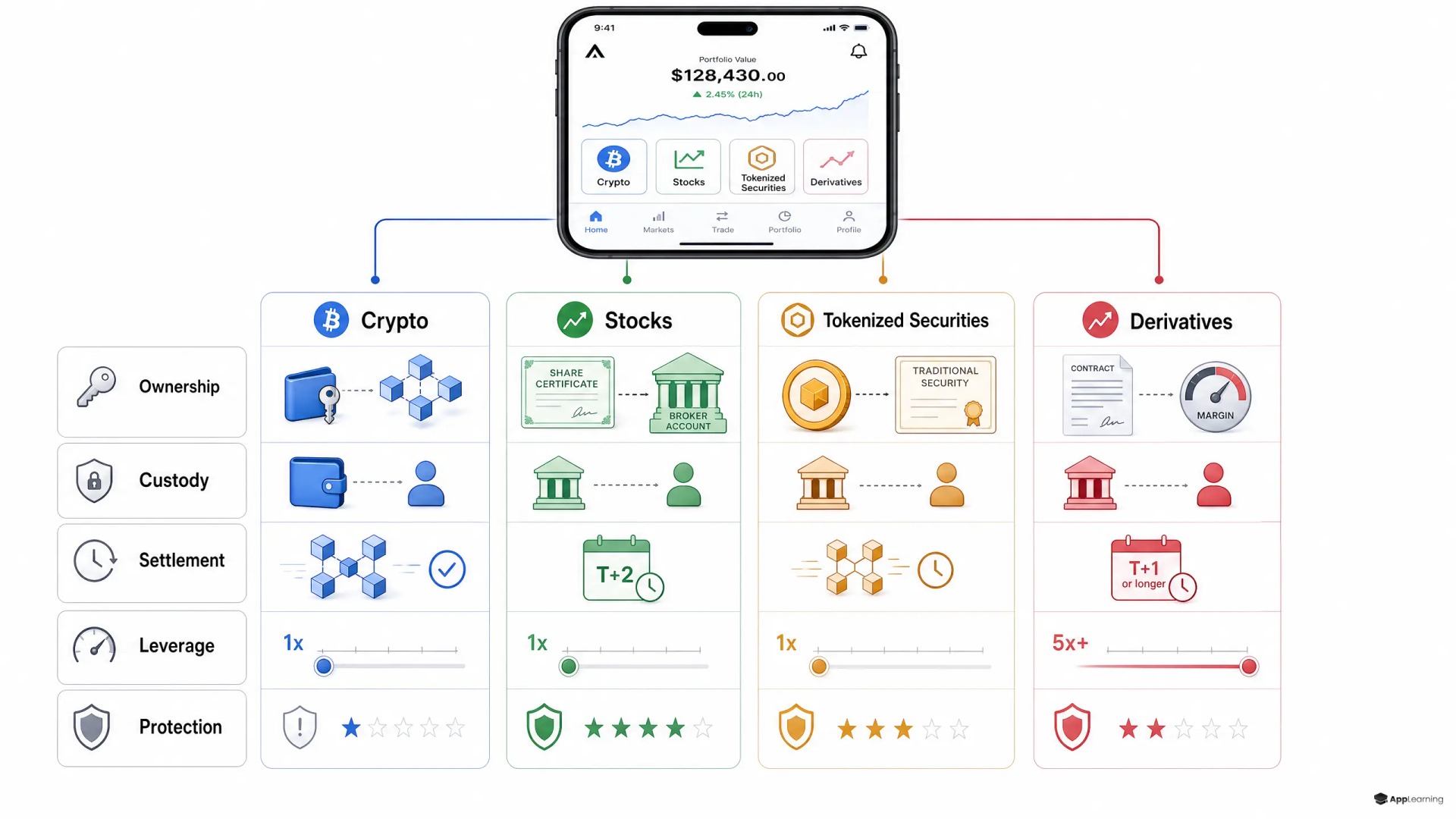
This is where crypto super app education becomes a product requirement. A unified interface reduces friction, but it also makes unlike products look similar. Bitcoin, a fractional stock, a tokenized equity, a perpetual future, and a prediction contract can all sit behind the same account balance and the same order button. The user sees continuity. The risk system sees different legal claims, custody models, settlement rules, margin rules, and protections.
That gap creates operational cost. Users may transfer assumptions from one asset class to another. They may expect stock-style protections for crypto balances, crypto-style 24/7 liquidity for securities, or spot-market downside for leveraged products. FINRA notes that crypto asset registration and related investor protections can be limited, while the Securities Investor Protection Corporation explains that its brokerage protection does not cover market loss or commodity futures contracts.
The curriculum follows the asset boundary
Cross-asset financial education should not start with market views. It should start with product mechanics. Tokenized securities education, for example, must clarify whether the user holds a direct share, a different class of security, or contractual economic exposure. The SEC staff statement on tokenized securities makes the distinction operationally relevant by focusing on the instrument’s structure, not its label.
- Ownership: what the user owns, references, or has a claim against.
- Custody: who controls the asset or key, and what happens if an intermediary fails.
- Leverage: how margin, liquidation, funding, and amplified losses work.
- Settlement: when a trade becomes final and when funds can be reused.
- Market access: trading hours, liquidity windows, halts, and maintenance periods.
- Protection: which regulator, compensation scheme, or disclosure regime applies.
Derivatives risk education needs extra friction because leverage changes the loss curve. The CFTC warns that futures traded through margin accounts use leverage, which can amplify the underlying risk. A user who understands spot Bitcoin is not automatically ready for perpetuals, stock perps, options, or event contracts.
Good to know
Is cross-asset education the same as investment advice?
No. It explains product structure, rights, risks, and mechanics so users understand what they are doing before they make their own decision.
Where should education sit in a crypto or fintech app?
It should sit in onboarding, feature unlocks, order previews, portfolio screens, and support flows instead of only in a help center.
How can a Bitcoin-focused company start before adding other assets?
Start with the concepts users already confuse most: custody, volatility, recurring buys, fees, wallet transfers, and self-custody.
Education turns expansion into controlled activation
For product leads, the education problem is not abstract. Weak understanding shows up as onboarding drop-off, support volume, abandoned feature launches, and distrust after a bad first outcome. Disclosures alone rarely solve this. They sit outside the decision moment. Good crypto product onboarding places short learning units inside the path: before account approval, before first trade, before leverage is enabled, and before a user withdraws an asset into self-custody.
- A first-time stock buyer sees why market hours and settlement differ from crypto.
- A tokenized equity user sees the difference between exposure and shareholder rights.
- A derivatives user passes a short liquidation and funding check before activation.
- A prediction-market user sees the binary payout before placing an order.
This is education as a control layer, not a content library or investment advice. It explains mechanics, rights, and risk before the user decides. It protects activation quality. It gives compliance, product, and support teams a shared language. It also lets growth teams promote new product lines without treating every user as an expert trader.
Build product education before confusion reaches support.
LearnModular academies fit financial super apps
The scalable model is modular. Build one concept layer for ownership, custody, volatility, order types, settlement, and risk. Then attach asset-specific modules for Bitcoin, stocks, tokenized securities, derivatives, and prediction products. Localize the examples, disclosures, and eligibility logic by market. Trigger the right module from the right screen. Measure completion, quiz confidence, hesitation points, and downstream behavior.
This is where App-Learning fits the operating model. An embedded academy can be designed as product infrastructure: mobile-first, brand-consistent, gamified where motivation matters, and maintainable when regulations or product terms change. For a Bitcoin-focused fintech, the same system can start with custody, recurring buys, savings plans, and self-custody, then expand as the product roadmap adds new asset classes.
Crypto super apps will not win trust by making every instrument feel interchangeable. They will win by making differences visible at the moment decisions are made. Cross-asset financial education is the mechanism: it slows users down where misunderstanding is expensive and gives them confidence where action is appropriate. The platforms that treat learning as infrastructure will onboard broader audiences without pretending retail users are professional traders.