

Key takeaways
- Federal supervision expands stablecoin literacy beyond crypto and compliance teams.
- Treasury, support, product, sales and partners need different operating depth.
- Shared terminology prevents handoff failures and misleading customer communication.
- A role-based academy turns stablecoin knowledge into repeatable operating control.
A trust-bank charter widens the operating perimeter
Circle’s July 10, 2026 approval to establish Circle National Trust puts part of USDC’s institutional infrastructure inside a federally supervised national trust-bank structure. At launch, the bank is set to provide fiduciary digital-asset custody for Circle and its affiliates. Reserve management is described as a future capability, not an immediate operating change.
That distinction matters. Teams must not turn “federally regulated” into a vague claim that implies deposit banking, a government guarantee, or unrestricted client services. Circle states that its trust bank does not take deposits or lend funds. It is a custody and fiduciary structure with defined limits, not a conventional commercial bank. Circle National Trust’s own description makes those boundaries explicit.
The learning problem therefore changes. Stablecoin training can no longer sit as specialist knowledge in legal, compliance, or a crypto-native product group. Once banking partners, institutional clients, distribution teams, and customer-facing functions touch the operating model, every handoff becomes a control point.
Stablecoin literacy belongs across the value chain
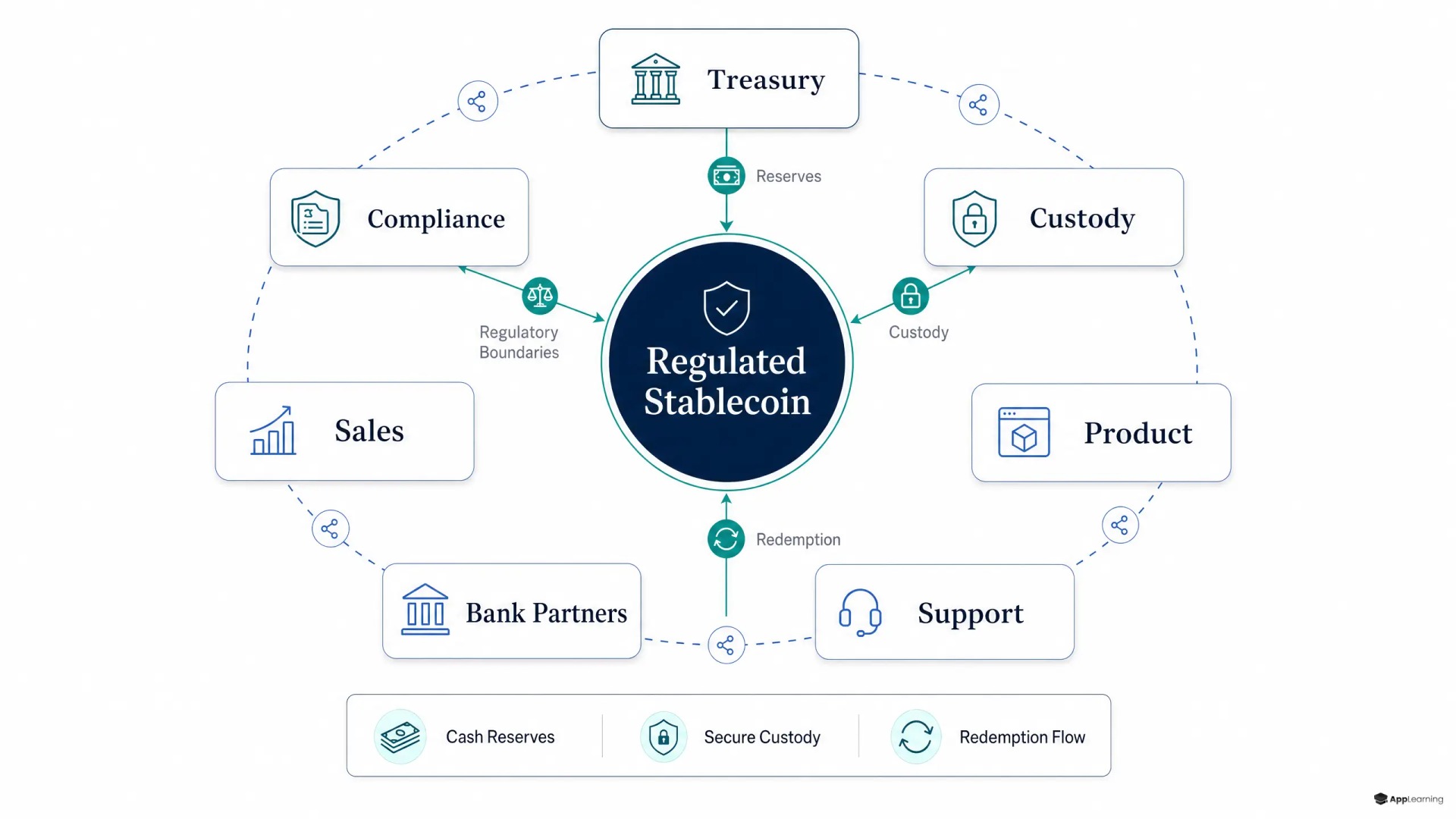
A stablecoin operating model connects customer instructions, wallet and custody arrangements, minting and redemption processes, reserve governance, transaction monitoring, exception handling, and partner communications. No single team owns that full chain. Each team needs enough context to make safe decisions within its own remit and to know when to escalate.
- Treasury needs to understand reserve boundaries, liquidity timing, reconciliations, and the difference between planned and live reserve-management responsibilities.
- Compliance and risk need a clear view of custody roles, transaction flows, controls, incident escalation, and claims that teams may make externally.
- Product needs to translate operational constraints into clear journeys, disclosures, status messaging, and recovery paths.
- Support needs practical USDC education for redemption expectations, wallet errors, transfers, account limits, and handoffs that require specialist review.
- Sales and partner teams need approved language for institutional custody, regulatory status, service scope, and implementation dependencies.
Role depth beats one-size-fits-all certification
A generic crypto banking training course produces familiarity, not operating readiness. The better design starts with a role map. It defines the decisions each audience makes, the errors it can create, the signals that require escalation, and the terminology it must use consistently.
For example, a treasury learner may need scenario drills on settlement timing and reserve reporting. A support learner may need guided diagnosis for a delayed redemption request. A product lead may need to test whether a proposed interface suggests protections or guarantees that the operating model does not provide. A partner manager may need to explain the difference between custody support at launch and future capabilities without overpromising.
This is where stablecoin compliance education should meet product enablement. The aim is not to make every employee a legal expert. It is to give every role a reliable mental model of assets, actors, boundaries, controls, and escalation paths.
Good to know
Which teams need stablecoin training first?
Start with the teams that make customer commitments or handle operational exceptions: product, treasury, compliance, risk, support, sales, partner management, and operations. Prioritize by decision risk rather than by department.
What should USDC education cover?
Cover the product flow, custody model, redemption process, reserve concepts, customer eligibility, permitted claims, escalation paths, and the difference between current services and planned capabilities.
How is crypto banking training different from general crypto education?
General crypto education explains concepts. Crypto banking training ties those concepts to roles, controls, customer communications, service boundaries, and specific decisions that teams make every day.
Knowledge gaps become live operational risk
Most failures begin as small misunderstandings. A sales deck implies that a service is available today. Support calls a blockchain delay a redemption failure. Product uses “banked” where “custodied” is accurate. A partner launches with an outdated explanation of reserve arrangements. Each error can create rework, customer confusion, regulatory exposure, or a breakdown in trust.
Shared language is therefore a control mechanism. Teams should use the same definitions for issuance, redemption, custody, reserves, settlement finality, wallet ownership, and service eligibility. They should also learn where definitions vary by product, entity, jurisdiction, and customer segment. This is the practical core of a digital asset operating model.
Build stablecoin operating literacy before your next partner or product launch.
Talk to usAn academy should mirror the operating system
Build the academy around real work rather than a linear textbook. Begin with a common foundation on how USDC moves through the system and where regulated responsibilities sit. Then branch into short role paths, decision simulations, product-release modules, and partner-ready playbooks. Update content when policies, service scope, or escalation procedures change.
For teams building mobile-first financial products, the same modular content can support internal readiness and contextual customer education. A concise lesson that helps a support agent explain wallet custody can also inform a clear in-app explainer, provided customer messaging is reviewed for its own regulatory and product context. That reuse reduces content debt without collapsing internal procedures into public copy.
App-Learning can provide the operating layer: role-specific learning paths, scenario-based checks, localized modules, release-driven updates, and analytics that show where teams or partners still lack confidence. The objective is not completion rates alone. It is fewer unsafe claims, cleaner handoffs, faster issue resolution, and consistent decisions across the stablecoin ecosystem.
As stablecoin infrastructure enters more formal banking structures, the advantage will not come from knowing the headline. It will come from making the operating model understandable at every point where a person, partner, or product decision can affect customer trust.