

Key takeaways
- AI is becoming a policy-controlled capability, not a universal product default.
- Author-facing and learner-facing AI need separate permissions and workflows.
- Controls should operate by tenant, role, cohort, feature and learning context.
- An AI-off configuration needs complete lessons, assessments and analytics.
- Audit records should preserve the policy active for each cohort and assessment.
The procurement question beneath AI adoption
AI is often presented as a feature race. For a bank buyer, it is more often a control question. Can the platform enable AI support for learning designers while keeping it away from learners? Can it limit a chatbot to an innovation cohort, block generation in regulated assessments, or pause one feature without disabling the entire academy? A configurable AI learning platform must answer these questions in product configuration, not with a bespoke promise in a sales call.
That changes the design standard for an enterprise LMS AI. AI cannot be a single switch that turns the whole experience on or off. It must behave as a policy-controlled capability with clear scope, accountable owners and a dependable fallback when a customer decides that a particular use case is out of bounds.
New York City shows policy divergence in practice
For the 2026–27 school year, NYC Public Schools guidance prohibits software with student-facing generative AI in grades 2K–8, while high-school use is limited to approved and vetted programs. The same policy preserves necessary accessibility tools and permits staff use of AI for planning and operational tasks subject to privacy, security and procurement requirements.
Banks should not copy a school policy. The useful inference is architectural: one institution can permit AI in one role and forbid it in another; it can allow narrow, supervised uses while retaining a conventional learning experience elsewhere. A platform that treats AI as inseparable from learning will fail that test.
Authoring and learning require different permissions
Author-side AI and learner-side AI create different risks and different value. A learning team may use assisted drafting to turn an internal policy update into a short module, generate initial quiz variants or structure a role-based learning path. That does not mean a relationship manager, compliance analyst or new joiner should receive an open-ended AI chat experience.
App-Learning can keep these paths modular. An administrator may allow AI in authoring, while learners continue to receive curated microlearning, conventional lessons, quizzes and progress analytics. This separation makes learner-facing AI controls practical rather than theoretical.
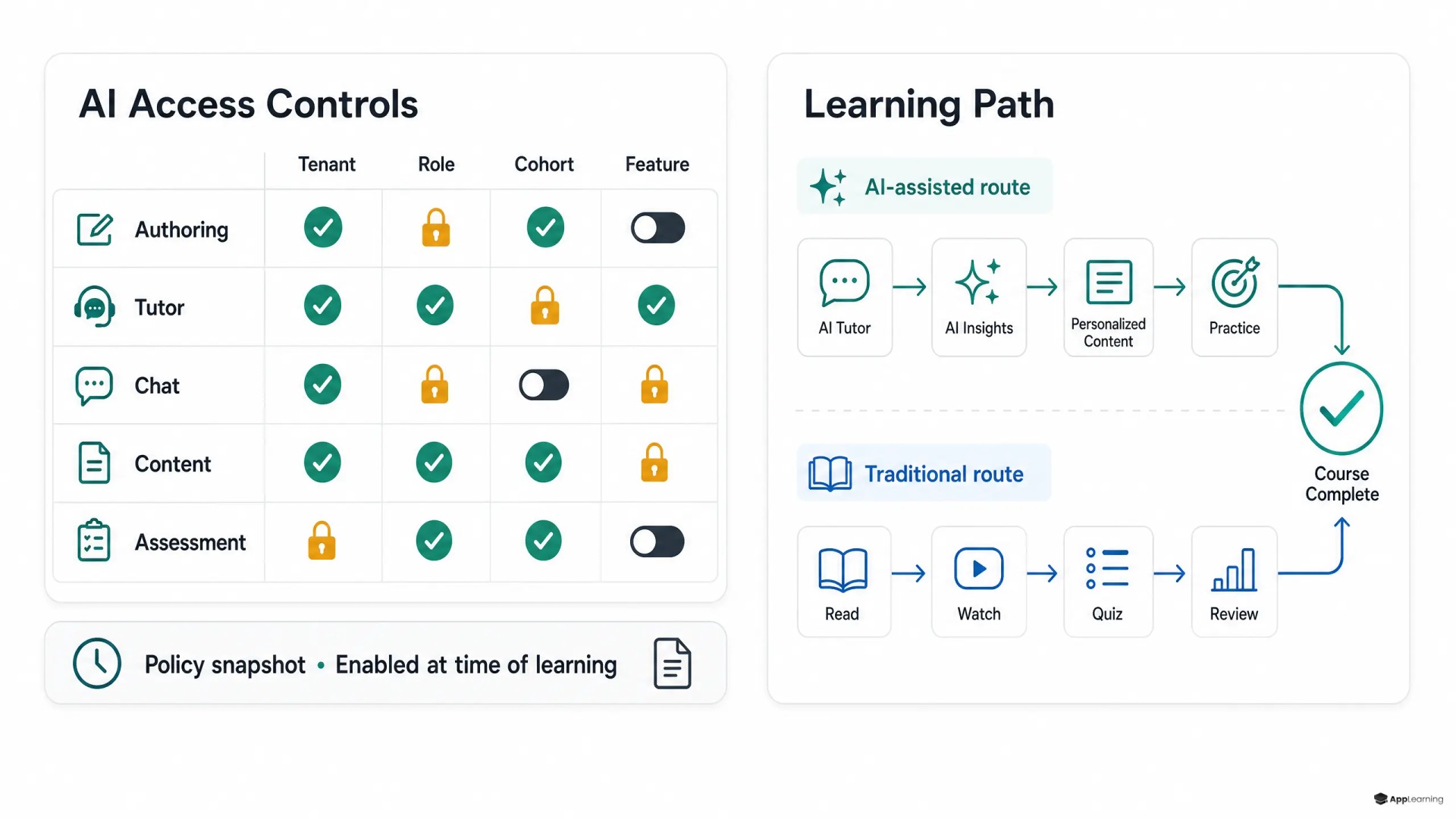
Controls must map to the operating model
A usable control model works at several levels. The goal is not a large settings page. It is a policy structure that mirrors how a bank actually manages risk, audiences and learning contexts.
- Tenant level sets the bank-wide baseline and approved AI providers.
- Role level separates platform administrators, authors, facilitators and learners.
- Cohort level enables controlled pilots for a business unit, geography or programme.
- Feature level controls chat, content generation, recommendations, feedback and translation independently.
- Context level blocks AI in named assessments, compliance modules or other sensitive journeys.
This granularity prevents the false choice between unrestricted rollout and blanket prohibition. It also lets innovation teams test a defined use case without forcing compliance, risk or operations teams into the same experiment.
The AI-off path must remain first-class
An AI-off mode LMS is credible only if it feels complete. Learners must still be able to discover content, complete mobile-first lessons, take quizzes, earn required completions and give feedback. Managers must still see participation, assessment outcomes and capability signals. Authors must not find that core publishing, reporting or localisation stops working because an AI service is unavailable or disabled.
This is a product discipline. Conventional content, rule-based learning journeys and standard analytics cannot become second-class remnants beside the AI layer. They are the baseline system that keeps onboarding, compliance and transformation learning running under every policy state.
Good to know
What is an AI-off mode LMS?
It is a learning platform configuration in which generative AI features are disabled while core learning remains fully usable, including content delivery, quizzes, completions, reporting and analytics.
Why separate author-facing and learner-facing AI?
The two groups have different jobs, permissions and risk profiles. An author may need drafting support, while learners may need a controlled or entirely non-AI learning environment.
Which controls should an enterprise learning platform provide?
At minimum, controls should work by tenant, role, cohort and feature. Sensitive contexts such as assessments and compliance journeys should support additional restrictions.
What should an AI policy audit log show?
It should show the policy version, enabled and disabled features, affected cohort, effective time period and the administrator or workflow that changed the policy.
Policy state becomes an audit record
An AI governance learning platform should treat each policy as versioned configuration. For every relevant cohort or assessment, the platform should record the active policy version, enabled features, applicable role and cohort rules, the time window and the administrator who made the change. If a learner disputes an assessment outcome or an auditor asks what tools were available, the organisation needs evidence of the experience that existed at that point in time.
This is more useful than a generic activity log. It links governance to a real learning event. It also supports safe change management: teams can test a policy in a pilot cohort, review outcomes, then promote or withdraw it without rewriting the academy.
See how App-Learning makes AI policy configurable without weakening the learning experience.
TalkConfigurability broadens the enterprise market
The commercial implication is straightforward. A bank can buy one learning platform while applying different AI policies across business lines, jurisdictions and programmes. It can use AI to accelerate authoring for an innovation academy, restrict it in mandatory conduct training and trial selected learner tools with a supervised cohort. Each choice remains reversible.
The stronger enterprise product is not the one that insists AI must be everywhere. It is the one that lets a bank introduce AI where it improves capability, withhold it where policy or learning design requires restraint, and prove exactly which configuration was active when it mattered.