

Key takeaways
- Define public and protected academy surfaces before building routes.
- Authenticate before protected content or learner data renders.
- Test deep links, expired sessions and identity-provider entry paths.
- Use automatic SSO handoff to remove redundant login steps.
- Ship access-control changes through the learning-product release process.
The hidden product decision inside an LMS login
An academy login boundary decides more than who can take an assessment. It determines which pages, assets, learner records and actions exist outside the trust boundary. That makes academy authentication a product decision shared by IT, security and L&D. For finance and crypto teams, a weak boundary can expose regulated learning material or create confusing learner states. A boundary that is too blunt can also turn every learning visit into a needless interruption.
The right starting point is simple: decide what a learner may see before identity is known, then enforce that decision consistently. A branded academy can still have public landing pages, programme descriptions and selected previews. But protected learning must not appear merely because the learner has not yet reached a quiz.
When authentication begins too late
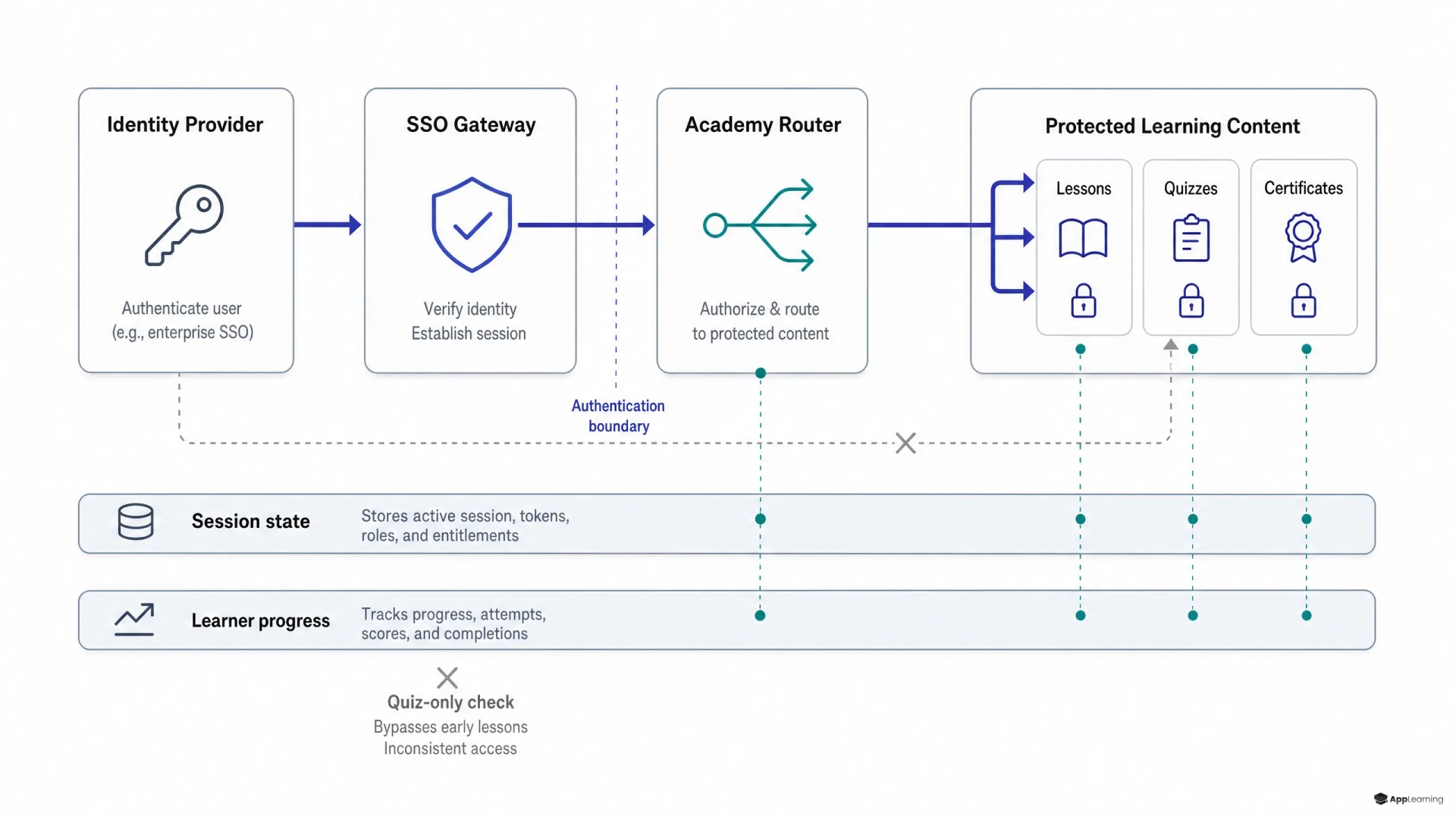
A common failure starts with good intent. The academy asks users to sign in when they begin an assessment, submit an answer or open a completion record. Earlier chapters remain available through a direct URL. The interface looks protected because the main navigation points toward the sign-in flow, but the route itself still delivers content.
That creates two problems at once. The OWASP authorization guidance recommends deny-by-default access and permission validation on every request. In learning-product terms, a route is not protected because its next button is protected. Each request for a lesson, asset, learner record or completion action needs the correct access decision.
- Introductory content becomes reachable through saved, shared or indexed links.
- Learners lose context when a late sign-in interrupts an active chapter.
- Progress can be ambiguous when anonymous activity meets an authenticated learner profile.
- Security teams must investigate a fragmented flow instead of one clear access policy.
Public and protected surfaces need explicit ownership
Treat the academy as two named surfaces. The public surface contains only content the organisation is prepared to disclose without identity. The protected surface contains lessons, media, downloads, search results, learner profiles, progress, cohorts, certificates and assessments. The default should be protection; public access should be an explicit exception.
This is where white-label LMS security becomes concrete. The protection rule must run before a protected page renders and before its data or media is fetched. Hiding a menu item, disabling a button or placing a sign-in wall only in front of the final interaction is not the same as protecting the underlying route.
Deep links reveal the real academy architecture
Navigation tests rarely find boundary failures because normal navigation follows the intended path. Direct links do. A resilient enterprise LMS SSO design treats a copied module URL as a first-class entry point, not as an edge case.
Test the academy while logged out, after session expiry and from a new browser. Test links to modules, videos, downloads, assessments and learner-profile pages. Test an employee arriving from the identity provider and a user whose role has changed since their prior session. Under NIST's current digital identity guidance, federation and application sessions are separate concerns; an identity-provider session does not remove the need for the academy to establish and manage its own session.
- A logged-out learner opens a protected deep link and is redirected before content loads.
- The requested destination is retained through sign-in and restored after a valid return.
- An expired academy session cannot reveal cached protected views or resume protected requests.
- A changed role or revoked entitlement is applied on the next protected request.
- Progress resumes against the correct learner identity after the handoff.
SSO should remove repetition rather than control
A strong SSO learning platform does not ask an already authenticated employee to prove the same identity twice. When a user reaches a protected academy route, the platform can redirect to the organisation’s identity provider, receive the approved response, establish its academy session and return the learner to the exact lesson. If the identity-provider session is active, the handoff can feel automatic. If it is not, the user sees the organisation’s normal sign-in and assurance steps.
That sequence preserves access control while reducing friction. It also keeps responsibilities clear: the identity provider verifies identity, the academy maps approved claims and roles to access, and the learning platform maintains the session and progress state needed for a coherent learning journey.
Good to know
Should every academy page require authentication?
No. Public pages can support programme discovery, employer branding or selected previews. The important decision is to define those exceptions explicitly and protect all other routes by default.
Can a learner open a protected deep link after SSO?
Yes. Store the intended route before redirecting to the identity provider, validate the sign-in response, establish the academy session and return the learner to that approved destination.
Does SSO remove the need for academy session management?
No. The identity provider and academy have separate session responsibilities. The academy still needs to manage timeouts, entitlement checks, logout behaviour and progress continuity.
Access control belongs in the release checklist
Authentication changes need the same release discipline as a new pathway, assessment or content update. Define the route policy, role mapping, return-path behaviour, timeout treatment, error states and audit events. Then test the whole journey with real personas: a new employee, an authorised learner, a manager, an administrator and a former employee.
This is especially important when compliance learning is already competing with capability building for attention. A broken sign-in flow does not feel like a security control to learners. It feels like the academy is unreliable. That reduces completion quality even when the content is strong.
Design academy access around the learner journey.
DiscussIdentity designed around the academy journey
App-Learning approaches identity access LMS design as part of the academy experience. Enterprise SSO, protected routing, session handling and learner-progress continuity must work as one system inside a branded academy. The implementation should reflect the customer’s security model while keeping the learner’s path from invitation to completion intact.
The academy login boundary is therefore a clear statement of product intent. Define what is public. Protect everything else before it renders. Preserve the learner’s destination through the identity handoff. Then release and test the flow as carefully as the learning experience itself. Security becomes stronger when it is built into the journey rather than added as an interruption at the end.