

Key takeaways
- Map customer moments where fraud risk and irreversible action meet.
- Trigger learning beside the decision, not during distant onboarding.
- Use realistic scenarios and decision checks instead of warning copy alone.
- Segment interventions to reduce warning fatigue and preserve trust.
- Measure safer decisions and recovery outcomes, not content views alone.
Fraud signals now look legitimate
Fintech fraud education has become harder because the attack often does not look like an attack. A message can mimic a support agent. A video can appear to show a trusted person. An investment offer can borrow the language, design and urgency of a legitimate financial product. The European Supervisory Authorities warn that AI-generated voices, videos, false profiles and convincing websites are making online scams more credible.
The result is a product problem, not only a compliance problem. Customers make high-consequence decisions inside payment, investment, support and recovery journeys. If the product leaves risk education in a help-centre article, it asks people to recall generic advice while under pressure from a highly specific scam.
Static awareness content misses the decision window
Fraud pages, email campaigns and onboarding checklists remain useful reference material. They establish a baseline of financial literacy and give support teams somewhere to send customers. But they are detached from the event that creates vulnerability: a first transfer to a new payee, a device change, a password reset after an unexpected call, or a high-value investment prompted through a messaging app.
That distance matters. A customer who has been told months ago to be careful may still act when a scammer creates urgency, secrecy or fear. The OECD’s fraud-prevention guidance identifies a pause paired with a just-in-time warning as a last line of defence that can help consumers reconsider a suspicious transaction.
The stronger model treats customer risk education as product infrastructure. It is brief, specific to the action, and designed to change the next decision rather than merely record a content view.
Risk events define the learning surface
A risk event is not every transaction. It is a moment where customer behaviour, product context or fraud intelligence suggests that a short intervention could reduce harm. Start by mapping events against exposure, reversibility, observed scam patterns, support contacts and false-positive cost.
- Adding a new payee before a first or unusually large transfer
- Changing a trusted device, phone number, password or recovery method
- Entering an investment journey after a social, referral or messaging-app prompt
- Requesting a transfer cancellation or reporting a suspicious payment
- Receiving a support contact during an account-recovery flow
- Making a crypto withdrawal to a new external address
This map should vary by market and product. The scam examples that matter in one country, customer segment or asset class may be irrelevant elsewhere. The OECD recommends that education familiarise consumers with scam types that are common in their jurisdiction and that emerging threats receive timely warnings.
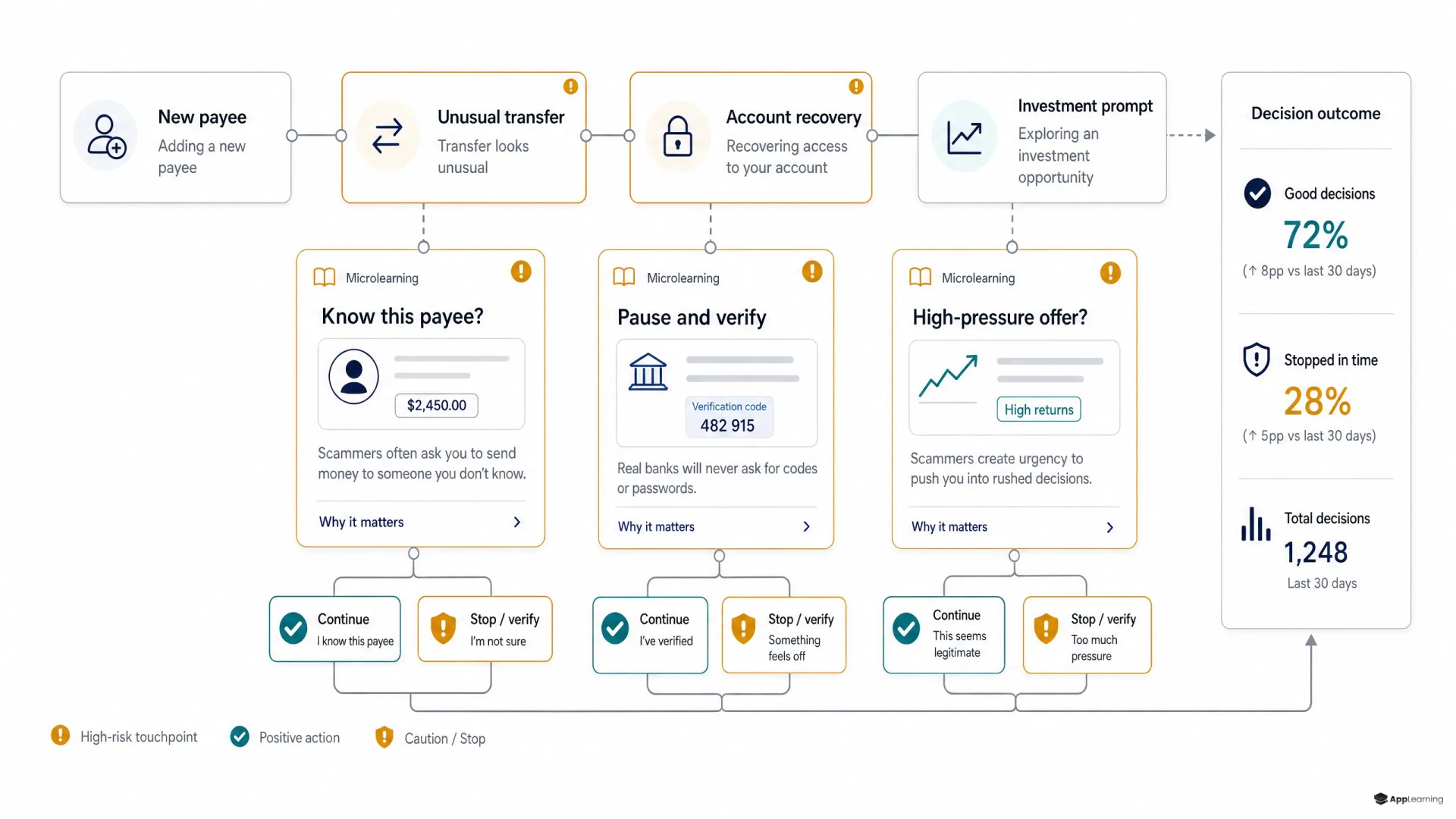
Scenarios turn warnings into decision practice
Warning copy tells customers what to fear. Contextual microlearning lets them practise what to do. At a relevant event, present one realistic scenario, one or two recognisable signals, and a decision check. For example, before a new-payee transfer, show a short chat in which a supposed bank employee demands a verification code and asks the customer to move money to a “safe account.” Then ask which action is safe.
The interaction should not pretend to diagnose every scam. It should create a pause, reveal the specific signal, and offer a clear route to verify, stop or seek help. Keep the intervention proportional to risk. A low-risk event may need a compact prompt. A high-value or anomalous event may justify a stronger hold, a confirmation step and a fast path to human support.
- Detect the risk event through product rules, behavioural signals or fraud operations input.
- Serve a localized scenario with plain language and accessible design.
- Ask for a decision or recognition response rather than passive acknowledgement.
- Route uncertain customers to verification, reporting or recovery without shame or dead ends.
Good to know
Does event-triggered fraud education replace fraud controls?
No. It complements fraud detection, authentication, transaction monitoring, payment holds and recovery processes. Education helps customers recognise manipulation; controls reduce exposure when recognition is not enough.
Which risk events should a fintech prioritise first?
Start where customer harm is high, actions are difficult to reverse, and fraud or support data shows recurring confusion. New payees, account recovery and unusual withdrawals are common candidates.
How can teams prevent warning fatigue?
Use risk thresholds, suppress repeated prompts, vary scenarios by context and measure whether each intervention improves decisions. Do not show the same warning to every customer at every payment.
What should a successful programme improve?
It should improve correct decisions at risk moments, increase appropriate reporting and verification, reduce avoidable losses, and support faster recovery when an incident occurs.
Outcome metrics expose weak interventions
Completion rate is a delivery metric, not proof of protection. Measure the intervention rate by event type, scenario completion, correct recognition response and the share of customers who choose a safer path. Pair these with downstream signals: transfer cancellation, delayed confirmation, scam reports, repeat contacts, support resolution and recovery outcomes.
Abandonment needs careful interpretation. A rise in abandoned high-risk transfers may be positive if customers later confirm a legitimate payment through a safer route. A rise in abandoned onboarding or recovery may signal that the intervention is too broad, too alarming or badly timed. Review results by risk tier, country, customer cohort and scenario version rather than relying on one global average.
Build safer customer decisions into your highest-risk product moments.
TalkA shared operating system keeps content current
Product, fraud operations, compliance, support and growth teams need one operating rhythm. Fraud teams define evolving risk patterns. Product teams own event placement and experience quality. Compliance validates claims and escalation paths. Support closes the loop with real customer confusion. Growth protects activation by ensuring that risk controls are targeted rather than indiscriminate.
A practical implementation starts with a small event catalogue, two or three high-risk journeys and a content library built from reusable scenario components. App-Learning can provide the embedded microlearning layer: multilingual lessons, recognition tasks, decision checks and analytics that sit inside web and mobile product flows without forcing the core team to build a separate education platform.
The goal is not to make every customer complete a fraud course. It is to make the safer choice easier when the product can see that a consequential decision is about to happen. That is where customer risk education becomes part of a trustworthy financial experience rather than another page that customers find after the loss.