

Key takeaways
- Course platforms centre on publishing, checkout, and selling learning products.
- Customer education connects learning to onboarding, product use, and support demand.
- Business teams need segmentation, lifecycle journeys, and outcome-focused analytics.
- App-Learning fits companies where education is part of customer success.
Two systems built around different jobs
The course platform vs customer education platform decision starts with the operating model, not the lesson format. A course platform packages knowledge as a product: build a curriculum, publish it, attract an audience, and often sell access. Thinkific, for example, positions its platform around helping users create, market, and sell learning products. That model is useful for creators, training providers, and companies with a clear course catalogue.
A customer education platform treats learning as part of the product experience. Its job is to help a new user reach a first meaningful outcome, help an existing account adopt deeper features, and answer recurring questions before they become support tickets. The academy is not a separate storefront. It is a working layer in onboarding, lifecycle communication, customer success, and product change management.
Creator workflows and customer workflows diverge
Creator-oriented tools optimise for course production, landing pages, payments, bundles, communities, and audience growth. Business customer training needs a different control system. Teams must decide who sees which learning path based on plan, role, product maturity, region, or risk profile. They also need to place education where users need it. Skilljar describes this model as using the customer journey to guide people to content based on their tenure, product, and needs in its guide to external training systems.
- A course platform asks whether someone enrolled, completed, or purchased.
- A customer education platform asks whether a user reached the next product milestone.
- A course platform organises content into a catalogue.
- A business academy organises content into journeys that respond to customer context.
Completion data is not enough
Completion rates matter, but they are only an operational signal. A Product or Growth leader needs to know whether learning preceded account activation, use of a key feature, fewer repeated support requests, or stronger retention. That requires learner data to meet CRM, product, support, and lifecycle data. The value of this approach is clear in Skilljar’s Salesforce integration guidance, which frames training activity alongside measures such as customer health, churn, expansion, and support tickets.
- Track drop-off by lesson and by customer segment.
- Link learning paths to specific activation events.
- Use support demand to identify missing or unclear education.
- Update journeys when product releases change the user task.
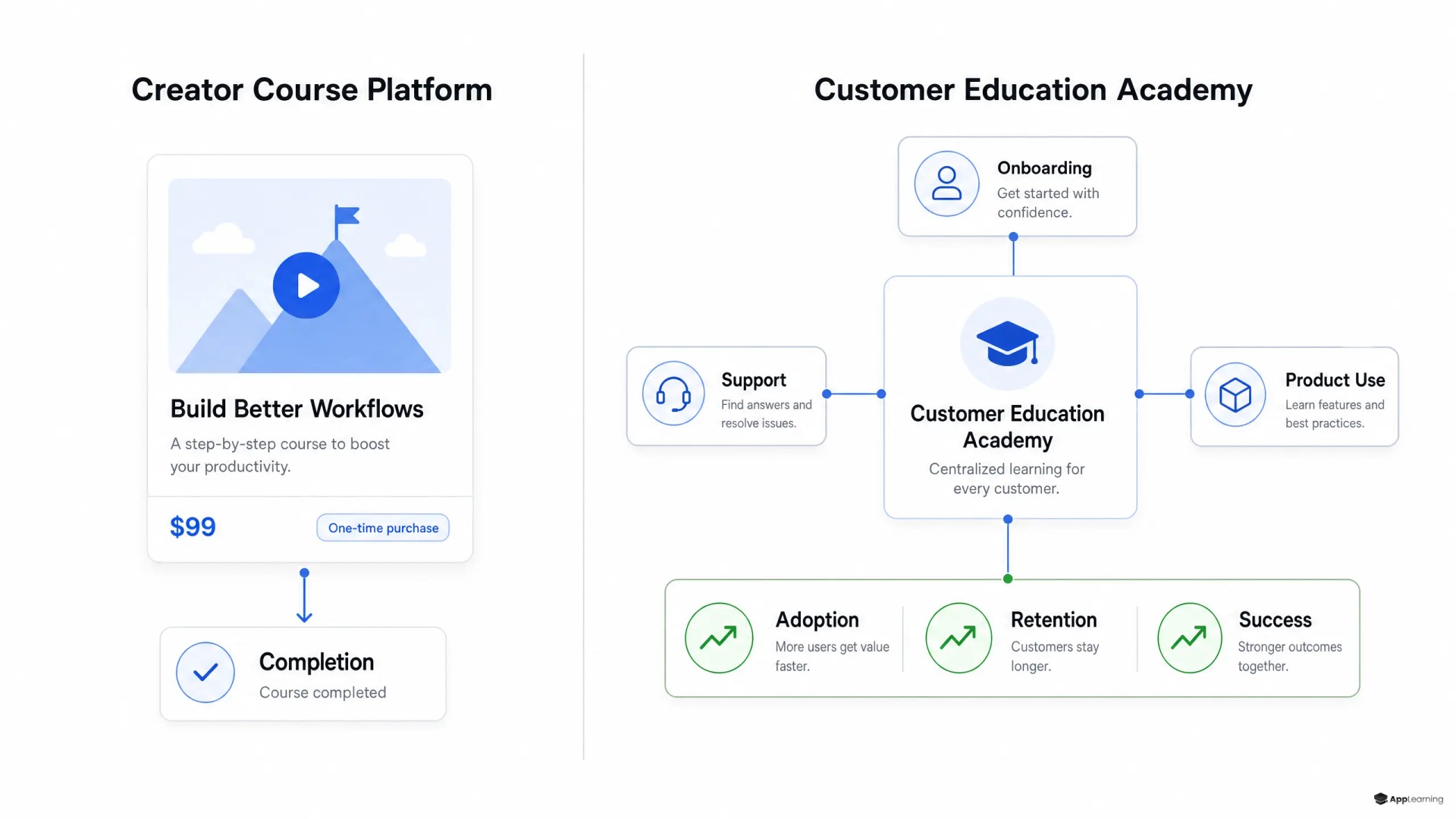
A business academy turns education into a growth system
For complex fintech products, the central challenge is not simply explaining features. It is helping users form enough confidence to take the next safe action. That calls for short, practical modules on topics such as funding an account, understanding fees, setting security controls, or using an advanced product feature. The learning flow should begin in onboarding, return in lifecycle moments, and be reachable from product and support surfaces.
App-Learning is designed for this business-academy model. Its platform capabilities include role-based learning paths, branded web and mobile experiences, progress analytics, SSO, and deep links into individual lessons. Its content workflow also combines AI structuring with expert review, which helps teams turn product knowledge, policy updates, and support material into focused microlearning without treating every update as a full course-production project.
Good to know
Can a course platform support customer education?
Yes, especially for a small, stable course library. The limits appear when education must be segmented, triggered by lifecycle events, and measured against product outcomes.
Which option suits fintech onboarding best?
A customer education platform is usually the stronger fit when users need staged explanations, trust-building content, and clear guidance toward the first valuable product action.
Which metrics should a customer academy track?
Start with activation milestones, lesson drop-off, feature adoption, repeat support demand, and retention signals by learner segment.
Course platforms still have a clear place
An online course platform for business remains a sound choice when the primary goal is to publish a stable curriculum, sell certification or training access, run a cohort, or build a public learning brand. It can also be enough when learner groups are simple and the business does not need to connect education to product behaviour. This is not a question of whether a platform can host courses. Nearly all of them can.
The constraint appears when education becomes part of customer success. If the team needs lifecycle segmentation, product-triggered entry points, shared ownership across Product, Growth, and CX, and evidence beyond completions, a generic course setup can become a collection of manual workarounds.
Make product education a measurable part of customer activation.
Talk to usThe decision rests on the operating model
- Choose a course platform when selling or publishing the learning product is the main outcome.
- Choose a customer education platform when product adoption and customer confidence are the main outcomes.
- Prioritise segmentation when different users need different explanations at different stages.
- Prioritise integrations when learning data must inform product, CRM, support, or retention decisions.
The right platform reflects the role education plays in the business. If learning is content beside the product, a course platform may be enough. If learning helps users understand, trust, and use the product, it needs to operate as customer infrastructure rather than a standalone catalogue.