

Key takeaways
- A successful pilot does not establish production availability or repeatable customer benefits.
- Tokenized deposits, tokenized fund shares and settlement networks serve different functions.
- Off-hours workflows need named approval, reconciliation and exception owners.
- Role-specific decision drills provide stronger readiness evidence than a generic completion quiz.
- Assessment should track handling accuracy, escalation quality and retained understanding.
The Weekend Settlement Scenario Inside a Treasury Academy
HSBC’s 30 October 2026 announcement describes a 24/7 liquidity and settlement demonstration with Uber, Franklin Templeton, Tradeweb and Fireblocks on Canton. It included liquidating fund holdings over a weekend. That establishes a demonstrated workflow, not general availability or repeatable customer benefit.
The learning implication is operational. A treasury academy should test who can release liquidity, approve instructions and resolve conflicting records outside banking hours. The framework below is a proposal, not an existing rollout or evidence of a new legal training requirement.
Three distinct layers shape the transaction
The UK government’s digital-markets taxonomy distinguishes tokenized deposits representing commercial bank money from tokenized funds representing investment shares or units. These belong in separate boxes in the course diagram.
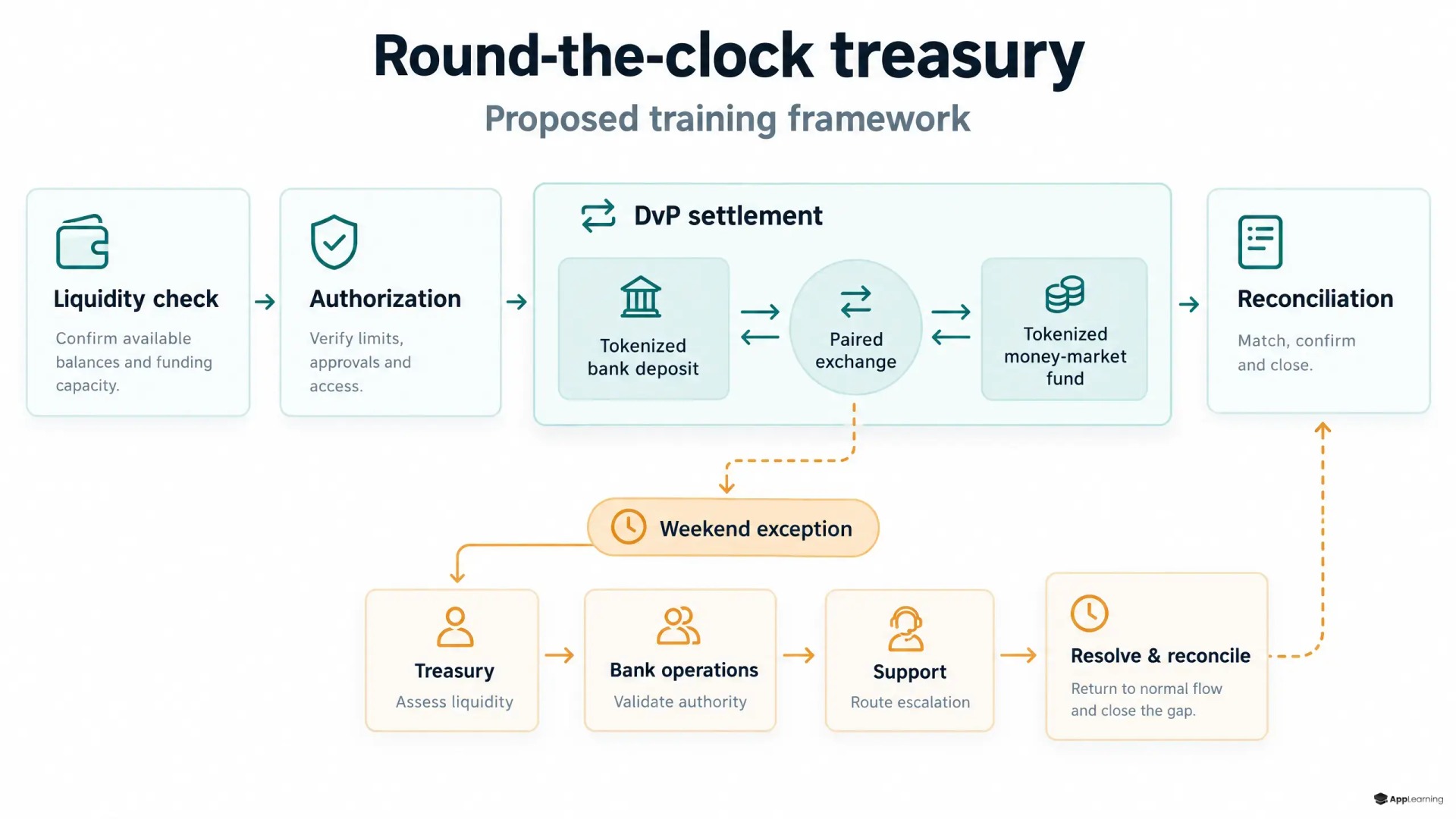
Canton’s account of the pilot supports this annotated teaching path. The checks are proposed learning tasks, not descriptions of participants’ internal controls.
- Deposit money supplies funding through HSBC tokenized deposits. The learner checks available liquidity and authority.
- The investment order purchases Franklin Templeton tokenized MMF shares on Tradeweb. The learner checks instrument and amount.
- Delivery-versus-payment exchanges deposit money and fund shares on Canton through the Fireblocks-enabled workflow. The learner checks settlement status.
- Liquidation returns liquidity, including outside normal hours in the demonstration. The learner checks proceeds and the permitted destination account.
The ECB’s definition of delivery-versus-payment links securities delivery to the corresponding payment. That mechanism is distinct from the instruments exchanged. On-chain settlement training should preserve this distinction.
Weekend exceptions make ownership explicit
The following are hypothetical training cases, not reported pilot defects. Each should require a decision, an owner and an evidence trail.
- An instruction fails on Saturday. Operations establishes its status before considering resubmission; treasury identifies authorized fallback liquidity.
- A valuation is challenged on Sunday. Risk checks the approved pricing basis and timestamp; support avoids promising an unverified redemption value.
- Wallet and ledger records disagree. Operations isolates the break, preserves transaction identifiers and escalates to the reconciliation owner rather than assuming either record is correct.
One canonical course branches into four roles
A shared foundation would anchor tokenized deposits training and corporate treasury education in one controlled explanation of instruments, permissions, settlement and redemption. Digital assets microlearning would then branch into distinct simulations.
- Treasury decision makers weigh payment deadlines, liquidity buffers and delegated approval limits.
- Settlement operations verify instruction status, reconcile records and document recovery decisions.
- Risk teams assess limit breaches, valuation uncertainty and exceptions requiring approval.
- Client support explains confirmed status, captures evidence and routes issues without making unsupported promises.
App-Learning could deliver this design through branded, multilingual mobile and web paths, scenario quizzes and completion analytics. Product owners would approve the canonical content and each localized version. No App-Learning involvement in the pilot is implied.
Readiness depends on decisions, not completion
A proposed rubric would score transaction diagnosis, authorization discipline, reconciliation evidence and escalation quality. A critical authorization error should block readiness regardless of the aggregate score. Completion would remain an administrative measure, separate from operational competence.
The dashboard would track handling accuracy, escalation completeness and delayed-retest performance. A later supervised exercise could measure exception-resolution time and reconciliation rework, without treating faster handling alone as success.
Build a treasury academy around your weekend exception workflows.
DiscussProduction remains a separate decision
The SEC staff’s January 2026 statement explains that tokenized securities remain securities. Before deployment, legal, product and operations owners should validate applicable rules, eligibility, fund terms, permissions and off-hours coverage.
The academy’s purpose is not to turn a pilot announcement into a launch decision. It is to expose unresolved ownership before a real payment depends on it. A team is ready when it can explain the flow, stop an unsafe action and carry an exception to a documented resolution.