

Key takeaways
- Learners can enter the same academy with different starting knowledge.
- Chapter navigation and assessment access can follow different rules.
- Both routes should use the same assessment and completion standard.
- Missed topics should lead directly to the relevant learning material.
- Analytics should distinguish assessment-first completion from the full learning path.
A fixed sequence assumes the same starting point
During an anonymised product-education rollout, reviewers asked for direct access to module quizzes without first moving through every chapter. The academy was expanding with additional modules. The request exposed a design assumption worth challenging: everyone needed the same instruction before being assessed.
As Carnegie Mellon’s guidance explains, (cmu.edu) existing knowledge influences how learners interpret new material. For a product academy, the implication is straightforward. A fixed learning sequence should serve a defined purpose, not act as the default proof of understanding.
Assessment access can sit outside chapter navigation
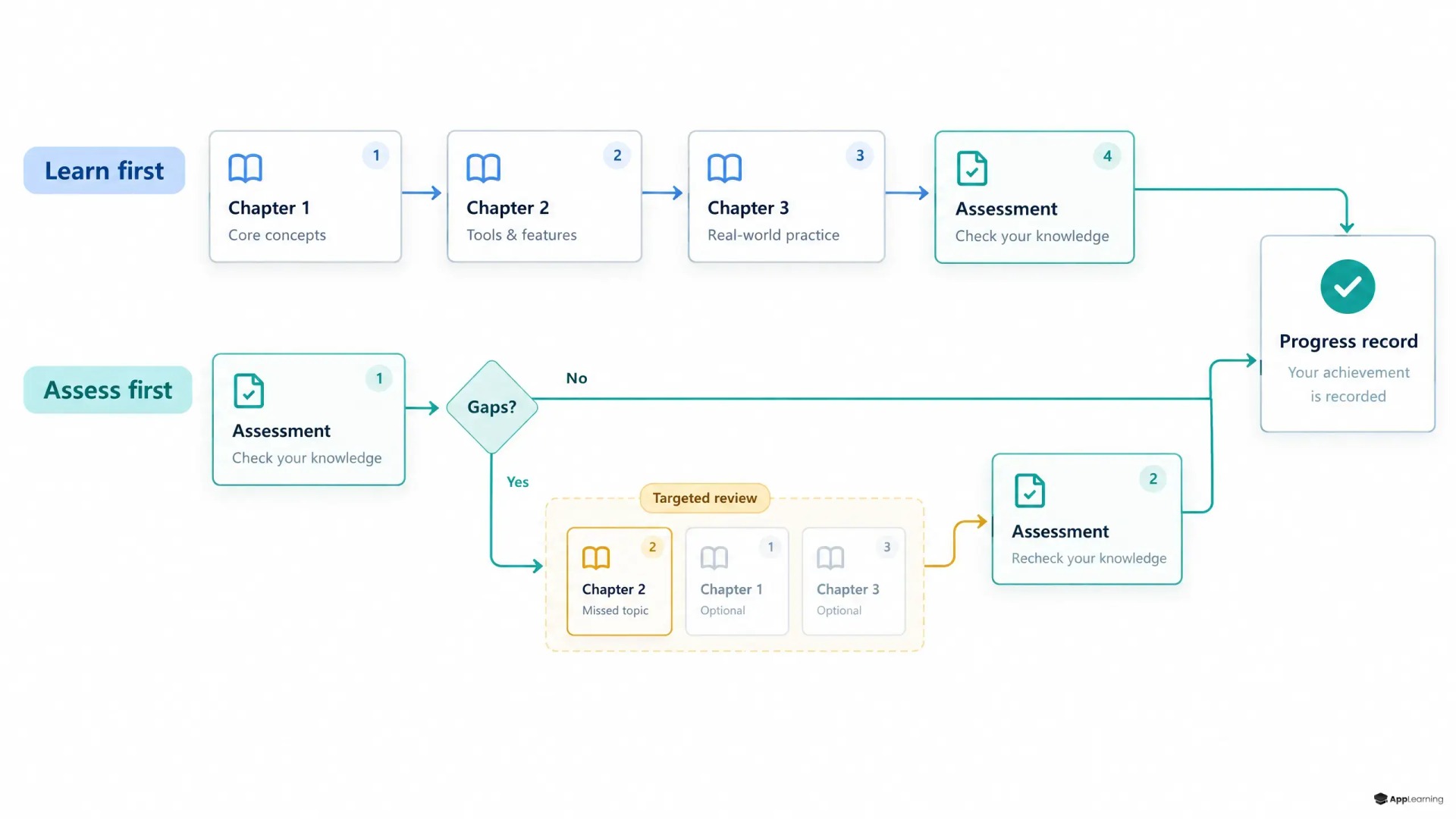
App-Learning can support two routes through the same academy, using shared questions, progress rules and completion records. The distinction belongs in the route, not in a duplicate course.
- Learn-first gives users the full material before the assessment.
- Assess-first opens the assessment immediately and directs missed topics back into learning.
A “skip to quiz” LMS option should change access, not lower the passing standard. Learners should remain free to open the chapters whenever they need them.
The shortcut depends on a credible assessment
According to the University of Illinois’s assessment guidance, (citl.illinois.edu) assessments should match the intended learning objective. If the objective involves applying knowledge, recalling product terms is not enough.
For a transfer module, a scenario could ask which details need checking before confirmation. Both routes should use the same question pool, topic coverage and passing rules. Critical objectives should require demonstrated understanding rather than disappear inside an aggregate score. Retakes should use equivalent question variants where possible.
Missed topics need precise return paths
Assessment-first learning needs a question-to-content map. Each question should connect to a learning objective and the chapter that explains it. Feedback should identify the gap and provide a direct return link. After reviewing that material, the learner should be able to resume assessment without restarting the module. Mobile and translated versions need the same mapping.
One completion record must preserve the route
Product academy learner paths can differ while completion retains one meaning. The record should capture route choice, route changes, assessment attempts, topic results and content versions. Chapter visits should remain separate from demonstrated understanding. A learner who passes directly may have completed the module without reading its chapters; the dashboard should not imply otherwise.
Good to know
Does assessment-first replace the full learning route?
No. The full route remains available, including for learners who start with the assessment and then decide they need more support.
Should skipped chapters count as read?
No. Module completion and chapter visits should remain distinct so the record accurately reflects what happened.
Confirmation and required exposure are different goals
Recognising prior knowledge in product training fits modules designed to confirm understanding. It should not override a programme’s explicit requirement to encounter particular material or follow a supervised sequence. For a fintech academy, that boundary should be defined module by module before opening assessment access.
Design an assessment-first route for your product academy with App-Learning.
DiscussCompletion gains need a knowledge check
As Carnegie Mellon’s assessment guidance notes, (cmu.edu) evaluating learning gains requires understanding what learners knew at entry. A direct pass should therefore count as demonstrated knowledge, not automatically as knowledge gained through the academy.
A pilot should track completion, time to completion, missed objectives, review behaviour and performance on a later scenario check. Where practical, randomly offering the option would provide a stronger evaluation than comparing self-selected routes alone.
The right shortcut removes unnecessary instruction, not evidence of understanding. Experienced learners should be able to finish without replaying every chapter, while a knowledge gap should lead straight to the material that addresses it.