

Key takeaways
- Learning notifications need audience segmentation as well as good copy.
- Locale-aware routing prevents one global message from becoming the default.
- Payload validation is a reliability control, not an implementation detail.
- Learner re-engagement improves when messaging follows academy state and learner context.
The Reminder Is Part of the Product
A learning reminder is not a marketing afterthought. It is a product interaction that asks a learner to resume a task, complete a path, or return to a capability they have not yet built. For a fintech team, that might mean returning to a lesson on risk, security, product mechanics, or a feature the user abandoned during onboarding. If the message is late, irrelevant, untranslated, or broken, the learning experience fails before the learner sees it.
That changes how teams should design LMS push notifications. Copy still matters, but copy is the final layer of a system. The system must know who should receive a message, which learning state triggered it, which language applies, and which client can display it. Treating learning engagement notifications as a campaign task produces broad sends. Treating them as part of the mobile learning platform produces controlled, contextual re-entry points.
A Multilingual Message Has a Delivery Problem
A multilingual academy cannot rely on one default-language notification and call it segmentation. Language is part of the delivery decision. A learner enrolled in an English onboarding path should not receive a German reminder because the campaign was assembled globally. Equally, a learner in a German path should not be routed to English simply because the sending system has no explicit locale model.
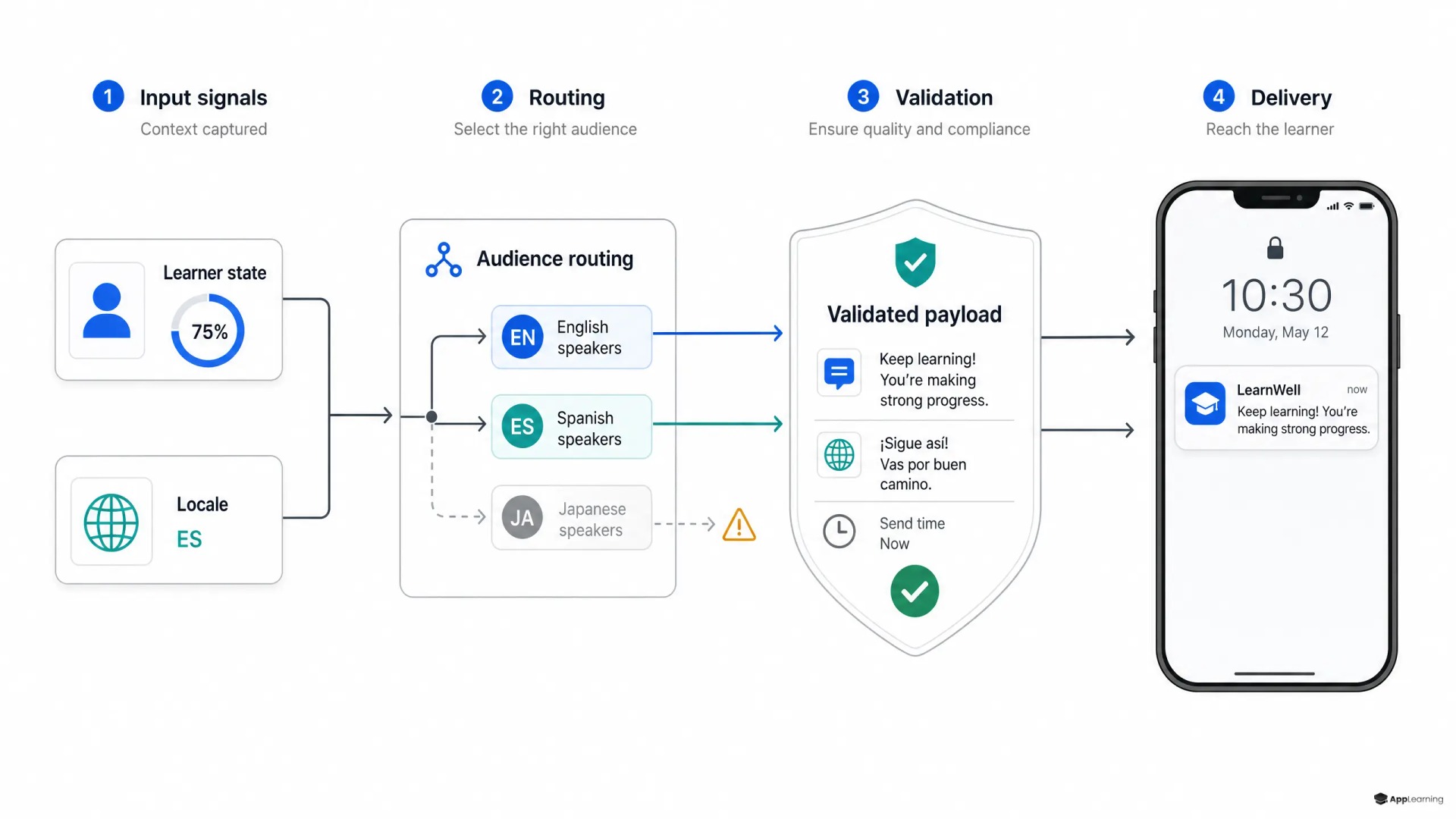
The platform layer can support this separation. Firebase Cloud Messaging can target devices, groups, or topic subscribers, while its localization model can resolve message resource keys against a device’s language settings through client-side string resources. The operational choice is then clear: use locale-specific routing when the audience and learning journey differ by language, and use client-side localization when the same event and message structure should adapt to the learner’s device language.
Topics Turn Audience Logic Into Delivery Logic
Topic and locale routing provide a simple model for learner segments. Instead of building a recipient list every time a reminder is needed, the academy assigns learners to durable delivery channels that reflect their current context. The notification service publishes to the channel; the platform has already decided who belongs there.
- Use a topic for the academy or product area, such as onboarding or security basics.
- Add the learner segment that defines the moment, such as incomplete first module or inactive for seven days.
- Add locale where content, compliance language, or the learning flow differs by market.
- Remove or update subscriptions when learners complete a path, change locale, or revoke notification consent.
The naming convention matters less than the ownership model. Product defines the activation event. Learning defines the path state and content intent. Engineering defines the topic contract and subscription lifecycle. Growth can then run learner re-engagement without rebuilding audience logic in a separate campaign tool.
Good to know
Should every learner receive an individual notification?
No. Use durable segments when learners share the same learning state, locale, and next action. Reserve individual targeting for events that truly require personal context.
Is locale routing the same as translating notification copy?
No. Translation changes language. Locale routing decides which learners receive which message flow before delivery, including paths that differ by market or product context.
Where should notification payload validation happen?
Validate at the sending boundary before the message reaches the delivery provider. The sender should serialize structured data, enforce a schema, and reject invalid routes or fields.
Payloads Are an Interface, Not Copy
Dynamic notification text creates a common delivery failure. A learner name, module title, or AI-generated summary may contain quotation marks, line breaks, backslashes, or other characters that are harmless in copy but unsafe when inserted into a JSON string by concatenation. The JSON standard requires quotation marks, reverse solidus characters, and control characters to be escaped inside strings. One malformed value can invalidate the payload before it reaches the mobile client.
The fix is architectural. Build a typed notification object, serialize it with a real JSON encoder, and validate it before dispatch. Validate required fields, permitted routes, locale format, payload size, deep-link format, and fallback text. Log the message identifier, audience channel, template version, and validation outcome. This is not defensive coding for its own sake. It makes delivery failures observable and prevents a small content change from becoming a silent learner-facing outage.
Build reliable learner re-engagement into your academy.
Talk to usRe-Engagement Should Follow Learner State
The strongest reminder is connected to a meaningful academy event, not a generic calendar rule. A user who started a lesson but stopped at a knowledge check needs a different prompt from a user who completed an introductory path but has not applied the product feature it explains. Notification messages and data messages give mobile teams different display and handling options, which makes it possible to pair visible prompts with structured context such as the destination screen, module identifier, or progress state.
For fintech product and growth leaders, this makes education measurable as part of activation rather than a parallel content program. The academy can trigger a specific learning return, route it to the right learner group, and open the exact next step when the learner taps. The result is a more reliable bridge between product complexity and user confidence.
Reliable learner re-engagement starts long before a notification is written. It starts with a delivery architecture that treats learner state, locale, audience membership, payload integrity, and mobile routing as one learning system. That is how a reminder becomes a useful product moment instead of another message competing for attention.