
Key takeaways
- Treat AI-generated prose as a value, never as ready-made payload text.
- Quotes, line breaks, and backslashes can break manually assembled JSON.
- Serialize once at the API boundary instead of escaping across every workflow step.
- Schema validation turns opaque automation failures into actionable errors.
- Reliable LMS content automation depends on contracts, not fragile prompt strings.
Good content can still produce broken requests
An AI model can return a strong onboarding module, a clear knowledge check, or a useful manager guide. The copy may be accurate, well structured, and ready for a learner. Then the automation fails before anyone sees it.
We saw this pattern in two separate automation flows this week. Dynamic natural-language content was inserted directly into JSON text before an API call. The content itself was valid. The payload was not. A quotation mark, line break, or backslash changed the JSON structure and caused the downstream system to reject the request.
This is not an edge case. Under the JSON data format, quotation marks, reverse solidi, and control characters require escaping inside strings. AI-generated learning content uses these characters naturally. It may include a learner quote, a multiline explanation, or a path-like reference without any warning that a hand-built payload will fail.
Prose needs a data boundary
The central mistake is to treat generated text as though it were already safe transport text. It is not. It is a value: a piece of content with meaning, length, language, and a destination in a larger object.
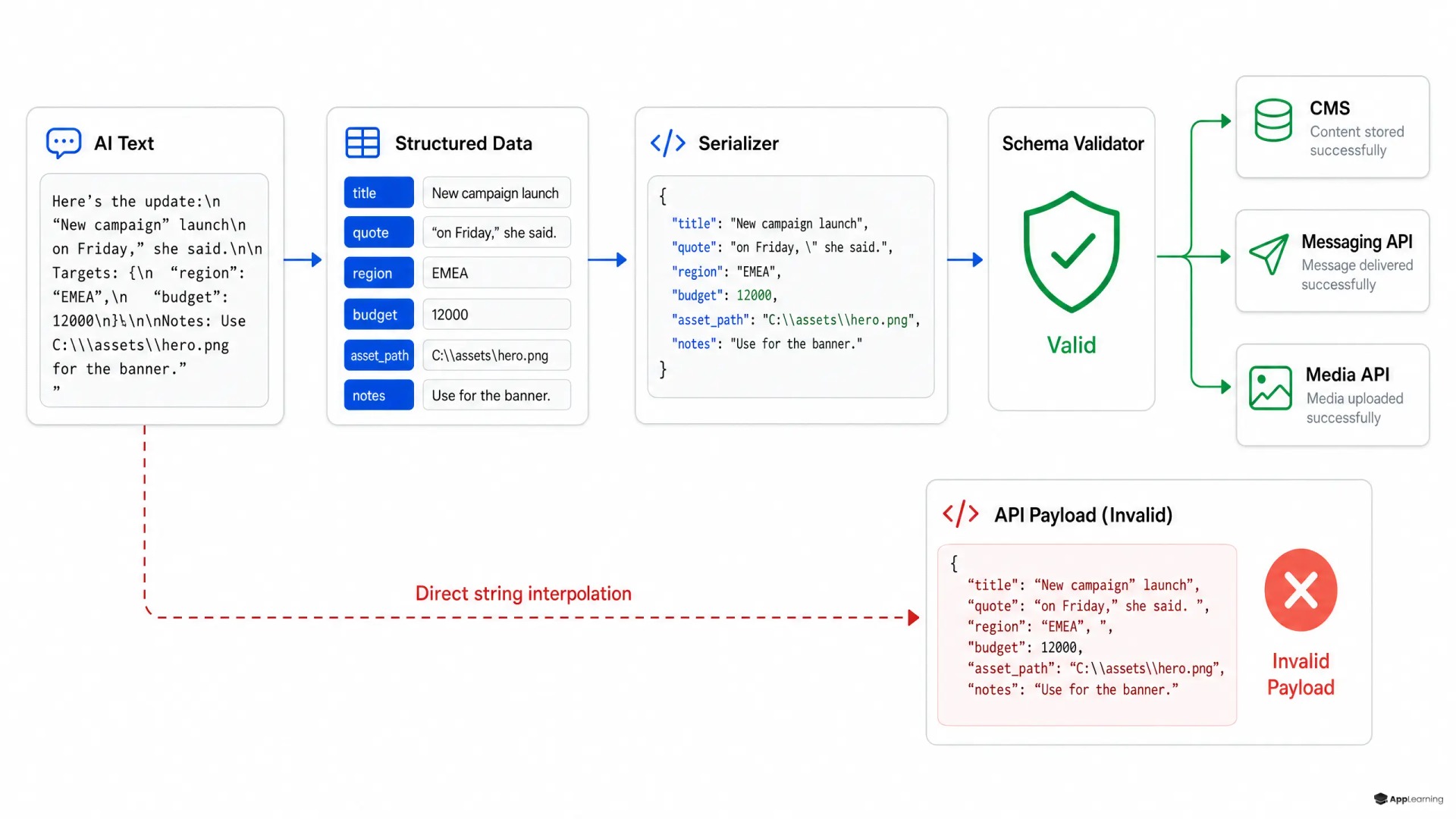
A learning content pipeline should keep that value separate from the structure around it. The title belongs in a title field. The lesson body belongs in a body field. Question options belong in an array. Metadata belongs in typed fields. Only the system responsible for sending the request should turn that object into JSON.
That distinction makes AI content automation easier to reason about. The model produces content. The workflow stores values. The integration layer creates the API request. No prompt step needs to know the escaping rules of the LMS, CMS, messaging platform, or content-generation service that follows.
Escaping is not a workflow strategy
Manual escaping often begins as a quick fix. A team replaces quotation marks, strips line breaks, or adds backslashes with a string-replace step. It may solve the current failure and create the next one.
The issue is not only missing characters. It is also sequence, ownership, and double handling. One tool may escape a value correctly, while a later step escapes it again. A field can be safe for one API and invalid after it is embedded inside another JSON string. Attempts to block “dangerous” characters also damage legitimate learning content. OWASP advises teams to validate structured data for syntax and business meaning rather than relying on deny lists of supposedly bad characters in its input-validation guidance.
For a growing company, these failures have a real operating cost. A broken automation can delay onboarding content, create incomplete assignments, or force someone to inspect raw payloads during a launch. The more systems the pipeline connects, the less defensible manual string concatenation becomes.
Good to know
Why does AI-generated text break JSON payloads?
The text is usually valid prose, but JSON has syntax rules. When a workflow inserts prose into JSON by hand, characters such as quotation marks, backslashes, and line breaks can alter the payload structure.
Is manual escaping ever acceptable?
It may work for a narrow, controlled case, but it is brittle across tools and payload formats. Use a standard serializer when a system converts values into JSON.
What should an API payload schema cover?
Start with required fields, field types, arrays, allowed values, length limits, and the business rules that must hold before content is published or assigned.
Does schema validation replace content review?
No. Schema validation checks whether content is structurally safe for the next system. Editorial review and learning design checks still decide whether it is accurate, useful, and appropriate for learners.
The reliable pattern is typed and observable
A safer learning content pipeline has four deliberate controls before it calls an external service:
- Keep model output as plain values in named fields rather than assembling request text.
- Build a typed content object with explicit fields for module, lesson, audience, locale, body, questions, and metadata.
- Serialize the complete object once at the API boundary with a standard JSON serializer.
- Validate the object against a schema, log validation failures with a workflow ID, and retain a safe version of the rejected object for debugging.
Schema validation is useful because it checks the contract before the request crosses a system boundary. A schema can require a string where a string is expected, an array where answer options are expected, and required metadata before publication. The JSON Schema validation specification defines this model as constraints on the structure of an instance, which is exactly the control an automated content handoff needs.
Logging completes the pattern. Record which generation run created the content, which schema version validated it, which integration received it, and why validation failed. Do not log sensitive learner data or full secrets. Do log enough context to reproduce the failure without guessing whether the problem came from the prompt, the mapping, or the destination API.
Build learning automation that remains reliable as your company grows.
Talk to usEnterprise learning needs recoverable automation
At small scale, someone can repair a failed payload by hand. At 50 employees and beyond, that approach becomes hidden operational work. Founders want onboarding to become consistent, company knowledge to stop living in individual heads, and internal training to run without building a large L&D operation. LMS content automation can support that goal only if it is dependable when content volume and system connections increase.
This is where a technology partner should add more than prompts and templates. At App-Learning, we design the learning content pipeline around data contracts, JSON serialization, API payload validation, and clear failure paths. That lets teams improve content generation without making every new lesson, integration, or language variant a new reliability risk.
The durable unit of automation is not the generated sentence. It is the validated content object that can move safely from model to workflow to learning system. Build that boundary well, and AI can accelerate learning operations without turning ordinary prose into production incidents.