

Key takeaways
- Course context is becoming a core requirement for useful AI learning support.
- Visible sources make AI answers easier to verify, challenge and trust.
- LMS integrations can turn specialist AI tools into accessible learning infrastructure.
- App-Learning can combine grounded assistance with paths, assessment and analytics.
The generic chatbot has no course boundary
A generic chat interface can explain almost anything. That is also its weakness in a learning environment. It does not know which material the learner was assigned, which version of a policy is current, what sequence the course follows, or where the organisation wants learners to look first.
For a growing startup, this problem appears quickly in onboarding. A new hire asks how a process works and receives a plausible answer that conflicts with the handbook, a manager’s current practice or a customer-facing policy. The result is not just a wrong answer. It creates rework, inconsistent behaviour and more dependency on the people who already know the system.
Generic AI can be useful for drafting and exploration. It is a weak default for capability building because its knowledge boundary is unclear. Learning needs a defined body of knowledge, a progression through it and a way to check whether understanding has improved.
Grounding turns assistance into part of the learning system
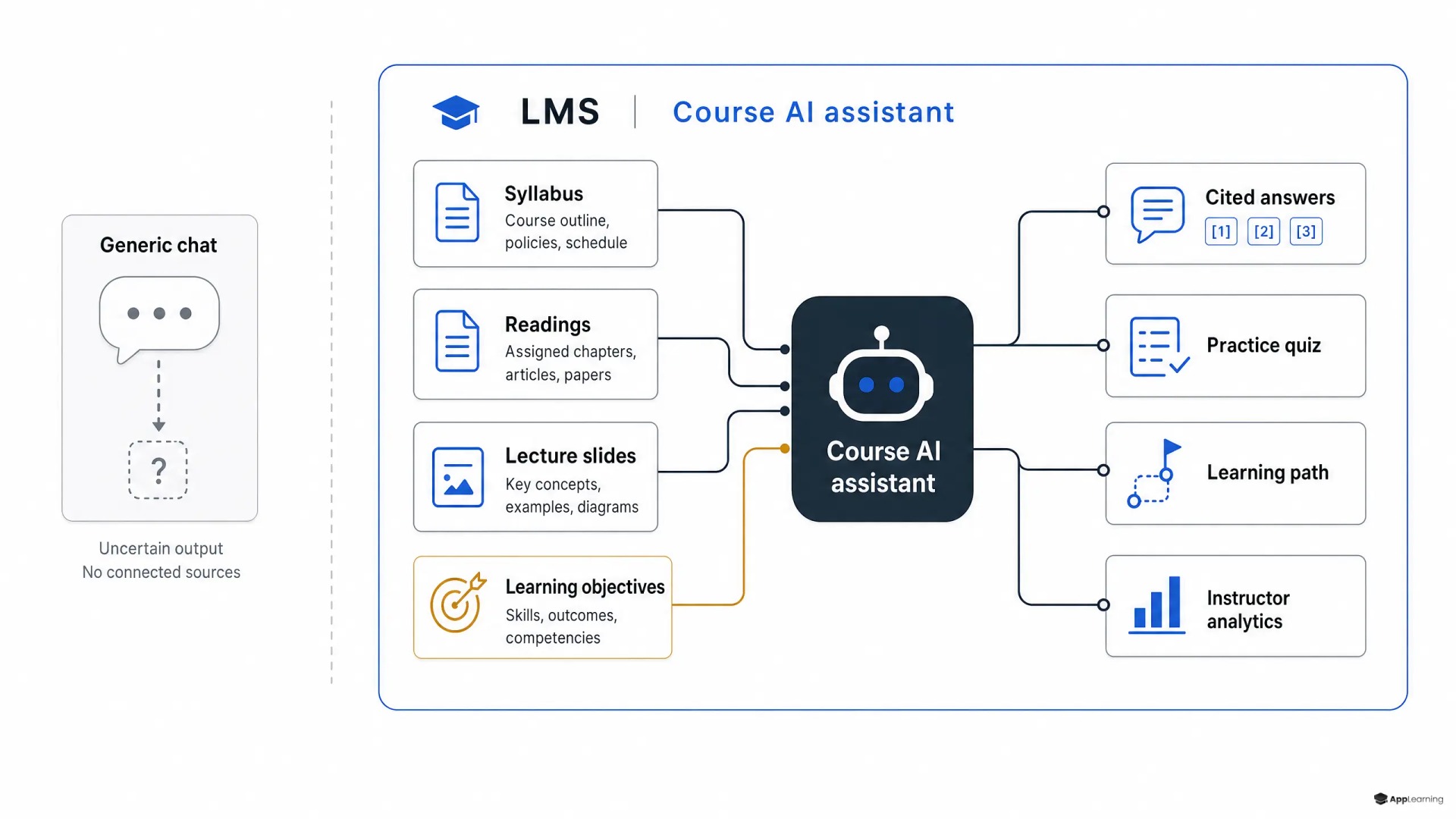
Course-grounded AI starts with a bounded source set. It retrieves from approved modules, videos, files, policies, reading material and assessments. It also receives the learning objectives and the learner’s place in the path. That changes the job of the assistant from answering a broad prompt to helping someone work through a specific learning task.
A grounded learning assistant should not replace the academy. It should make the academy easier to use at the moment of need. It can clarify a concept from the current module, point a learner back to the relevant source, generate a practice question, or explain why an answer was incorrect. The course remains the operating model. AI becomes an interface to it.
- Approved content defines what the assistant may use.
- Learning objectives shape the depth and direction of an answer.
- Assessments reveal where reinforcement is needed.
- Learner activity creates signals for improving the course itself.
Visible evidence creates a better learning loop
Grounding does not make an AI system infallible. Retrieval can fail, source material can be outdated and a model can still misinterpret context. The practical goal is different: constrain the answer, expose the evidence and give the learner a clear route to validate it.
This is where source visibility matters. A learner should be able to see which policy, module or page informed an answer, then open it and judge the context. That supports learning behaviour instead of creating passive acceptance. It also gives content owners a way to find weak, conflicting or missing material when the same questions recur.
The evidence for connecting AI to live course structure is encouraging but should be read with care. The Canvas-based Ask ME research found that dynamically retrieving verified content from structured course elements helped constrain responses to course material. The lesson is operational: source control and instructional structure should be designed into AI study support, not added later as a disclaimer.
Good to know
Does course-grounded AI eliminate hallucinations?
No. It reduces the space in which the model can improvise by retrieving from approved material. Good implementations still need source links, permission controls, content review and a clear process for handling uncertain answers.
Can a startup use this model without a traditional LMS?
Yes. The essential requirement is structured learning content rather than a specific platform label. A defined academy, approved sources, clear learning objectives and simple assessment create the context that an AI assistant needs.
Which academy should get grounded AI support first?
Start where repeated questions create the most operational drag. New-hire onboarding, product training and customer enablement are strong candidates because the source material can be bounded and the impact on time to productivity is visible.
The LMS is becoming an AI distribution layer
The market signal is no longer limited to standalone chat tools. On July 16, 2026, Kortext announced its entry into the Instructure Partner Program, positioning Kortext IQ inside Canvas with responses grounded in course structure and links to permitted source content. This does not establish a universal standard overnight. It does show where implementation is heading: AI support is moving into the environment where learning already happens.
That matters because distribution shapes use. If learners must leave the LMS, find a separate tool, paste materials into it and remember its limits, adoption becomes fragmented. When a tool sits inside the learning workflow, it can use the context that the LMS already manages: enrolment, modules, content access and learning progress.
The integration layer is expanding as well. Kortext’s July 2026 product update states that its AI can use VLE pages, lecturer-uploaded files and institution-approved URLs, with integrations across Canvas, Moodle, D2L and Blackboard. That is a useful indicator of the next LMS AI integration pattern: connect trusted content first, then make assistance available where learners are already working.
Build an academy that turns company knowledge into reliable learning support.
Talk to usAcademies need an AI layer with boundaries
The same pattern applies beyond higher education. A startup academy is a course environment, even if it is built from product training, sales playbooks, security policies, manager routines and onboarding checklists. AI customer education follows the same logic. Customers need answers grounded in the product version, the assigned learning path and approved help content, not a generic response assembled from the open web.
For App-Learning, the opportunity is not to place an ungrounded chatbot beside a course catalogue. It is to connect AI study support to structured academies, controlled source content, quizzes and analytics. A learner can ask for help inside a module; a team can see where questions cluster; and content owners can improve the material that drives both the course and the assistant.
That model also keeps implementation realistic for a 50-person company. Start with one high-value academy, such as new-hire onboarding or product enablement. Define the approved source set, map the path, add short knowledge checks and review unanswered or low-confidence questions. Expand only after the content and governance loop works.
The next LMS standard will not be a chat window that happens to sit next to learning content. It will be an accountable support layer that knows the course, shows its evidence and helps people progress through work that the organisation has deliberately designed.