
Key takeaways
- Infrastructure ownership and content ownership can be separated cleanly.
- Authorized editors should not need developers for routine content changes.
- Preview and review workflows reduce publishing risk when more stakeholders gain access.
- Role-based CMS access makes managed academies easier to maintain over time.
Managed delivery is not vendor lock-in
A managed LMS often creates the wrong expectation. The provider runs hosting, authentication, releases, monitoring and application maintenance, so clients assume the provider must also control every lesson, quiz, translation and content update. That is not managed delivery. It is unnecessary dependency.
The real issue is whether the client can maintain its own knowledge without opening a technical support ticket for routine work. For a fintech product team, this matters when product flows change, a new market needs localized guidance, or support data exposes a recurring point of confusion. Waiting on engineering to update an academy turns education into a bottleneck.
LMS vendor lock-in begins when a platform makes ordinary content maintenance expensive, slow or opaque. A managed academy should do the opposite. It should take operational risk away from the client while leaving the client in control of the expertise that belongs to its business.
Two operating layers keep accountability clear
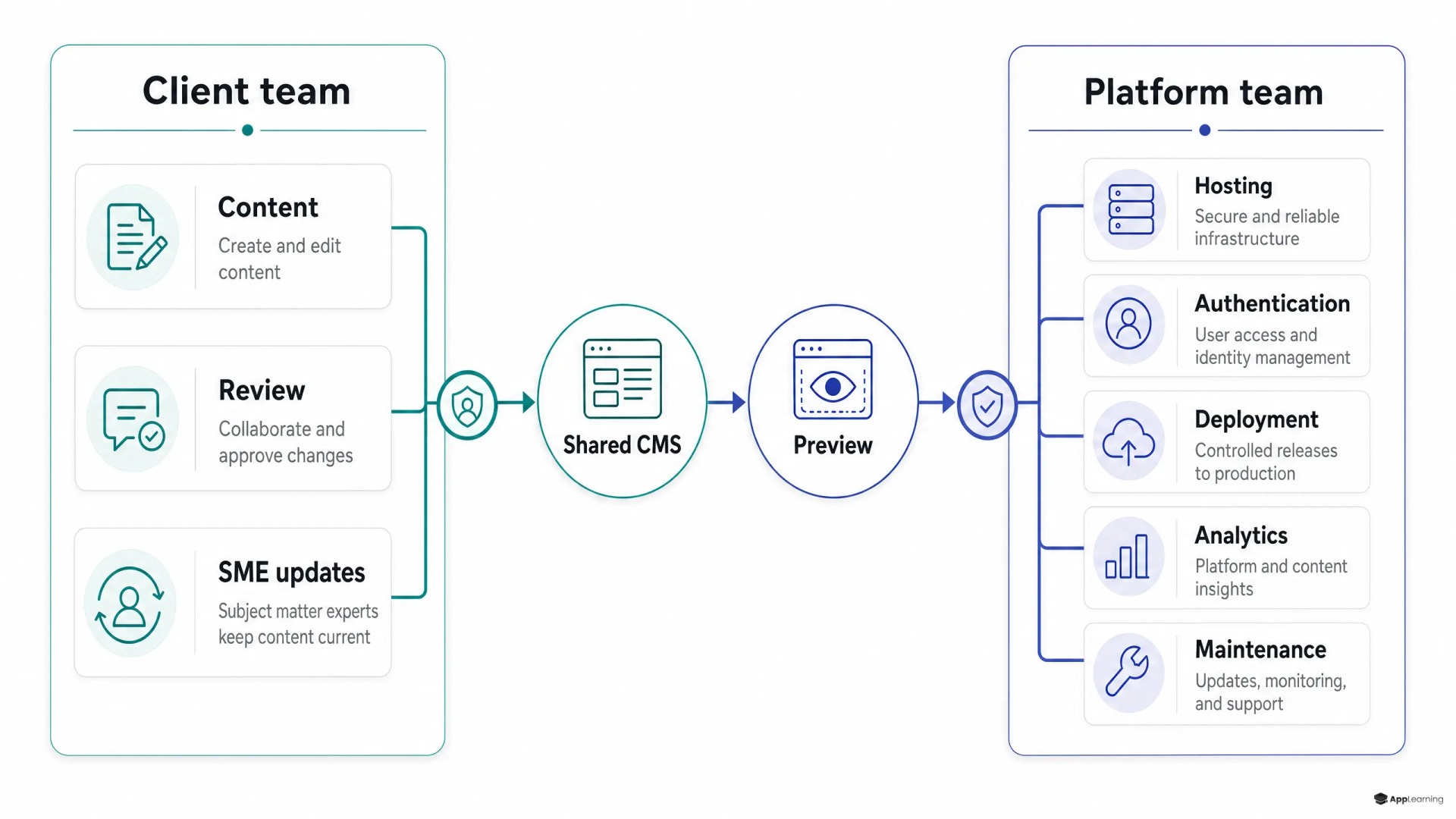
The clean model separates academy content management from platform operations. Each layer has a distinct owner, cadence and risk profile.
- Client content operations cover learning paths, copy, media, quizzes, product explanations, translations and editorial review.
- Platform operations cover infrastructure, identity and access foundations, application releases, integrations, performance, security controls and technical maintenance.
- Shared governance covers content standards, publishing rules, brand requirements, analytics definitions and escalation paths.
This separation lets a provider operate a reliable white label academy CMS without pretending to own the client’s product knowledge. It also prevents a common failure mode: a client receives administrator access to everything, then becomes responsible for systems it never intended to operate.
Editors need control over knowledge, not the production stack
Authorized client stakeholders should be able to handle the work that changes most often. That includes creating and editing lessons, replacing screenshots, updating feature explanations, adapting terminology, managing translations, changing quiz questions and reviewing learner-facing copy before it goes live.
They should also see the academy as learners see it. A preview environment matters because financial education can be precise in source documents but unclear in a mobile learning flow. Product, compliance, support and localization reviewers need a shared view of the final experience before publication.
They do not need access to deployment pipelines, production infrastructure or the application codebase to make these changes. Giving them that access adds risk without improving content ownership. Good academy content management gives editors enough control to act quickly and enough structure to avoid accidental damage.
Good to know
Can a client update academy content without technical access?
Yes. Client editors can work in a dedicated content-management layer while the provider retains responsibility for infrastructure, releases, authentication and application maintenance.
Which stakeholders should receive CMS access?
Give access to the people accountable for product education, editorial quality, localization and review. Use roles so authors, reviewers and publishers have only the permissions they need.
How can teams avoid accidental publishing mistakes?
Use draft states, approval steps, learner-facing previews, version history and limited publishing permissions. These controls make updates faster because the process is defined before an urgent change arrives.
Does client content ownership weaken a managed academy model?
No. It strengthens the model by assigning knowledge ownership to the client and technical operations to the platform provider. Each side controls the work it is best placed to maintain.
Guardrails make broader access safe
More editors do not have to mean uncontrolled publishing. The operating model should match permissions to responsibility. An author can draft and revise content. A reviewer can approve it. A publisher can release it. A platform operator can manage the underlying system without becoming the gatekeeper for every wording change.
- Role-based access that limits each stakeholder to the areas they own.
- Draft, review and approval states that make accountability visible.
- Preview workflows for checking content, navigation and brand presentation before release.
- Version history and rollback options for correcting mistakes without technical intervention.
- Clear ownership for content quality, product accuracy and platform reliability.
These safeguards are especially useful in fintech, where product education often crosses product, legal, support and market teams. The goal is not to make publishing slow. It is to make the right checks repeatable, so routine updates do not become an improvised coordination exercise.
Keep your knowledge in client hands.
DiscussClient knowledge can stay client-owned
In a recent App-Learning delivery, a new client-side stakeholder was onboarded directly into the academy’s content-management layer while App-Learning continued to manage the academy itself. The stakeholder could participate in content maintenance without taking responsibility for hosting, authentication, deployments or application maintenance.
That is the useful boundary for a managed LMS. The client owns the accuracy, relevance and evolution of its knowledge. App-Learning operates the technology that delivers that knowledge as a stable, branded learning experience across the customer journey.
For product leaders, the result is practical: education can move at the speed of product change without moving platform operations onto the product team’s desk. A managed academy becomes a durable capability, not a black box that holds the client’s own expertise hostage.