

Key takeaways
- White-label LMS tools solve branding but not always academy strategy.
- Branded academies require content, journeys, and measurable outcomes.
- External audiences often need more polish than internal portals.
- App-Learning fits teams seeking a managed branded academy experience.
White label changes the surface
The comparison between a white label LMS vs branded academy platform starts with a simple distinction. A white label learning platform lets a company replace vendor signals with its own identity. For example, LearnWorlds defines white-label LMS software through controls such as custom domains, logos, fonts, portals, certificates, and mobile branding. That is valuable infrastructure. It can make training look like it belongs to the company rather than the LMS vendor.
White labeling is often the right answer when the job is to launch a practical training portal with a familiar identity. It is especially useful for internal enablement, client training businesses, or distributed partner programs that need several branded environments. CYPHER’s white-label offering illustrates this model with branded web and mobile experiences, communications, and separate portals under one system.
But visual ownership is not the same as academy design. A logo, color palette, and custom domain do not decide what a new customer needs to understand before making a first deposit, completing identity verification, securing a wallet, or using a complex feature with confidence.
An academy is a learning system around the product
A branded academy platform should make education feel like a coherent part of the product experience. That means it has to serve four connected jobs: present a trusted experience, guide people through the right sequence, keep content current, and show whether learning changed a meaningful behavior.
- Experience: The academy should carry the same tone, interaction quality, and trust signals as the app, website, and lifecycle messages.
- Journey: Learning paths should reflect audience needs and product moments, not merely a catalogue of available courses.
- Operations: Product, Growth, CX, Compliance, and subject-matter experts need a repeatable workflow to turn changing knowledge into approved lessons.
- Evidence: Analytics should show progress and knowledge gaps, then connect learning activity with product events such as activation, feature adoption, fewer avoidable support contacts, or partner readiness.
This matters most in fintech. Customers are not learning for its own sake. They are deciding whether they understand a financial concept, trust a workflow, or feel ready to take an action that may involve money and risk. If education sits in a generic portal outside the onboarding flow, it can feel optional at the exact point where it should reduce uncertainty.
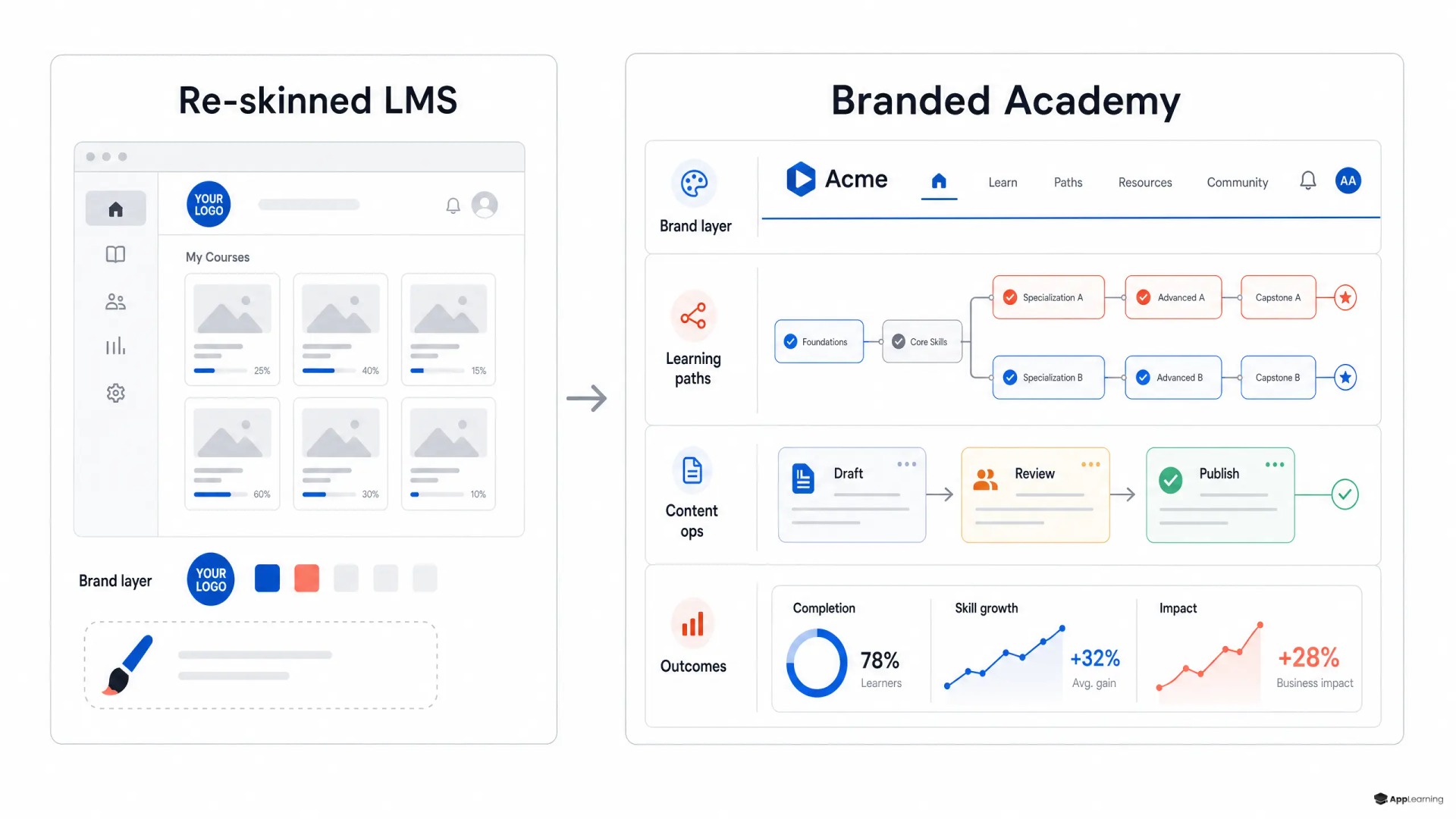
The operating model behind the branded experience
The difference becomes clearer after launch. A white-label LMS may give a team strong control over presentation, while the academy still depends on someone manually collecting source material, briefing course creators, chasing legal review, and rebuilding lessons after every release. That is not a branding problem. It is a content operations problem.
App-Learning takes an academy-led approach: its academy platform combines branded delivery with role-based learning paths, microlearning modules, quizzes, certificates, and learner analytics. Its content model also turns existing product documents, help-center material, slides, and expert knowledge into structured learning assets. The point is to give teams a faster route from changing product knowledge to a publishable learning journey.
For a Product or Growth leader, this creates a more useful unit of work than “build a course.” Start with a moment of friction. A user has created an account but not completed a first transaction. A customer has viewed a risk feature but not enabled it. A partner has joined a program but cannot yet explain the product. Design a short path for that moment, place it in the relevant product or lifecycle flow, and measure the behavior that follows.
Good to know
What is the main difference between a white label LMS and a branded academy platform?
A white label LMS focuses on removing vendor identity and applying your brand. A branded academy platform also organizes the learner experience around audience needs, learning paths, content operations, product integration, and outcome measurement.
When is a white label learning platform enough?
It is enough when your team mainly needs a branded training portal and already has clear ownership of curriculum, content production, review workflows, learner segmentation, and reporting.
Why do fintech customer academies need more than branding?
Fintech users often need clarity before they take meaningful actions. The academy should simplify complex concepts at specific onboarding and lifecycle moments, while reinforcing the product’s trust signals and measuring whether learning helps users progress.
Which metrics should a branded academy platform track?
Track completion, drop-off points, quiz results, repeat engagement, and path progress. Then compare those signals with product measures such as first successful transaction, feature adoption, support demand, certified partner readiness, and retention.
Selection follows audience pressure
A white label LMS is usually a sound choice when the learning need is established, the audience accepts a conventional portal, and the team already owns content strategy, production, governance, and reporting. It is a technology purchase first.
A branded academy platform is the stronger model when education is part of customer activation, trust, retention, or product adoption. It is better suited to teams that need external learners to experience education as part of the brand, want short and guided formats instead of course libraries, and need the academy to stay aligned with product releases.
- Choose a white-label LMS when branding control is the main gap and your operating model is already mature.
- Choose a branded academy platform when external education must support a defined product or growth outcome.
- Prioritize content workflows when product, legal, support, and marketing all contribute to the same learning material.
- Prioritize integration and data export when education must be tested against activation or retention metrics.
Build education around the product moments that determine user value.
Talk to usQuestions that expose the real requirement
Ask vendors to show more than a themed login screen. Can a learner move from a product message to the exact lesson they need? Can one audience see a different path from another? Can a product manager update a lesson without creating a production bottleneck? Can the team see where people stop, fail knowledge checks, or fail to reach the next product milestone?
The best decision is not about whether an LMS can wear your brand. It is about whether the learning system can earn its place in the customer journey. A polished portal that cannot guide, update, and prove its value remains a rebranded tool. A well-run academy becomes part of how users understand the product, trust it, and reach value.