

Key takeaways
- Bounded learning-path routing and open-ended tutoring are separate tasks.
- Explicit misconception labels, model confidence and next activities make routing inspectable.
- Evaluation needs end-to-end latency, total cost, routing accuracy and later independent assessment.
- Consequential learning paths still need rule-based baselines, safe fallbacks and human review.
The pause after an answer needs a decision
A customer answers a short question inside a fintech app. The next useful step might be another scenario, a worked example or a clarification. None necessarily requires a freshly generated paragraph.
OpenAI announced general availability of its Decisions API on October 22, 2026. Its announcement describes bounded decisions from text, images and structured inputs, with vendor-claimed speeds up to ten times faster than GPT-6 Luna through the Responses API. (openai.com) That is an architecture signal, not a benchmark for your app or evidence of better learning.
A bounded decision comes before the model choice
A narrow learning objective is the starting point. A learner’s explanation might suggest confusion about the components of a transfer fee. A proposed label set could distinguish fee-component confusion, calculation error, insufficient evidence and no detected misconception. Each label needs examples and a defined response.
The Decisions documentation distinguishes probabilities, choices from fixed options and rubric-based scores. (developers.openai.com) For adaptive microlearning, those outputs serve as routing evidence. Model confidence and learner-reported confidence must remain separate. Neither should become a permanent judgment of ability.
If a multiple-choice answer already maps cleanly to a remediation, a rule is sufficient. An AI decision API should be reserved for inputs that need interpretation, such as a short written explanation.
Curriculum rules control the next activity
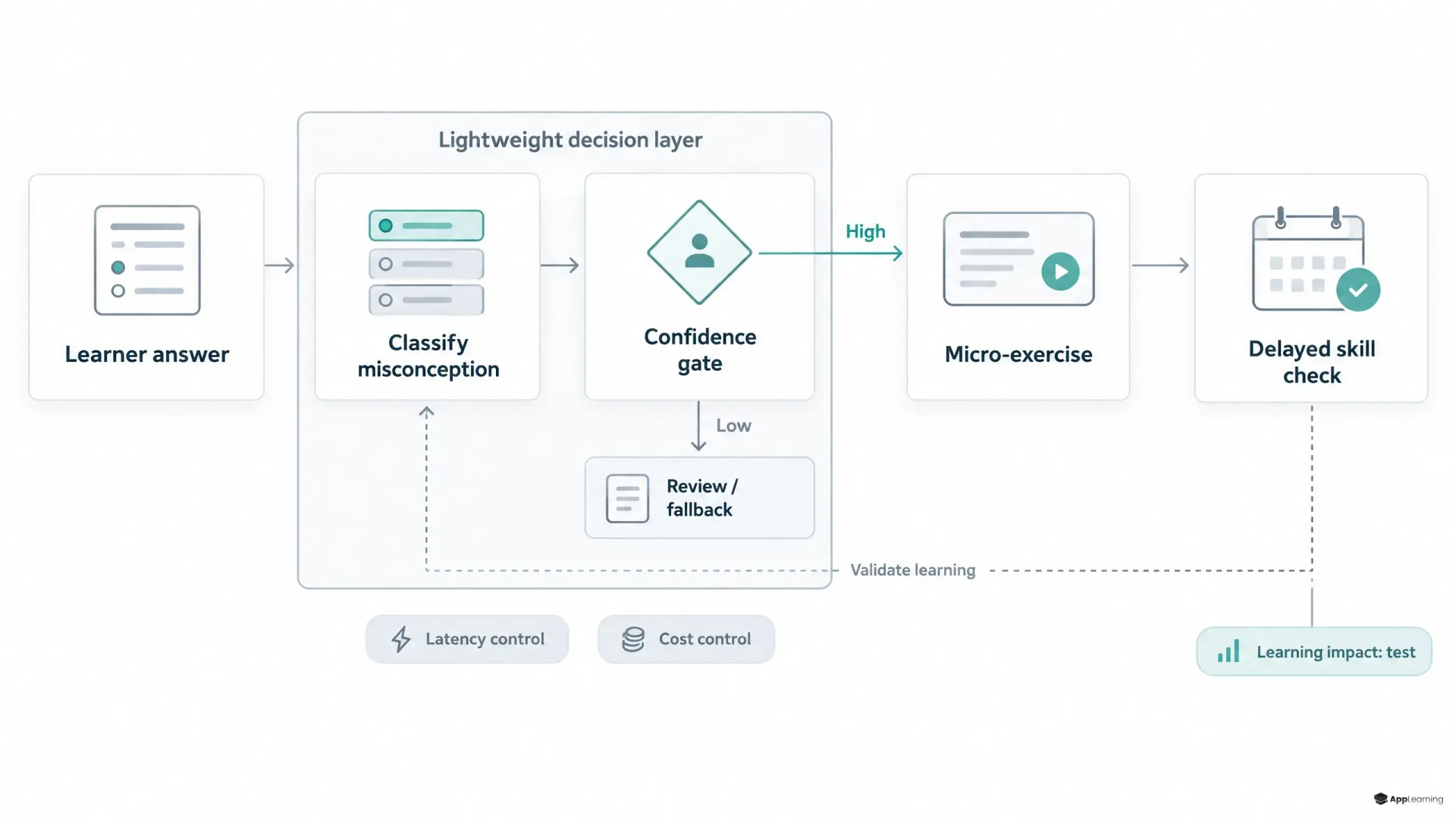
A proposed AI tutoring architecture should separate interpretation from permission. The classifier suggests a label; curriculum rules determine which activity may follow.
- Capture an assessment event with the answer, objective, item version, locale and relevant attempts.
- Classify the evidence using explicit labels and an insufficient-evidence option.
- Apply curriculum rules for prerequisites, review thresholds and approved remediation.
- Return the next exercise and log the route, decision version and any fallback.
Learning path personalization should return an approved activity identifier rather than an invented lesson. Uncertain results need clarification or review. A timeout path prevents an unavailable service from blocking the academy.
Routing and learning need separate measures
OpenAI recommends setting routing thresholds with labeled application examples and the costs of false positives and false negatives. (developers.openai.com) Automatic routing should start with an educator-reviewed test set. Disagreements need analysis by misconception and language, not just aggregate accuracy.
- Speed — measure p95 time from answer submission to the next usable screen.
- Cost — count classification, retries, generated feedback and human review.
- Routing quality — inspect a confusion matrix, missed misconceptions and unnecessary remediation.
- Learning — test retention and transfer later with unfamiliar tasks and no AI assistance.
The next step is an A/B test against a rule-based path. Activation and product retention need separate tracking from knowledge retention. A faster route should not count as an educational improvement unless the independent assessment supports it.
Explanations still have a role
Free-form feedback remains useful when a learner asks why, presents an unfamiliar rationale or needs a comparison that approved content does not cover. Explanations must be grounded in reviewed material, with product education kept separate from personal financial recommendations. Ambiguity should not be forced into a convenient label.
Design one testable learning route with App-Learning.
DiscussOne embedded learning route is a practical starting point
For App-Learning, this is an optional architecture pattern: a combination of a Flutter embedded academy, short assessments, structured learner signals and workflow automation. It is not a claim of an existing feature or proven outcome.
- Choose one recurring misconception and map approved follow-up activities.
- Minimise learner data sent to the classifier.
- Version labels, prompts, rules and multilingual content together.
- Assign review ownership and define rollback criteria.
The strongest tutor is not the one that writes after every answer. It is the system that selects a defensible next step, explains when needed and can show whether the learner understood.