
Key takeaways
- Completion is a weak proxy for understanding.
- Wrong-answer rates expose unclear explanations and weak question design.
- Attempt tracking separates quick completion from real learner readiness.
- Better LMS metrics tell teams what to improve next.
The clean number hides the messy work
Completion rates are attractive because they are clean. They travel well into board packs, audit files and monthly L&D dashboards. But completion mostly proves that a learner reached the end of a module. It does not prove that they understood the control, can apply a policy, or are ready to act when the situation is messy.
That is the trap in many LMS metrics. The system reports that 96 percent of people finished sanctions training, while the same three questions keep failing. The dashboard says the rollout is done. The learning system is telling a different story, if it is allowed to show it.
Friction is the signal
Friction is any point where learning slows down: repeat quiz attempts, low first-pass accuracy, skipped content, long pauses before a question, or a wrong answer pattern around one scenario. These are not signs that the learner failed. They are signals that the system needs attention.
The field has been moving in that direction. The Society for Learning Analytics Research now frames learning analytics around actionable insights that enhance learning and teaching. OECD work on formative assessment makes the same operational point: assessment data should shape what happens next, not only record what happened before.
Wrong answers point to design debt
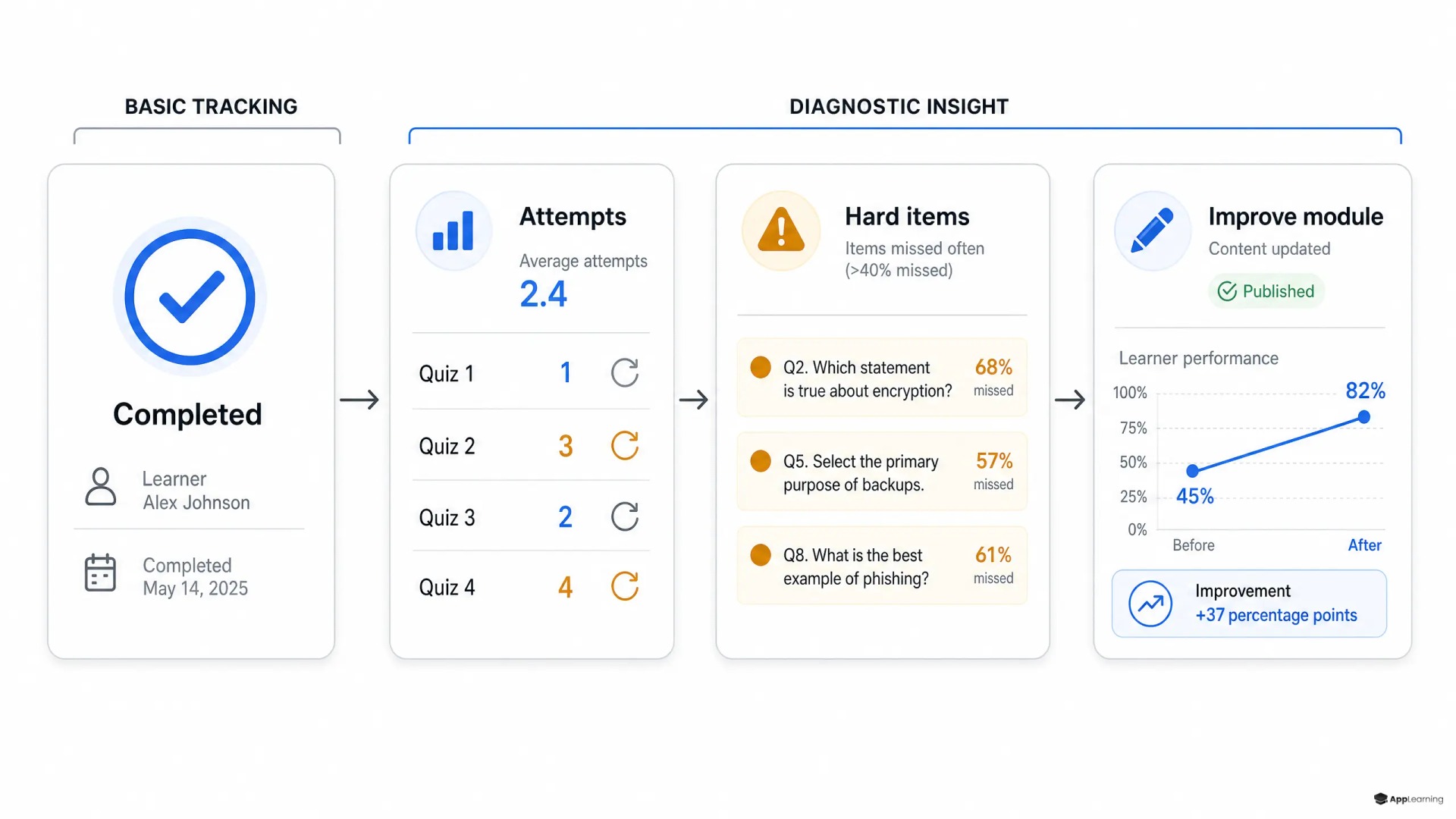
Wrong-answer rates are not just learner data. They are content QA. A question with high failure rates may show a real knowledge gap. It may also show an unclear explanation, weak scenario wording, a misleading distractor or a policy nuance that the module glossed over. The correct response is not to blame the learner. It is to inspect the learning design.
Assessment practice has long used item-level response data for test improvement and remedial work; psychometrics guidance for medical education describes analysis of responses to assessment questions as a tool for improving tests and remediation. In workplace learning, that logic becomes practical. If one question is difficult for almost everyone, revise the content. If one team struggles, add targeted support. If only one role fails, check whether the scenario fits their work.
Attempts change the readiness discussion
Attempt tracking changes the reporting conversation from who completed to who needed support to complete. Two learners can both pass. One answered correctly on the first try. The other needed four attempts and guessed through the last section. A completion report treats them the same. A readiness report does not.
- First-pass success shows where the material already works.
- Repeat attempts show where confidence or clarity is missing.
- Question difficulty analytics show which items need review.
- User-level progression shows who may need coaching before high-risk work.
This matters for learner readiness because regulated work is not a memory contest. A customer due diligence analyst, payments operations specialist or crypto support agent needs to recognize patterns under pressure. The LMS should help L&D see who is ready, who is nearly ready and where the content still blocks understanding.
Good to know
Is completion data still useful in compliance training?
Yes. It proves delivery, but it should be paired with attempts, item difficulty and progression to show readiness.
What is question difficulty analytics?
It is reporting that shows which quiz questions learners answer incorrectly or need repeated attempts to pass.
How should L&D use repeat attempts?
Use them to find unclear content, trigger support and separate fast completion from genuine readiness.
Regulated teams need evidence they can use
Finance and crypto learning has a hard constraint. Training must satisfy compliance needs, but it must also improve judgment. FINRA’s 2025 AML guidance points to ongoing AML training for appropriate personnel, while EU DORA includes relevant ICT security awareness and digital operational resilience training in the resources financial entities must budget for. In that context, training effectiveness cannot stop at attendance.
Better reporting reduces audit tension rather than increasing it. It shows that the organization can prove delivery, inspect understanding and improve the module after launch. That is useful for compliance owners, but it is also useful for managers who need people to handle live risk.
Make regulated learning easier to measure.
TalkReporting becomes a content improvement system
App-Learning’s reporting layer is built around this feedback loop. It can show quiz attempts per learner, question-level difficulty and user-level progression. The point is not surveillance. The point is to find friction early, then turn it into a clear action for the learning owner.
- Rewrite the explanation before a difficult question.
- Replace a distractor that teaches the wrong lesson.
- Add a scenario for the role that struggled.
- Flag learners who passed only after repeated attempts.
- Compare cohorts after the revision to see whether friction falls.
The best LMS analytics do not admire the dashboard. They shorten the distance between evidence and improvement. Completion still matters, especially in regulated training. But it is the floor. A useful LMS shows where people struggled, which questions created repeat attempts and where the learning material should be improved. That is how reporting becomes part of the learning system, not a report about it.