
Key takeaways
- AI learning content QA is now a production requirement, not a final polish step.
- Pedagogical QA covers accuracy, depth, relevance, learner fit and bias.
- Useful AI instructional design protects productive struggle instead of removing it.
- Quiz data and learning analytics show where AI-generated training content fails.
AI has removed a real bottleneck in learning operations. Drafting modules, summaries, scenarios, checks for understanding and localization variants is now faster. For HR and L&D teams in finance and crypto, that speed is attractive because regulation changes, products move and onboarding cannot wait six months.
But learning content automation changes the failure mode. The risk is no longer only slow production. The risk is publishing fluent, plausible and subtly wrong AI-generated training content across many roles before anyone notices.
Speed has become a quality risk
Traditional content review often assumes that errors are visible. A subject matter expert checks facts. A learning designer checks flow. A compliance owner checks policy language. AI breaks that pattern because many defects look polished. A weak explanation may use the right vocabulary while missing the decision rule. A quiz item may have a technically correct answer but poor distractors. A personalized hint may remove the exact struggle the learner needed.
Regulated teams cannot treat this as a cosmetic issue. The European Commission describes the AI Act as a risk-based framework and lists some AI systems used in education that may determine access or professional life, such as exam scoring, as high-risk use cases with obligations for risk management, documentation, logging, human oversight, robustness and accuracy in relevant contexts through the EU AI Act framework. Even when internal workplace training does not meet that threshold, the operating lesson is clear. AI in learning needs traceable controls.
Pedagogical QA turns review into a system
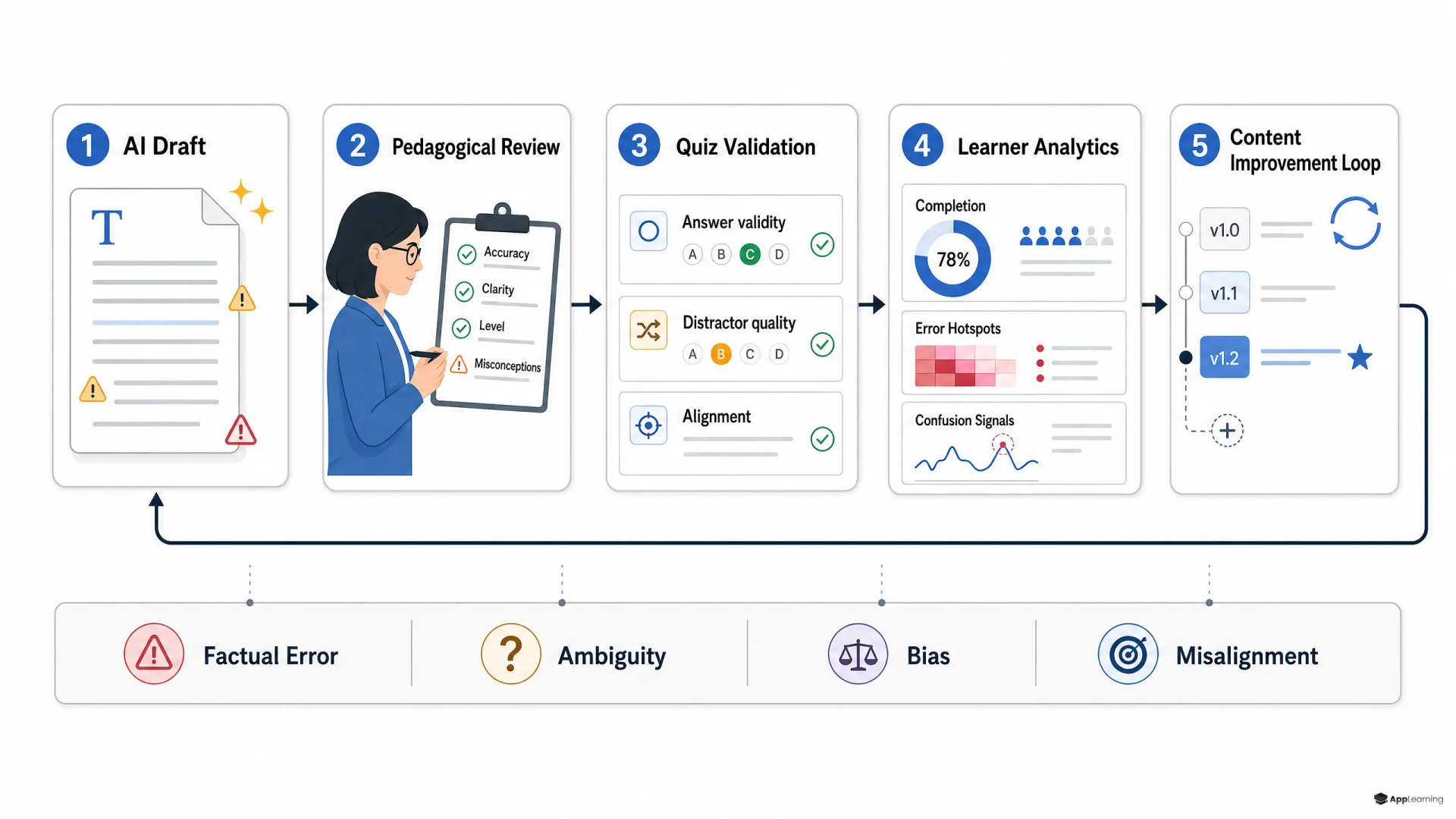
Pedagogical QA is not spell-checking. It is a structured review of whether an asset can support the intended learning outcome for the intended learner in the intended context. For AI instructional design, that means every generated asset needs a risk profile before release, not only a human glance after generation.
- Accuracy against approved source material
- Depth and completeness for the required capability level
- Relevance to the role, task and business context
- Appropriateness for learner experience and prior knowledge
- Bias, ambiguity and misleading simplification
- Assessment logic, distractor quality and feedback quality
- Version history, ownership and review evidence
This is where AI learning content QA becomes operational. A low-risk glossary draft may need light review. A compliance scenario for anti-money-laundering onboarding needs SME approval, policy traceability and quiz validation. An adaptive pathway that changes access, certification or remediation needs stronger governance.
Fluent content can still block learning
The OECD’s Digital Education Outlook 2026 makes a useful distinction for L&D leaders. GenAI can support learning when guided by clear teaching principles, but task performance with AI does not automatically produce learning. That distinction matters in employee training. If the system gives the answer too early, summarizes away the hard part or rewards recognition instead of judgment, completion rates may rise while capability does not.
A 2025 scoping review of GenAI personalization in computer science education found more positive learning processes where systems used explanation-first guidance, solution withholding, graduated hints, artifact grounding and human-in-the-loop quality assurance instead of unconstrained chat interfaces through an exploration-first adoption framework. The workplace version is simple. Personalization should scaffold the learner. It should not do the job for them.
Good to know
Can AI-generated training content be used in compliance learning?
Yes, but it should move through a governed workflow with source control, SME review, pedagogical QA, version history and analytics after release.
Where should human review sit in AI instructional design?
Human review should sit before learner release and after analytics signals show problems, not only at the end of the first draft.
Which analytics signals show weak AI content?
Useful signals include high retries, wrong-answer clustering, fast completions with poor applied performance, repeated drop-offs and role-specific error patterns.
Quizzes reveal the weak points
Quizzes are not just assessment objects. They are sensors for content quality. If many experienced employees miss the same item, the item may be ambiguous. If novices pass without retries but later fail scenario tasks, the quiz may be too shallow. If one distractor is never chosen, it is not testing a real misconception.
Learning analytics add a second layer. A 2026 study on interactive learning dashboards integrated an LLM-based pedagogical agent with dashboard data and found that eliciting learners to reflect on their data can support metacognitive engagement in a real course setting through pedagogically designed dashboard interaction. For corporate learning, the same principle applies. Analytics should not only report completions. They should help L&D teams inspect where content, questions and learner support are breaking down.
- High retry rates after one explanation
- Wrong-answer clusters around the same misconception
- Fast completions with weak scenario performance
- Drop-offs at the same content step
- Feedback ratings that conflict with quiz outcomes
- Role groups showing different error patterns
Build a safer AI learning workflow with App-Learning.
TalkRegulated L&D needs an operating layer
For finance and crypto companies, the practical answer is not to ban AI from content operations. It is to stop treating generation as publishing. The safer model is source-controlled, rubric-led and analytics-backed.
App-Learning supports this layer around the content workflow. AI can help draft explanations, quiz variants and practice scenarios. The platform logic should then hold those assets against learning objectives, approved source material, review status, quiz behavior and learner analytics. That creates a path from fast production to controlled release.
1EdTech’s AI-generated content best practices recommend risk tiers, subject-specific review and storing AI-generated content with metadata such as provenance, disclosure labels, timestamps and review history. That is the right direction for modern L&D stacks. The goal is not more process for its own sake. The goal is to make quality visible before content reaches learners and measurable after it does.
AI will keep making learning production faster. The teams that benefit will be the ones that add an equally strong quality system around it. In regulated learning, trust does not come from fluent content. It comes from evidence that the content is accurate, useful, reviewed and improving.