
Key takeaways
- AI lowers the cost of producing a plausible first draft.
- Generated curriculum still needs pedagogical, factual, and brand-specific QA.
- Assessment, analytics, and workflow integration gain value as content becomes abundant.
- Learning products should optimize the editing loop, not only generation speed.
Claude for Teachers redraws the boundary
On July 14, 2026, Anthropic’s Claude for Teachers moved premium AI capability directly into the educator workflow. The offer gives verified U.S. K-12 educators free access to Claude Pro capabilities, teaching skills, and curricula mapped to state standards.
That is not just a product launch. It is a pricing signal. Lesson plans, differentiated variants, quizzes, exit tickets, and explanations are now too cheap to be the core of an EdTech moat. Investors noticed because the target was concrete. Barron’s listed the launch under the headline “Stride Stock Falls After Anthropic Announces Claude for Teachers,” which shows how quickly AI curriculum generation can reframe market expectations.
The first draft is no longer the scarce asset
Instructional content automation changes the cost structure of course production. A prompt can produce a plausible module outline, scenario, quiz, or explainer in minutes. For many topics, that first draft is good enough to start editing. It is not good enough to deploy as a learning system.
The risk is confusing fluency with readiness. Generated curriculum can miss prerequisites, overstate facts, use the wrong tone, ignore local context, or test recall when the business needs behavior change. In companies, the problem is even sharper. Internal knowledge sits in founder calls, support tickets, sales objections, product demos, compliance notes, and manager habits. AI can summarize that material. It cannot decide which parts are true, current, mandatory, measurable, and safe to teach without an operating process around it.
Content and learning operations are different systems
A startup with 50 or 100 people rarely lacks information. It lacks controlled transfer. New hires ask the same questions. Managers explain the same process in different ways. Critical context stays inside senior people’s heads. The learning problem is not the absence of content. It is the absence of learning operations.
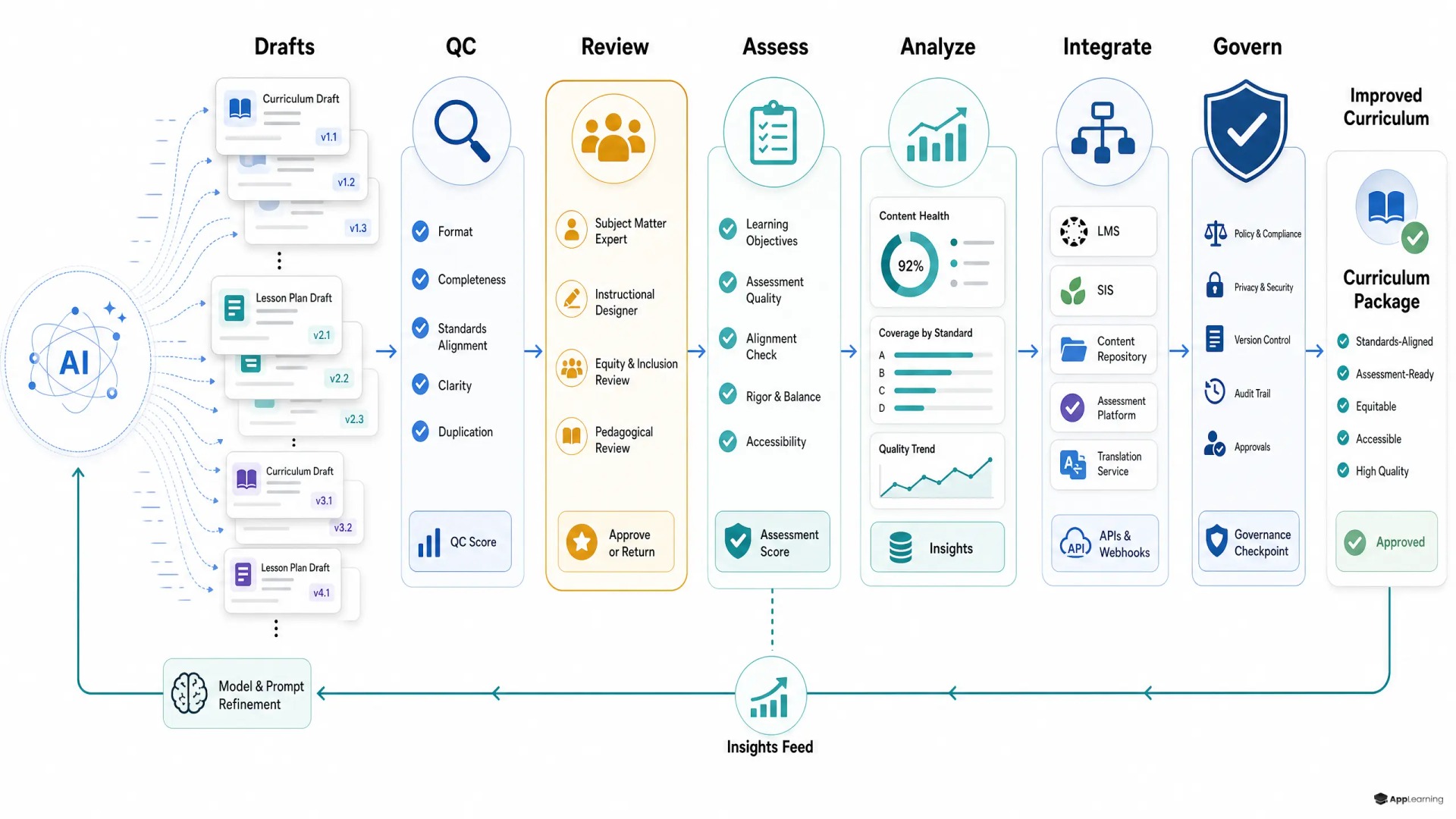
Learning operations means the full chain from knowledge capture to deployment. It includes ownership, versioning, review, assessment, analytics, integrations, reminders, completion rules, and improvement cycles. This is where AI course creation becomes useful in practice. The model creates raw material. The operating layer turns that material into something a team can trust.
Good to know
Does AI make course authoring tools obsolete?
No. AI lowers the cost of drafting. The remaining work is structuring, checking, approving, measuring, and improving learning over time.
What should a growing startup train first?
Start with onboarding, role-specific SOPs, customer stories, product knowledge, and manager expectations. These areas usually reduce ramp time fastest.
Where does App-Learning sit in the AI stack?
App-Learning sits after generation. It turns drafts and internal knowledge into structured microlearning with quizzes, review flows, analytics, and a branded academy.
The moat moves into quality control
Pearson’s 2025 results show the same direction from another angle. In its investor transcript, Pearson argued that its products are “not just learning content” but are integrated with learning management systems, student information systems, curricula, and assessments at course level through end-to-end learning workflows. That is the defensible pattern. The value moves from static libraries to trusted systems of record and improvement.
- Pedagogical QA that checks sequence, cognitive load, examples, and practice design
- Factual QA that keeps lessons aligned with current product, policy, and process knowledge
- Assessment design that measures application, not only completion
- Analytics that show ramp time, knowledge gaps, and team-level progress
- Integrations that place learning inside onboarding, HR, support, and knowledge workflows
- Governance that defines who can approve, edit, archive, and republish training
Governance is not an enterprise luxury. UNESCO’s guidance on generative AI in education emphasizes privacy, human accountability, and capacity building as core conditions for responsible use, not optional add-ons for later in its policy guidance. Fast-growing startups need the same discipline in lighter form. Someone must own the truth of the training system.
Build onboarding that scales without adding L&D overhead.
PlanApp-Learning fits after generation
App-Learning starts where the model stops. Raw AI output, founder notes, SOPs, sales playbooks, support macros, and product walkthroughs become structured microlearning paths. Teams can add quizzes, review drafts, track progress, and publish a branded academy without building an L&D department.
This matters because the bottleneck is no longer writing from zero. The bottleneck is getting from draft to deployed learning with enough structure that people use it, enough measurement that leaders trust it, and enough flexibility that it stays current as the company changes.
The next EdTech winners will not be the teams with the largest pile of generated lessons. They will be the teams that make learning reliable after generation. Content will keep getting cheaper. Operational trust will not.