

Key takeaways
- Faster change exposes slow learning operations, not only content gaps.
- Role-based delivery and update speed matter more than larger course catalogs.
- Readiness and application should sit above completion reporting.
- Regulated employers need speed without losing governance or evidence.
The bottleneck is execution speed
The July 2026 Fosway release, reported by Learning News, frames the problem plainly: L&D is struggling to cope with the pace of change. Expectations are rising. Budgets are under pressure. AI is changing the work itself. For finance and crypto employers, this is not an abstract trend. Product, risk, compliance, security, and customer operations all change faster than traditional training cycles can follow.
The old rules are being ripped up.
The first 2026 research cluster on the Learning Technologies hub covers L&D Strategy and Resourcing. That framing matters. The issue is not a lack of learning intent. It is the gap between strategic demand and operational capacity. A modern L&D strategy has to shorten the path from business change to employee readiness.
More content makes the queue longer
Course catalogs often grow when L&D feels pressure. That is understandable, but it rarely solves the real constraint. If the operating model is slow, every new module creates more review work, more targeting decisions, more outdated material, and more reporting noise. The team becomes a publisher of static assets, not an operator of readiness.
Fosway’s priorities data shows the shift. AI leads the 2026 priority list at 67%, followed by upskilling and reskilling at 58%, business transformation at 47%, and compliance and regulatory training at 35%. Compliance has not gone away. It has become the baseline. The differentiator is whether L&D can support capability growth while keeping that baseline intact.
Learning operations replaces course administration
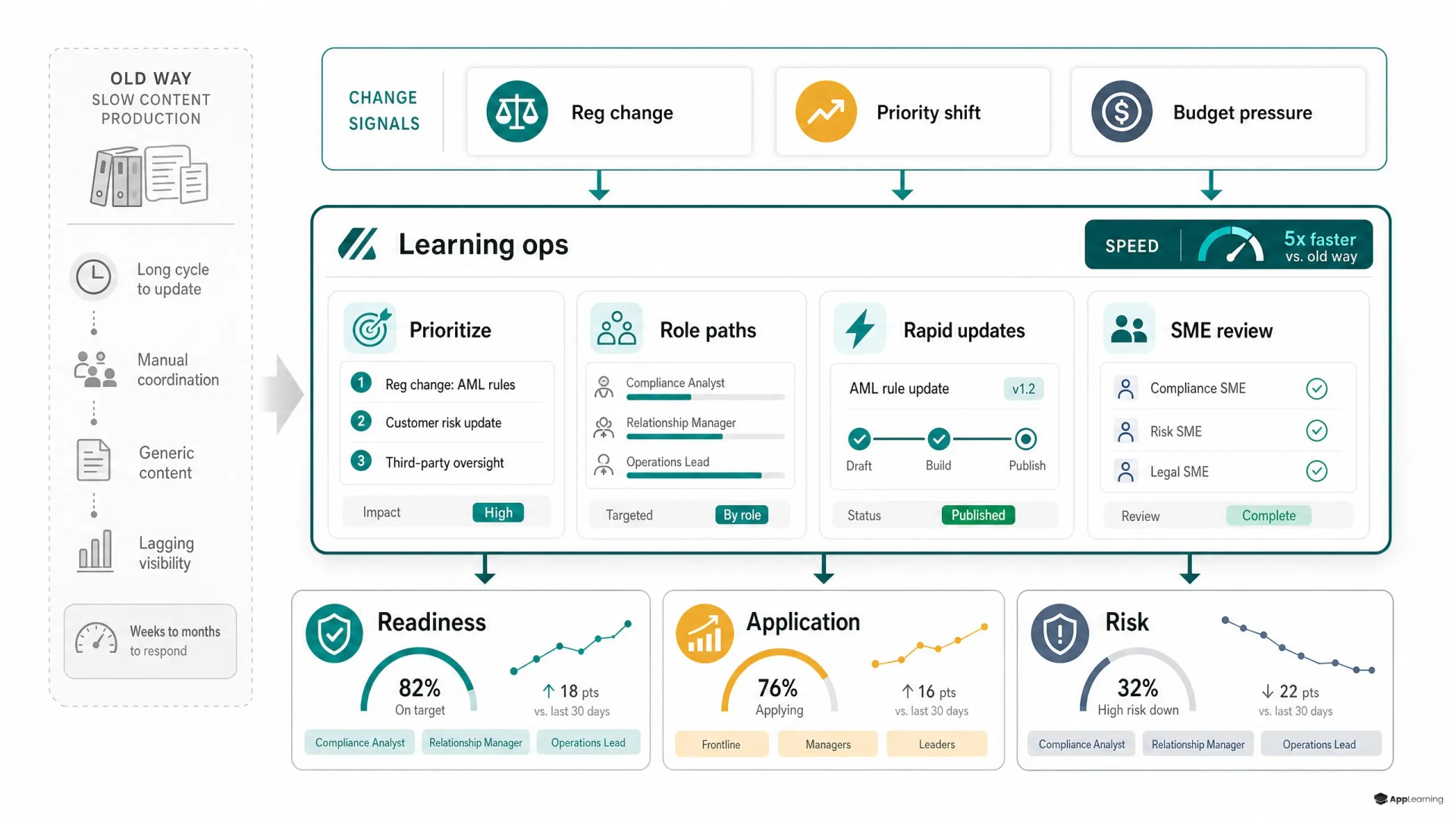
Learning operations is the system that turns business change into targeted learning, evidence, and improvement. It includes intake, prioritisation, role mapping, content governance, release management, reinforcement, analytics, and iteration. Course administration asks whether a course exists and who completed it. Learning operations asks which role must do what differently, by when, with what proof.
- Map learning to roles, permissions, risk exposure, and business processes.
- Separate core policy knowledge from role-specific application scenarios.
- Use short update cycles for fast-changing topics such as AI, fraud, sanctions, crypto risk, and product change.
- Measure confidence, judgement, readiness, and manager-observed application.
- Keep version history, approvals, and evidence clean enough for audit.
Regulated teams need controlled speed
Regulated employers cannot treat agile learning operations as uncontrolled speed. The point is the opposite. Fast systems need clearer ownership, tighter version control, and better evidence. A finance L&D lead should know which employees received which learning, which version they saw, what changed since the last release, and where application is still weak.
Fosway’s budget research says L&D budgets are under growing pressure, with one in four teams experiencing cuts in 2026. That makes operating design more important. Teams need fewer handoffs, less duplicate content, and clearer reuse. A slow governance model is expensive because every change becomes a small project.
Good to know
How should a finance L&D team start improving learning operations?
Start with one high-change area, such as onboarding, fraud prevention, AI use, product knowledge, or regulatory updates. Map the roles, define the required behaviours, remove duplicate content, and build a shorter release and measurement cycle around that journey.
Does faster learning conflict with compliance governance?
No. Faster learning operations should make governance stronger. The system needs clear owners, approval steps, version history, role targeting, evidence capture, and analytics that show readiness beyond completions.
What should replace completion reporting?
Completion data should remain, but it should not be the main signal. L&D teams should add role readiness, assessment quality, confidence, scenario performance, manager feedback, application evidence, and update adoption.
Platforms must shorten the release cycle
Technology helps when it reduces operational friction. It fails when it only adds another place to host files. The useful platform pattern is role-based, mobile, branded, measurable, and easy to update. For App-Learning work with regulated teams, the goal is not to replace every system. It is to create focused internal learning journeys that sit close to the employee and produce usable readiness data.
- Create role-based paths instead of one-size-fits-all assignments.
- Push short updates when policy, product, or process changes.
- Use quizzes, scenarios, and reflection to test judgement, not memory alone.
- Give HR, L&D, compliance, and business owners shared visibility.
- Feed analytics into improvement cycles instead of annual reporting decks.
This is also where adaptive learning systems become practical. Fosway’s future skills research shows L&D teams prioritising AI, analytics, personalisation, skills, and ecosystem connection. Those capabilities only matter if they change execution. The test is whether a team can release, target, measure, and improve learning faster than before.
Modernize internal learning without losing regulatory control.
DiscussFast learning is a governance choice
The next stage of L&D maturity is not a larger library. It is a faster operating model with stronger control. Finance and crypto companies need learning systems that can keep pace with regulatory change, product change, AI adoption, and shifting risk. The winners will not be the teams with the most content. They will be the teams that turn change into role-relevant action, measure readiness, and update the system before the next gap becomes visible.