

Key takeaways
- Bad learning analytics usually start before the dashboard.
- Test users and real learners need clean separation.
- User properties and event names shape future measurement.
- Privacy-aware reporting is part of professional LMS implementation.
Clean dashboards can still mislead
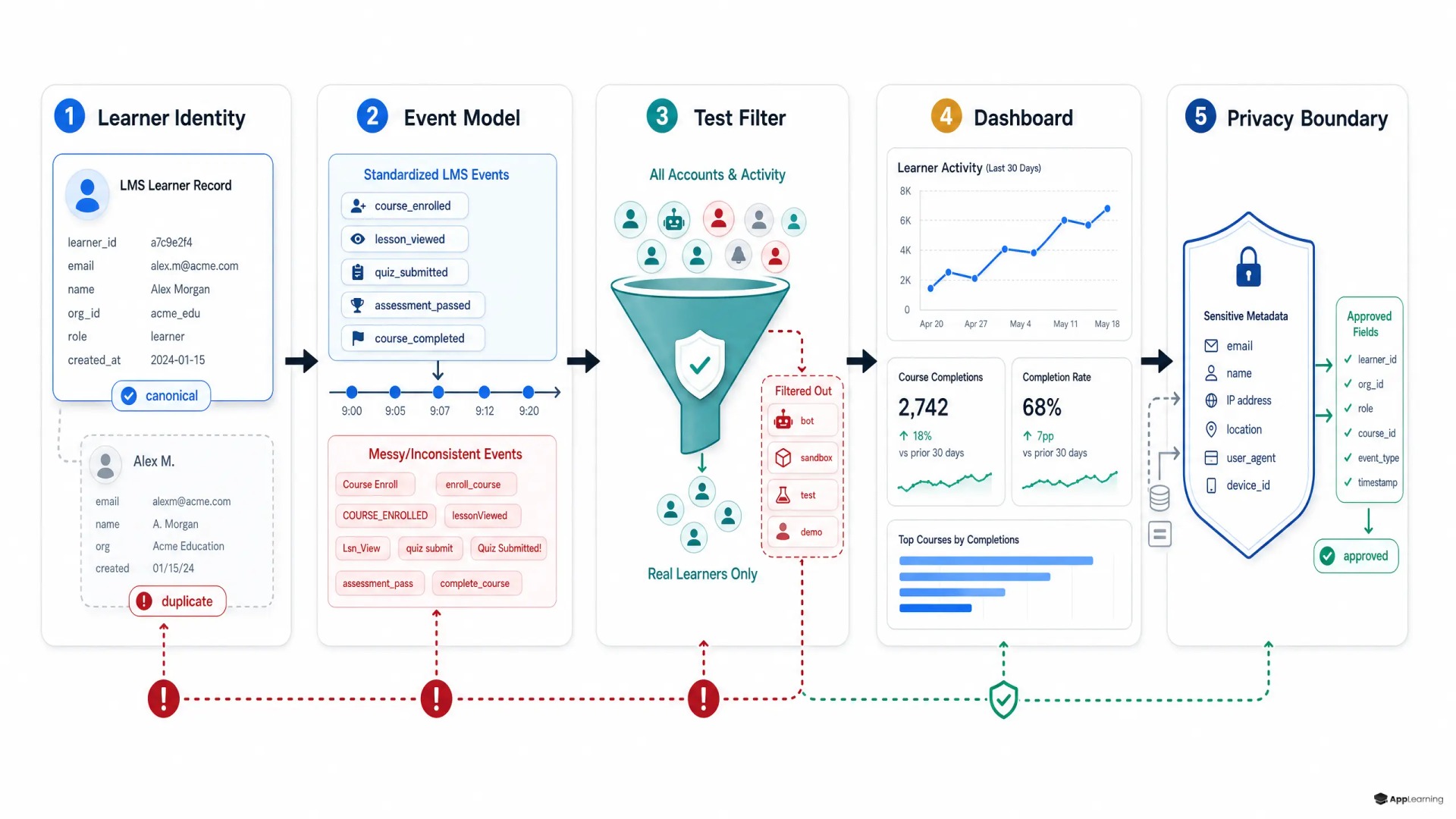
A training dashboard can look precise and still be wrong. Completion bars, cohort charts, quiz averages, and adoption curves all create confidence. But if test activity is mixed with real learner activity, if users appear twice under different identities, or if a renamed event breaks a filter, the dashboard reports theatre, not evidence.
Banks already know this problem from risk reporting. The Basel Committee’s risk data principles came from a hard lesson after the financial crisis, when many banks could not aggregate exposures fully, quickly, and accurately. Learning data is not risk data, but the operating principle is similar. Leaders can only act on reports when the underlying data model can be trusted.
The data model is the learning model
Every academy user tracking event makes a design choice. The LMS decides who acted, what happened, when it happened, which journey it belonged to, which content version was used, and which role or cohort should be attached to the record. Standards such as Caliper Analytics make this explicit by treating learning activity as structured data that can be passed to an aggregator or dashboard.
That learning analytics data model is not neutral. It defines what the bank can measure later. If the event taxonomy only tracks page views, the dashboard cannot explain skill confidence. If the user properties do not capture role, region, or business line consistently, the bank cannot compare readiness across relationship managers, operations teams, compliance, IT, and leadership.
- Identity rules for employees, external users, admins, and migrated accounts
- Event names for starts, completions, retries, assessments, streaks, and feedback
- Content versioning for updated modules, changed questions, and retired journeys
- User properties for role, cohort, entity, region, and reporting group
- Dashboard definitions for active learner, completion, pass, overdue, and confidence
Test activity is not harmless noise
In LMS implementation, the fastest way to corrupt a report is to let designers, product owners, compliance reviewers, and pilot users behave like production learners. Their clicks are useful for quality assurance. They are harmful inside adoption and effectiveness reporting.
A clean LMS data hygiene setup separates test users by design. That can mean a staging academy, durable test flags, separate client entities, or dashboard filters that exclude non-production activity by default. The important part is not the specific mechanism. The important part is that the separation survives content updates, user imports, single sign-on changes, and repeated review cycles.
Metadata sets the reporting boundary
Banks need role-based reporting, but they do not need unlimited employee profiling. A privacy-aware LMS starts with the reporting purpose and works backwards. European Commission guidance on GDPR processing principles links personal data use to purpose limitation, data minimisation, accuracy, storage limitation, and security safeguards.
That changes the analytics conversation. The question is not how much data the LMS can store. The question is which fields are necessary to run the academy, prove compliance readiness, target support, and show capability growth without creating unnecessary employee surveillance.
Good to know
Where should LMS data hygiene start?
Start with the reporting questions, then define identity rules, event names, user metadata, test-user logic, and dashboard definitions before the academy rollout.
How should test users be handled in learning analytics?
Give test users a separate environment or durable test flag, exclude them from production dashboards by default, and audit exceptions before executive reporting.
Which user metadata is useful in a banking LMS?
Use the minimum fields needed for decisions, such as role, business unit, cohort, region, entity, and required learning path.
Why does this matter for innovation programs?
Innovation leaders need to know which groups are ready for new tools and which groups need support, not only who clicked through a module.
Dashboard logic needs ownership
The dashboard is a policy surface. Someone must own the definitions. Does an active learner mean a login, a module start, or a meaningful learning event? Does completion require opening all screens, passing the final test, or acknowledging a policy? Are no-shows included in the denominator? Are reassignments counted once or many times?
These details sound small until an executive asks why AI training adoption dropped after a content update, why one business line shows weaker cybersecurity readiness, or why a mandatory course has more completions than assigned users. Bad definitions create debates about the dashboard. Good definitions create debates about the work.
Talk to us about a cleaner LMS analytics layer.
TalkAnalytics belongs in the LMS build
At App-Learning, we treat analytics as part of the LMS architecture, not a report added at the end. The technical layer includes identity logic, event dictionaries, metadata handling, test-user separation, dashboard filters, and content-version rules. This is less visible than the learner interface, but it decides whether the academy can support transformation at bank scale.
For a bank, the goal is not more data. It is cleaner evidence. Leaders need to see whether onboarding works, whether innovation programs reach the right roles, whether AI and automation learning creates readiness, and where support is needed next. Employees need a platform that tracks progress without turning every interaction into unnecessary monitoring.
The dashboard is the last mile. Trust starts earlier, in the structure of the learning system itself. Data hygiene is part of learning design because it decides which questions the LMS can answer, which answers leaders believe, and which interventions teams are willing to make.