

Key takeaways
- Branding is table stakes. Journey integration and analytics decide value.
- A useful platform supports activation, not just content hosting.
- Localization, modular publishing, and measurement belong in the buying decision.
- The best setup educates users without fragmenting the product experience.
The branding trap in platform selection
Many teams evaluate a white label learning platform as if the main risk is visual inconsistency. They compare logos, domains, colors, certificates, and UI themes. Those checks matter, but they do not solve the commercial problem. In a Bitcoin fintech, users usually hesitate because they do not yet understand wallets, keys, volatility, security steps, fees, recurring buys, or why the next product action is safe enough to take. A branded academy solves recognition. Activation needs timing, context, and proof of understanding.
Education belongs inside the activation path
If education drives activation, the evaluation should start with the product journey, not the LMS feature list. Google’s Play Console user journey checklist tells app teams to map key onboarding moments, analyze drop-off between steps, test onboarding flows, and personalize the experience around user needs. The same logic applies to Bitcoin products. A lesson about seed phrases is most useful before wallet setup. A short explanation of recurring buys is most useful when the user is considering a savings plan.
The user should not leave the app, search a help center, read a static article, and then remember where they were. A strong white label learning platform should support deep links, embedded modules, single sign-on, mobile-first layouts, and returns to the product action that triggered the learning moment.
The capabilities that decide commercial value
Gamification is useful only when it supports the behavior you need. A multilevel meta-analysis of gamified learning assessed how different combinations of game elements affect learning outcomes, which is a good warning against treating points and badges as universal fixes. For activation use cases, the platform should be judged on operational capabilities:
- Activation mapping between lessons, product steps, and user segments.
- Contextual delivery at moments such as KYC, first purchase, wallet setup, or feature discovery.
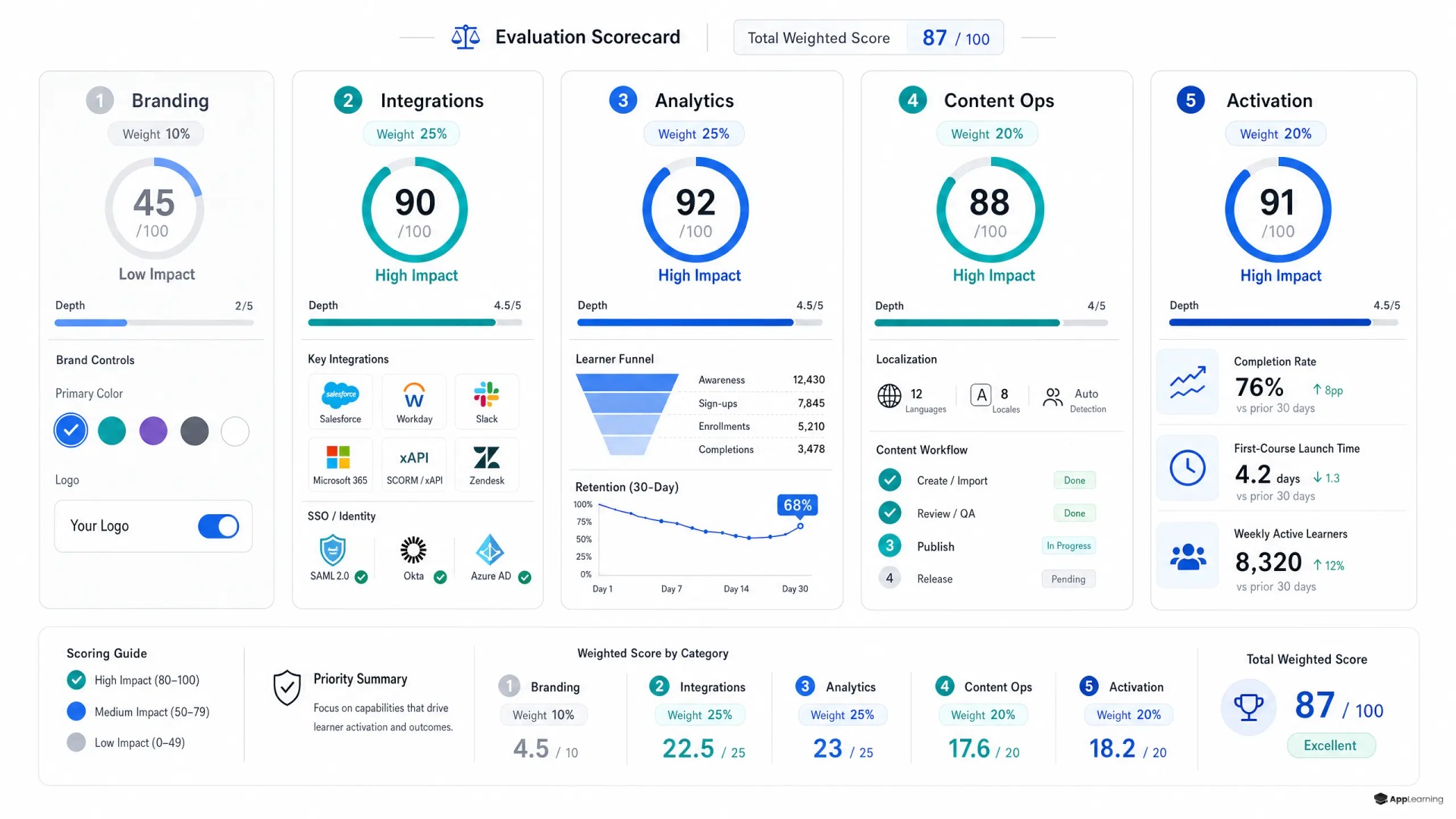
- Brand control across UI, certificates, tone, domains, and visual assets.
- Modular content that can be edited without rebuilding a whole course.
- Localization workflows for markets, languages, and regulatory wording.
- Quizzes that test comprehension before a risky or important action.
- Analytics on completion, drop-off, quiz performance, cohorts, and downstream product behavior.
Integration depth is the hidden buying criterion
Procurement often asks whether the platform can be white labelled. Fewer teams ask how learning data moves. That is where value is won or lost. The platform should expose events such as lesson started, quiz passed, module completed, reward claimed, and product CTA clicked. Standards matter here because learning records must travel between systems; ISO/IEC/IEEE 39274-1-1:2025 describes an xAPI-based JSON and REST model for communication between learning activities and a learning record store. Even if a vendor does not use that exact standard, buyers should expect clean event exports and API access.
Without this layer, product teams cannot compare learned users with non-learned users. They cannot see whether a beginner module improves first purchase conversion, whether wallet education reduces support tickets, or whether quiz failures predict later hesitation. The academy becomes a content shelf with nicer branding.
Content operations beat one-off course launches
Bitcoin education does not stay finished. Product copy changes. Wallet flows change. Scam patterns change. Regulatory language changes. New countries add new assumptions. A useful platform must let product, compliance, and content teams update small units, maintain a glossary, reuse modules, manage review, and publish localized versions without an engineering sprint.
This is where platform architecture becomes practical. In App-Learning’s Invity Academy case, the team launched an in-app React academy in under two months with 19 lessons, six quizzes, English and Czech content, certificates, illustrations, and product calls to action embedded into the learning flow. The important point is not the number of lessons. It is the operating model: education became part of the product experience instead of a separate marketing asset.
Good to know
What is a white label learning platform?
It is a learning platform that can be branded as your own academy or education layer. For activation use cases, it should also integrate with your product journey, analytics stack, content workflow, and user segmentation.
How should a Bitcoin company use a white label learning platform?
Use it to explain difficult concepts at the exact point where users hesitate. Good examples include wallet setup, first purchase, recurring buys, security checks, self-custody decisions, and advanced feature adoption.
Which analytics matter most for activation-focused education?
Track lesson completion, quiz accuracy, drop-off points, time to completion, product CTA clicks, cohort behavior after learning, and conversion into the activation event the lesson was designed to support.
Is branding still important?
Yes. Users must feel that the learning experience belongs to your product. But once trust and visual continuity are covered, integration depth and measurable behavior change matter more than cosmetic customization.
Better vendor questions
- Which activation event should each lesson support?
- Can a module open from a specific app state and return the user to that state?
- Which learning and product events can be exported?
- Can quiz results create user segments for lifecycle messaging?
- Can compliance review and localize content without developer support?
- How fast can one lesson be updated across all markets?
- Can we test content order, incentives, and calls to action?
- Does the experience work cleanly in mobile web and native app contexts?
Procurement mistakes that surface after launch
The most common mistake is buying admin features before defining the activation metric. The second is treating localization as translation, not market adaptation. The third is rewarding clicks instead of comprehension. The fourth is separating learning analytics from product analytics. The fifth is asking support to own the curriculum alone, even though product, compliance, growth, and trust teams all depend on the result.
These mistakes usually look harmless during vendor demos. They become expensive after launch, when the academy is live but disconnected from onboarding, the content is hard to maintain, and nobody can show whether learning changed user behavior.
Build a branded academy that helps Bitcoin users move with confidence.
TalkA practical standard for Bitcoin teams
At App-Learning, we treat white label education as a product layer. The system needs short lessons, quizzes, incentives, analytics, localization, brand control, and entry points inside the user journey. The goal is not academy traffic. The goal is to help a curious user understand the next safe action, complete it with confidence, and build enough conviction to return.
The right white label learning platform should almost disappear into the product. Users should feel guided, not redirected. Product teams should see which knowledge gaps block usage. Support teams should stop answering the same beginner questions every day. Branding is the baseline. The buying decision should be based on whether the platform makes education operational, measurable, and close to the moment of decision.