

Key takeaways
- Passing KYC does not mean onboarding is complete.
- Users still need confidence, context, and guidance after access.
- Embedded education helps users act while intent is still fresh.
- Activation metrics matter more than operational completion alone.
Compliance creates the gate, not the habit
Many crypto teams define onboarding by the parts they can operationalize. Account created. Email confirmed. Identity verified. Risk checks passed. Product unlocked. These steps matter. In regulated fintech, they are not optional. In the United States, FinCEN guidance treats many virtual currency administrators and exchangers as money transmitters, which makes compliance a core part of operating a crypto product.
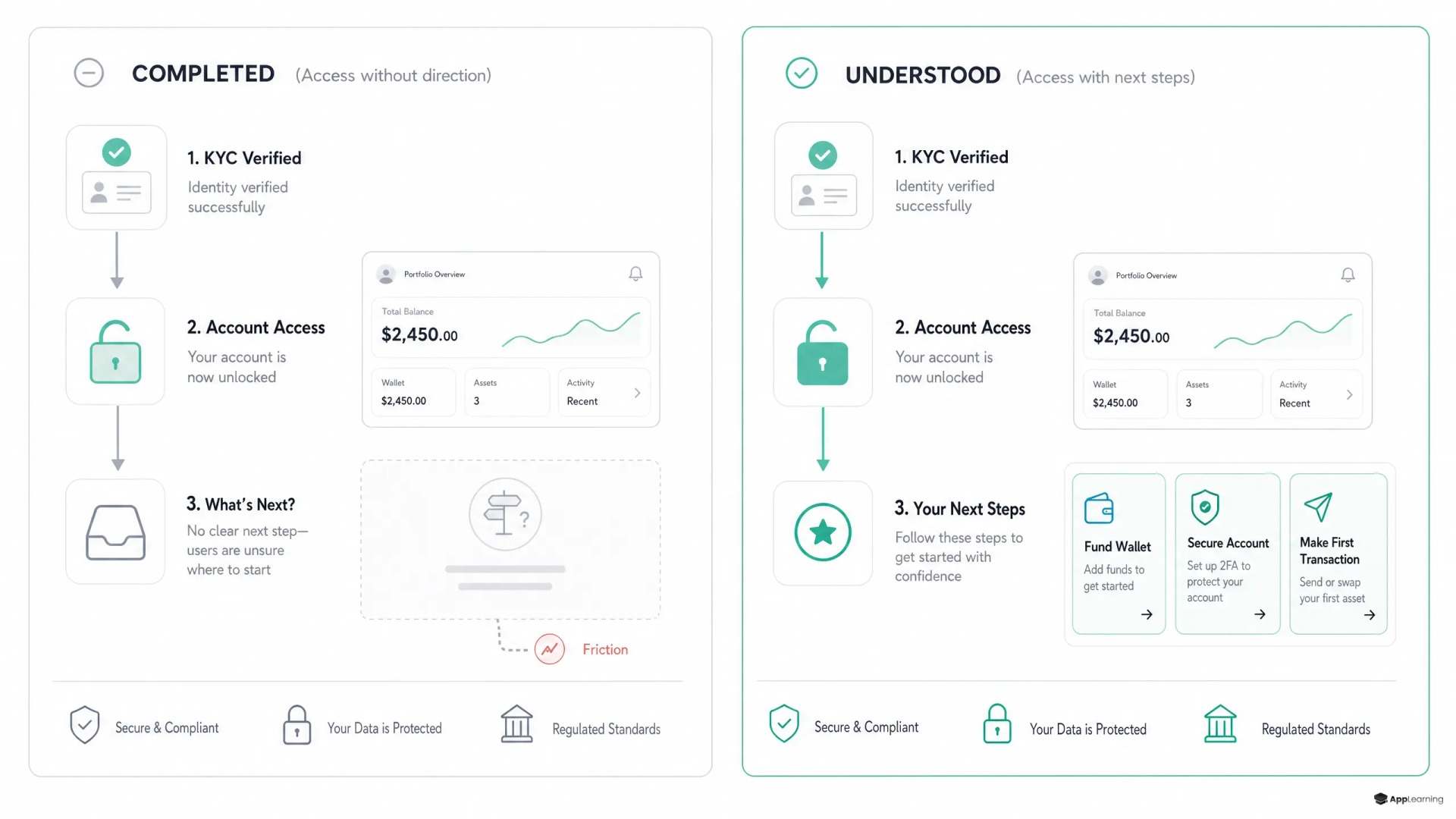
But compliance is not the same system as activation. KYC removes a barrier. It does not explain why a user should make a first purchase, how much risk they are taking, what a wallet address means, why fees change, or what happens if they send Bitcoin to the wrong place. Product access only gives the user the ability to act. It does not make the action feel safe, relevant, or understandable.
This is where crypto onboarding often breaks. The team sees a completed verification event and counts progress. The user sees a new interface full of unfamiliar consequences. Both views are true, but only one predicts whether the user will come back.
Access leaves the hardest decision untouched
A typical exchange or Bitcoin app journey already shows the split between operational readiness and user readiness. Coinbase's new customer guide walks users through account creation, identity verification, payment method setup, two-step verification, and then buying, selling, and trading crypto. That sequence is logical. It also makes the core issue visible. The user still has to decide what to do after the checklist ends.
For an experienced Bitcoiner, that next step may be obvious. For a mainstream user, it may not be. A first buy can raise basic but blocking questions. Is this an investment, a payment tool, or savings technology? What is the difference between holding Bitcoin in-app and withdrawing to a wallet? What is a seed phrase? Why does the app ask for more security steps after verification already succeeded? Why does a recurring buy matter if the user is not ready to invest today?
These are not edge cases. They are the normal questions of a user entering a high-consequence category. The friction is not only cognitive. It is emotional. Users hesitate when they feel that one wrong tap could cost them money, expose them to fraud, or make them look uninformed. In Bitcoin products, uncertainty behaves like friction even when the UI is clean.
The post-KYC moment needs a working path
The first product session after KYC should not be treated as a blank canvas. It should be treated as a decision environment. The product must reduce the distance between access and a confident first action. That does not mean adding a generic academy link in the footer. It means putting the right explanation beside the action it supports.
A new user often needs five things after signup, verification, and first app entry:
- A clear next action that fits their intent and knowledge level.
- A short explanation of the risk and benefit of that action.
- A safe practice step before money or self-custody is involved.
- A check that makes understanding visible before the user moves on.
- A reason to return after the first session.
The support surface of large crypto platforms shows how much happens after access. Kraken's support center organizes help around verification, funding, account security, cash deposits, crypto deposits and withdrawals, trading, cards, earn products, mobile apps, and account access. That structure reflects reality. Users do not stop needing guidance once identity checks pass. They need more specific guidance as soon as the product becomes usable.
For Bitcoin-focused products, this means the post-KYC flow should teach practical actions in context. Explain the first buy before the buy screen. Explain recurring buys when a user compares purchase frequencies. Explain wallet custody before withdrawal. Explain address checks before sending. Explain backup responsibility before self-custody. The product should not wait for confusion to become a support ticket.
Activation starts where operations stop
If a team only measures onboarding completion, it will optimize for the wrong finish line. KYC pass rate, time to verification, document retry rate, and account approval rate are important operational metrics. They tell you whether the gate works. They do not tell you whether the user became active.
Crypto onboarding needs a second layer of metrics that begins after access. Product teams should track the first meaningful action, not only the first permitted action. For a Bitcoin company, this may include first funded account, first buy, first recurring buy setup, first successful withdrawal, first wallet backup completed, first Lightning payment, or first use of a savings feature. The right activation event depends on the product promise, not on a generic funnel template.
The more useful view combines behavior and understanding. A user who completes KYC but never funds the account is not onboarded. A user who buys once but cannot explain custody risk may be fragile. A user who completes a short wallet lesson, passes a quick knowledge check, sets up a small recurring buy, and returns the next week is much closer to real activation.
This is also where education data becomes product data. Lesson starts, quiz accuracy, drop-off inside a concept, repeated glossary opens, and confidence checks can reveal where users hesitate before the event log shows abandonment. That data helps product, support, compliance, and content teams work from the same map.
Good to know
Is KYC part of crypto onboarding or separate from it?
KYC is part of crypto onboarding, but it is only the access and compliance part. A user can pass KYC and still not understand how to fund an account, buy Bitcoin, set up a recurring purchase, or use a wallet safely.
Why do verified users still fail to activate?
Verified users often fail to activate because the next product action still feels risky or unclear. They may not understand custody, fees, volatility, wallet addresses, recurring buys, or the difference between holding Bitcoin in-app and withdrawing it.
Where should education appear in a Bitcoin app?
Education should appear at the moment of action. A wallet lesson belongs near wallet setup, a fee explanation belongs near the transaction screen, and a custody explanation belongs before withdrawal or seed phrase backup.
Which metrics show whether crypto onboarding is really working?
Teams should measure post-KYC activation events such as first funding, first buy, first recurring buy, wallet setup, successful withdrawal, feature adoption, return usage, lesson completion, quiz accuracy, and support volume from beginner questions.
Education belongs inside the product loop
Most crypto education sits outside the flow. It lives in blog posts, help centers, webinars, PDF guides, YouTube videos, or long beginner courses. These assets can be useful, but they often arrive too early or too late. Too early, and the user lacks context. Too late, and the user already dropped off, made a support request, or formed a wrong mental model.
Embedded education works because it matches the moment. A short lesson before a wallet setup task. A tooltip that explains network fees when fees appear. A two-question check before self-custody withdrawal. A progress card that shows the user what they now know and what they can safely try next. Research on microlearning supports this operating logic; a 2024 systematic review and meta-analysis found that microlearning produced higher academic performance than macro-learning in the analyzed higher education studies.
Gamification can help, but only when it is tied to meaningful progress. Points, badges, streaks, rewards, and certificates should not decorate weak content. They should make effort visible, make the next step obvious, and turn learning into a repeatable habit. A systematic review in the International Journal of Game-Based Learning describes gamification as the use of game elements in nongame environments and shows how widely it has been applied across education settings.
For crypto products, the design principle is simple. Do not send users away to learn the thing they need in order to use the product. Teach the minimum useful concept at the point of action, test the concept quickly, then let the user do something real. Confidence grows when knowledge is connected to a safe action.
Build the learning layer your Bitcoin users need after KYC.
TalkThe learning layer becomes part of the operating system
A strong crypto onboarding system has three layers. The compliance layer decides who may enter. The product layer gives the user tools. The learning layer turns those tools into understandable actions. If one layer is missing, the system underperforms. Compliance without learning creates approved but inactive users. Product without learning creates feature exposure without conviction. Learning without product context creates content consumption without behavior.
At App-Learning, we see this most clearly in Bitcoin education. The Simple Bitcoin Academy example shows how short lessons, quizzes, visible progress, and small Bitcoin rewards can connect learning to doing. The important part is not the reward alone. It is the loop. Learn a concept. Answer a question. Try a safe action. See progress. Return with more confidence.
For crypto teams, this learning layer can be built into web and mobile journeys without turning the product into a school. App-Learning's platform supports branded learning academies with microcourses, quizzes, analytics, deep links, SSO, and web or mobile delivery, which makes it possible to place education close to the product moments that need it. That matters when internal product, compliance, and support teams do not have capacity to build and maintain full education systems across markets.
The strategic point is bigger than content production. Embedded education changes what onboarding means. It shifts the goal from verified access to confident use. It gives product teams a way to reduce hesitation before it becomes churn. It gives support teams fewer repeated beginner questions. It gives compliance teams a clearer path for risk communication. And it gives users what they actually need after KYC: not another screen to pass, but a clear reason and a safe way to move forward.
Crypto onboarding succeeds when the user can act with enough understanding to trust the next step. KYC and product access are necessary gates, but they are not the destination. The companies that win mainstream Bitcoin users will not be the ones that only approve accounts faster. They will be the ones that turn approval into comprehension, comprehension into action, and action into durable product habit.