

Key takeaways
- Activation slows when users reach uncertainty before they reach confidence.
- Education works best when it explains the next action, not the whole category.
- First value should be defined around meaningful product actions, not account creation.
- Contextual learning can reduce hesitation without becoming another onboarding step.
Hesitation is the real activation leak
Crypto activation does not usually fail because the button is missing. It fails because the user reaches a point where the next step feels larger than their current understanding. The app asks for a deposit, a first buy, a wallet setup, a backup phrase, a recurring purchase, or a transfer. The user pauses because the action feels irreversible, risky, or easy to misunderstand.
This is more than a UX issue. For many mainstream users, Bitcoin is a financial product, a technical system, and a trust decision at the same time. A normal fintech onboarding flow can explain identity checks, funding, and account access. A Bitcoin product also has to explain volatility, custody, transaction finality, wallet security, and the difference between owning exposure and controlling keys.
That risk perception is measurable. The FINRA Foundation’s 2024 investor survey found that two-thirds of crypto-aware investors view cryptocurrencies as very or extremely risky. A product team cannot remove that perception with a cleaner screen alone. It has to reduce the specific uncertainty that blocks the next action.
Access is not readiness
Many crypto products treat activation as a sequence of completed screens. Account created. Email verified. KYC submitted. Bank connected. First purchase offered. This measures access, not readiness. A user can pass every required step and still not feel ready to buy Bitcoin, set up a wallet, or enable recurring buys.
Readiness has a different structure. It depends on whether the user understands what the action does, what could go wrong, how to reverse or manage the decision, and why the product is asking for that step now. The FTC explains that cryptocurrency payments typically lack legal protections and are not usually reversible, which is exactly the kind of fact that raises the stakes of user hesitation. Good education does not hide this. It frames it clearly before the user acts.
This is where many standalone academies miss the moment. They contain useful material, but they sit outside the action path. A beginner may not know which lesson matters before a first buy. An experienced user may not want a full course before setting up a savings plan. The activation problem is not lack of content. It is poor timing.
First value starts with a chosen action
A Bitcoin company should define activation around the action that proves product value, not around the end of onboarding. For one product, that may be a first Bitcoin purchase. For another, it may be a funded savings plan, a completed wallet backup, a Lightning payment, a withdrawal test, or a security setup. Each action has a different learning burden.
This changes the product question. Instead of asking whether users saw the educational content, ask whether the content helped them complete the next meaningful action faster and with fewer support questions. The action should determine the learning unit.
- Before a first buy, explain price movement, fees, order confirmation, and the meaning of ownership in this product.
- Before a wallet setup, explain custody, recovery, seed phrase handling, and what the product can and cannot recover.
- Before recurring buys, explain habit, amount sizing, timing, and how to pause or change the plan.
- Before a withdrawal, explain address checks, network choice, finality, and small test transfers.
- Before advanced features, explain the user benefit and the risk boundary in plain language.
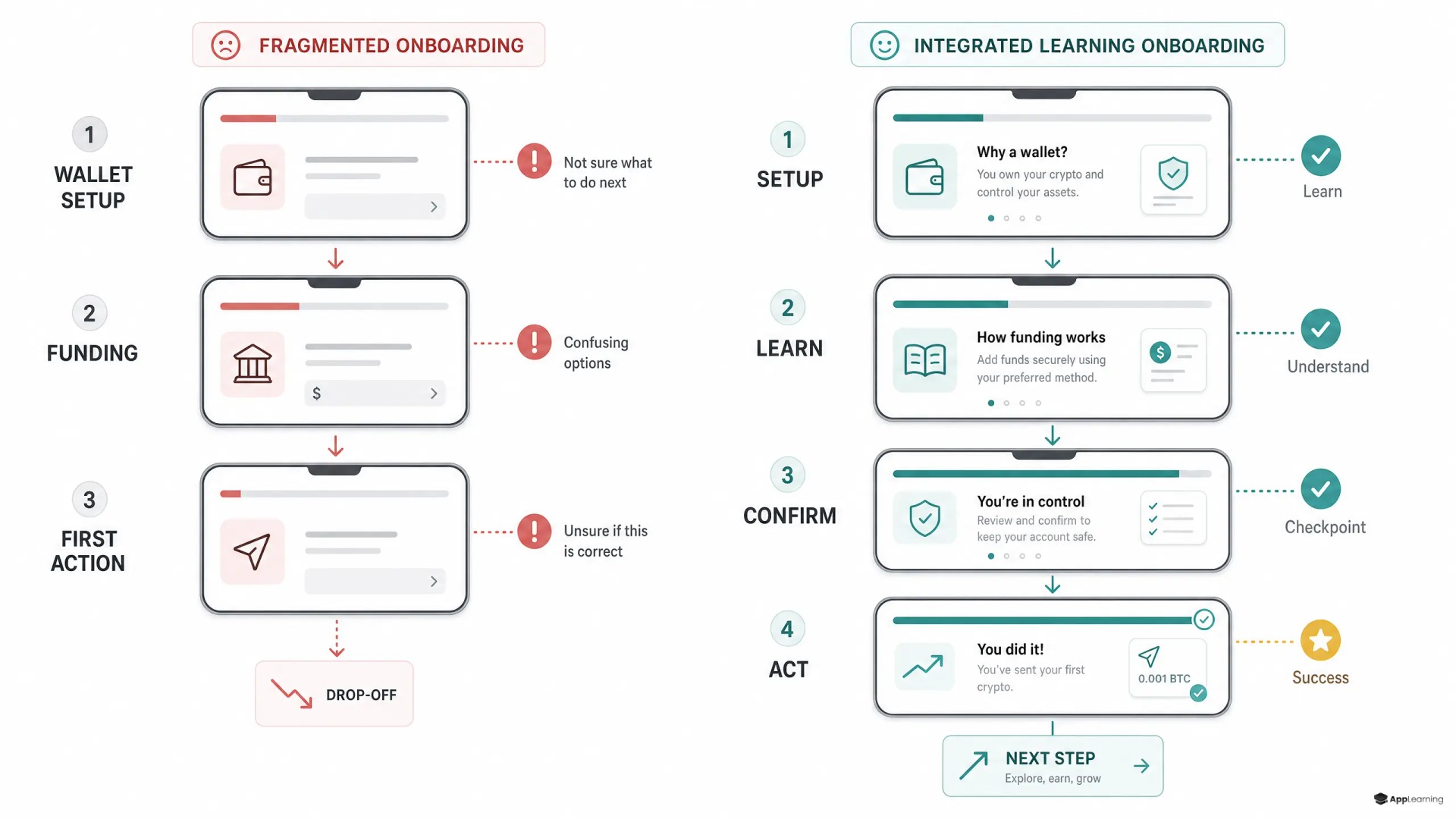
This is also why a crypto education platform should not behave like a library first. It should behave like an activation layer. The learning path should follow product intent, user knowledge, and friction signals.
Education belongs at the point of commitment
The strongest learning moments appear just before commitment. Not at the top of the funnel. Not after the user has already failed. Just before the action where uncertainty peaks.
Material Design frames onboarding around helping users take actions that increase engagement and retention in the first seven days, not around explaining every feature before the user starts. For Bitcoin products, this principle matters because education has to preserve momentum. If it becomes a gate, users skip it. If it appears too late, support has to clean up the confusion.
A useful education moment has four traits. It is short enough to finish now. It answers one decision. It uses the same language as the product screen. It ends with the action the user was already trying to take.
For example, a first-buy screen should not link to a ten-part Bitcoin course. It should answer the immediate doubt. What am I buying? What fees apply? Can I sell later? What happens after confirmation? A deeper course can exist, but it should not carry the burden of activation alone.
Good to know
Should crypto education be mandatory before a first purchase?
Usually not. Mandatory learning should be reserved for moments where risk, compliance, or user protection require proof of understanding. For most activation steps, optional contextual guidance is better because it supports action without turning education into another barrier.
Which activation events should Bitcoin teams prioritize first?
Start with the actions that prove core value and create future habit. Common examples are first Bitcoin purchase, bank funding, recurring buy setup, wallet backup, withdrawal test, and security setup.
How can teams tell whether embedded education is working?
Measure the behavior after the learning moment. Track completion, quiz accuracy, time to target action, drop-off at the next screen, repeat usage, support tickets, and retention by learning exposure.
Is a separate academy still useful?
Yes, but it should not be the only education layer. A standalone academy can build deeper conviction, while embedded lessons handle the specific doubts that block action inside the product journey.
Contextual learning must stay lighter than the action
Embedded education fails when it becomes another form to complete. The learning unit must be lighter than the hesitation it solves. In practice, that means micro-lessons, inline explainers, one-screen walkthroughs, short quizzes, examples, and optional detail layers.
The rule is simple. If the user came to take an action, learning should make the action feel safer and clearer. It should not redirect the user into a separate destination unless the action truly requires deeper understanding.
- Use tooltips for terms that block comprehension, not for every product label.
- Use one-minute lessons before high-stakes actions such as withdrawals or wallet backup.
- Use quizzes when proof of understanding matters for risk, compliance, or support prevention.
- Use progress and rewards to motivate learning paths that build conviction over time.
- Use behavior triggers to show guidance after hesitation, repeated errors, or feature discovery.
This approach also gives product teams better data. Instead of measuring page views on educational articles, teams can measure learning completion before a target action, quiz outcomes by segment, time from lesson to action, drop-off after a prompt, and support volume for the same topic. Education becomes part of the activation system.
Modular guidance makes education operational
Most fintech teams do not fail at education because they lack opinions. They fail because the work is operationally heavy. Content has to be accurate, localized, reviewed, compliant, visual, mobile-ready, and kept in sync with product changes. Internal product, growth, and compliance teams rarely have spare capacity for that cycle.
That is the practical case for modular in-product learning. App-Learning’s product layer combines short lessons, quizzes, certificates, gamified mechanics, and progress analytics so teams can build education around product journeys instead of maintaining static articles on the side. The goal is not to make every user study Bitcoin before using the product. The goal is to give each user the right learning step when hesitation would otherwise slow activation.
The model is already visible in live crypto education work. In the Invity Academy case, App-Learning describes an in-app academy delivered through React integration in less than two months, with bilingual lessons, quizzes, certificates, and contextual product calls to action. The important point is not the format alone. It is the connection between learning, product context, and the next action.
For a Bitcoin product lead, this creates a different roadmap conversation. Education is no longer a side project owned by content. It becomes a product capability with triggers, modules, analytics, localization, and iteration cycles. The team can start small with first buy, wallet backup, or recurring buys, then expand based on activation data and support patterns.
Turn Bitcoin learning into product momentum with App-Learning.
TalkFast activation comes from earned confidence
Crypto users do not activate faster because teams push them harder. They activate faster when the product removes the uncertainty that stands between curiosity and action. The fastest journey is not the shortest screen count. It is the clearest path to a meaningful step.
Education works when it respects that path. It should not delay every user with generic lessons. It should not hide important risk in legal text. It should meet the user at the moment of commitment, reduce the question in front of them, and return them to the product with more confidence than they had before. In Bitcoin, activation is not just conversion. It is the first sign that understanding, trust, and product value have started to compound.