

Key takeaways
- Customer education needs sequencing, timing, and context to change user behavior.
- Content alone is not a strategy if it is disconnected from the lifecycle journey.
- Different product stages require different education formats, depth, and proof points.
- Journey design connects education to activation, adoption, support, trust, and retention metrics.
Content can exist without changing behavior
Many customer education programs fail after the content work has been done. The videos are polished. The help center is full. The academy has courses. The onboarding emails are written. Still, users drop before they fund an account, complete KYC, make a first transaction, connect a wallet, configure rules, or understand why the product matters.
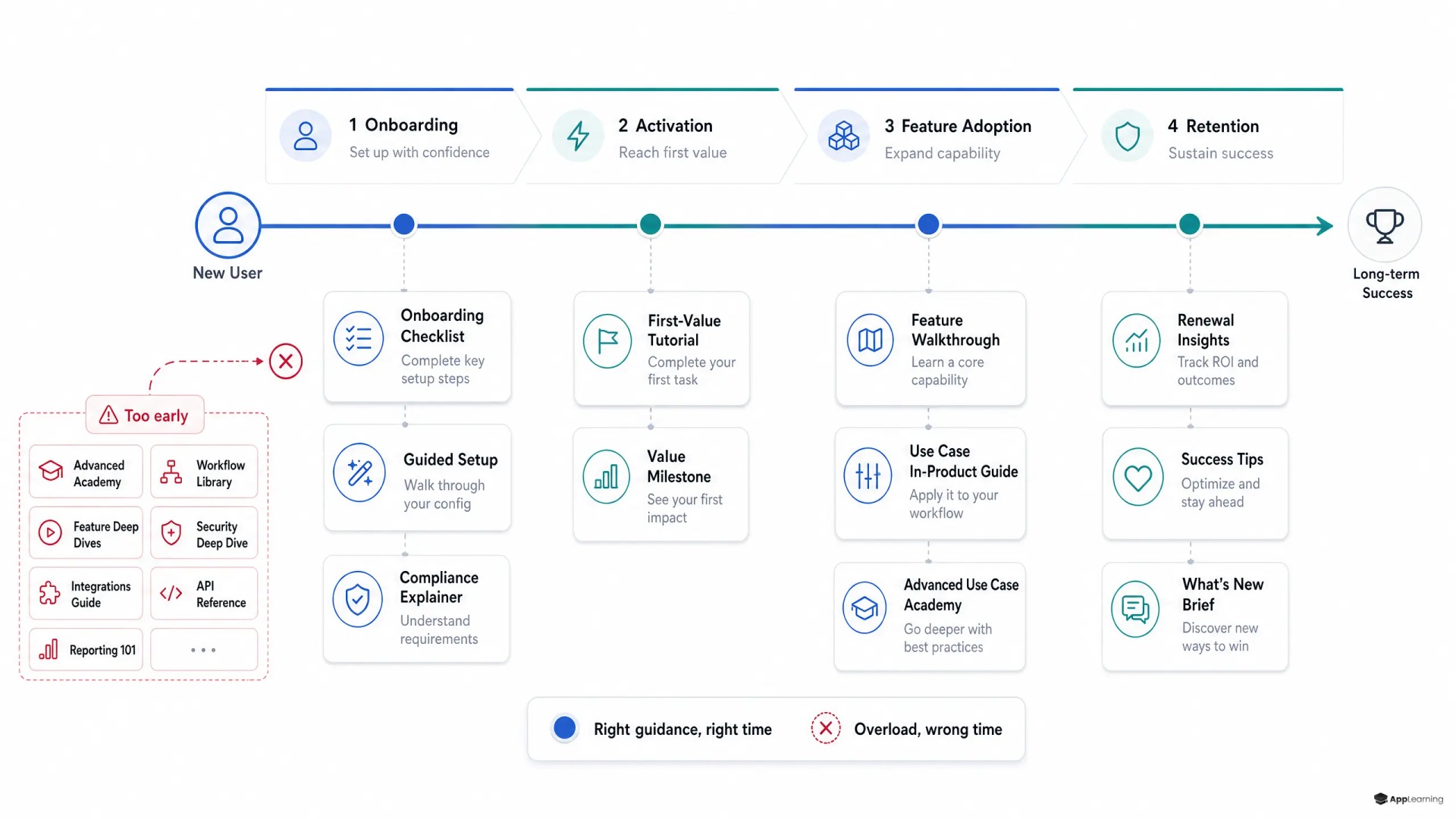
The problem is rarely only content quality. It is usually placement. A lesson that would be useful on day ten becomes noise on day one. A compliance explanation that should appear before a high-risk action sits in a generic course. A product tour explains ten features before the user has used one. The team has education assets, but not a customer education journey.
This matters more in fintech than in many other categories. Financial products ask users to act under uncertainty. They involve risk, regulation, identity checks, fees, limits, custody, tax implications, and trust. The G20 and OECD principles on financial consumer protection treat disclosure, transparency, responsible conduct, and financial education as connected parts of consumer protection. In product terms, that means education cannot live in a corner of the website. It must appear where decisions happen.
Journey design turns assets into a system
A journey-based education strategy starts with the path a customer actually takes. GOV.UK describes experience maps as a way to show what users do, think, and feel over time, from the moment they need a service until they stop using it. That framing is useful for customer education because it shifts the question from “What content should we publish?” to “Where does the user need help to move forward?”
A customer education journey maps the stages, triggers, questions, risks, and desired behaviors across the lifecycle. It connects product analytics, support themes, lifecycle messaging, content, and learning design. The output is not a bigger library. It is a sequence of guidance moments that reduce uncertainty and increase competent product use.
This is the difference between content creation and journey-based education. Content creation produces explainers, videos, webinars, articles, quizzes, and courses. Journey-based education decides when each format should appear, who should receive it, what behavior it should support, and how success will be measured. A customer education platform only becomes useful when it supports that logic.
Onboarding needs confidence before coverage
Onboarding is not the time to teach the whole product. It is the time to help a user complete the minimum path to trust and first value. In fintech, that path often includes identity verification, account setup, funding, risk acknowledgement, permissions, payment setup, or a first investment action. Each step can create anxiety if the user does not understand what is being asked, why it matters, and what happens next.
McKinsey has argued that banks lose value when they optimize isolated touchpoints instead of the full customer experience, including prospecting, sales, onboarding, and ongoing servicing. For a product or growth leader, the education implication is clear. The onboarding lesson should not be a generic welcome course. It should explain the next high-friction step in plain language and remove the specific doubt that blocks completion.
This is where sequencing matters. A new user may need a 30-second explainer before connecting a bank account, a tooltip before accepting a risk category, a checklist after verification, and a short scenario after funding. None of these moments needs to be large. They need to be timely, visible, and connected to the task.
Activation needs proof of value
Activation is where education must move from orientation to action. The user has entered the product, but has not yet formed a habit or seen enough value to return. Long-form education is often too heavy here. Better formats include guided tasks, short simulations, decision cards, contextual quizzes, calculators, embedded examples, and triggered micro-lessons.
Good activation education answers concrete user questions. What should I do first? What does this term mean in this context? What are the risks of this action? How will I know if it worked? What is the next useful step? Nielsen Norman Group’s guidance on help and documentation is blunt on this point: help should be easy to search, focused on the user’s task, concise, and shown in context when possible.
For a fintech team, this changes the operating model. Product, Growth, Lifecycle, CX, Compliance, and Content cannot each own separate fragments. The activation journey needs one shared map. Each education moment needs an owner, a trigger, a target segment, a success metric, and a maintenance rhythm. Without that, the user experiences the organization chart instead of the product.
Adoption needs depth after the first win
Once the user has reached first value, the education job changes again. The goal is no longer basic completion. It is competent, repeated, and expanded use. Users may need to understand advanced features, compare options, manage risk, interpret data, invite team members, set alerts, read statements, or recover from edge cases.
This is where a branded academy can help, but only if it is connected to product behavior. A course on portfolio basics should not be sent to every user at the same time. It should be offered when the user shows intent, reaches a threshold, explores a related feature, or asks support a recurring question. Coinbase, for example, describes its education surface as serving first-time and experienced crypto users with beginner guides, tutorials, market updates, and learning rewards. The principle is not the reward mechanic. The principle is matching depth to readiness.
Ongoing adoption also requires different formats. Microlearning supports repeated exposure. Scenario-based modules help users practice decisions before they make them with real money. Certificates may work for partners or professional users. Short refreshers help when rules, fees, markets, or product flows change. The education layer becomes part of lifecycle management, not a one-off onboarding project.
The same failure modes appear again and again
Customer education without journey design tends to fail in predictable ways. The symptoms are easy to miss because each team can still point to completed work. The content team shipped the guides. Product shipped the tour. Lifecycle sent the emails. Support updated the FAQ. Yet the user still fails to activate.
- Education is front-loaded before the user has context.
- The same content is sent to all users regardless of intent or maturity.
- The academy is disconnected from product events and lifecycle triggers.
- Support questions are not converted into better in-product guidance.
- Compliance explanations are written for approval, not user comprehension.
- Learning success is measured by completion instead of product behavior.
- Content ownership is unclear after launch, so lessons decay as the product changes.
These are not content problems in isolation. They are system design problems. A team can produce more content and still make the experience worse if the content increases cognitive load at the wrong moment.
Good to know
What is a customer education journey?
A customer education journey is the planned sequence of learning moments that supports users across onboarding, activation, adoption, and retention. It connects education content to real product stages, user questions, behavior triggers, and business metrics.
Why does customer education fail when the content is good?
Good content can fail when it appears too early, too late, or outside the user’s actual task. Users need guidance when they are making a decision or facing friction, not only when they visit an academy or help center.
What should fintech teams teach during onboarding?
Fintech onboarding education should focus on trust, clarity, and first value. It should explain identity checks, fees, risk terms, funding steps, security, permissions, and the next action needed to complete activation.
How should teams measure journey-based education?
Teams should measure both learning behavior and product behavior. Completion and quiz scores matter, but the stronger proof is improvement in activation, time to first value, support reduction, feature adoption, repeat use, and retention.
Measurement changes when education follows the journey
Journey design makes customer education more measurable because each learning moment is tied to a product behavior. Instead of asking whether users watched a video, the team can ask whether the lesson improved the next step. Did more users complete verification after the KYC explainer? Did fewer users contact support after the fee module? Did funded users return more often after the first-use guide? Did advanced users adopt the feature after the scenario course?
A practical measurement model separates learning metrics from business metrics. Learning metrics show whether the education experience works. Business metrics show whether it changes product outcomes. Both are needed.
- Learning metrics include starts, completions, quiz scores, drop-off points, replays, and confidence checks.
- Product metrics include activation rate, time to first value, feature adoption, funded accounts, transaction completion, and repeat use.
- Support metrics include ticket volume, contact reasons, deflection, resolution time, and escalation rate.
- Trust metrics include consent completion, risk acknowledgement comprehension, complaint themes, and user confidence signals.
This is also where App-Learning fits. App-Learning is built around microcourses, learning paths, quizzes, gamified mechanics, branded academies, analytics, and deep links into specific lessons or modules. For fintech teams, the relevant point is not having another content repository. It is being able to turn complex product and financial knowledge into short, structured learning moments that can sit inside onboarding and lifecycle flows.
Build customer education around the moments that drive activation.
PlanEducation becomes part of the product
The strongest customer education systems do not ask users to leave their journey to become educated. They bring the right explanation, practice, and reinforcement into the journey itself. They respect timing. They use depth carefully. They reduce uncertainty before key decisions. They turn support patterns into product guidance. They give teams a shared operating model for activation, adoption, trust, and retention.
Customer education fails without journey design because users do not experience products as content libraries. They experience a sequence of decisions, doubts, risks, and small wins. If education does not follow that sequence, it becomes background material. If it does, it becomes a growth lever that helps customers understand the product, use it safely, and keep returning because the value is finally clear.