

Key takeaways
- Static content works for reference, not always for confidence-building decisions.
- Guided education fits high-risk moments where users need sequence and reinforcement.
- Bitcoin products need education around trust, custody, volatility, and first actions.
- A financial education platform measures progress, not only content consumption.
Reference content solves retrieval
Static content is useful. A help center is the right tool when a user has a known question: withdrawal limits, account verification, transaction status, fee rules, password reset, tax documents. It is searchable, cheap to maintain, and good for support deflection.
It starts to fail when the user does not know which question to ask. That is common in financial products. A beginner may not only ask how to buy Bitcoin. They may wonder whether now is the right moment, what custody means, why the price moves, whether recurring buys make sense, and what happens if they send funds to the wrong address. One article can answer one question. It cannot build the whole decision path.
Bitcoin decisions carry more than information cost
Complex financial products create hesitation because the user sees risk before they see competence. Crypto makes this sharper. The OECD links crypto-asset vulnerability to high price volatility, limited consumer protection in some contexts, and low digital financial literacy. That is not a content gap alone. It is a confidence gap.
Awareness also does not equal readiness. In the FCA’s 2025 UK cryptoasset research, general public awareness of cryptoassets remained at 91%, while trust and regulation still shaped willingness to invest. For a product lead, this means top-of-funnel curiosity can look healthy while onboarding, first purchase, wallet setup, and retention stay weak.
Education wins at moments of hesitation
Guided financial education outperforms static content when the product decision needs order. The user must understand the concept, see the consequence, test their understanding, and then act. This is where customer financial education should sit inside the product journey, not in a separate blog archive.
- Before first purchase, explain volatility, fees, time horizon, and irreversibility.
- Before wallet setup, explain custody, recovery, and responsibility in plain language.
- Before recurring buys, explain habit formation without implying guaranteed outcomes.
- Before withdrawals, explain address checks, network selection, and transaction finality.
- After abandoned onboarding, explain the blocker and the next safe step.
The shift is from answer retrieval to guided progression. A passive article says, read this if you want. A learning path says, start here, prove you understood, then continue.
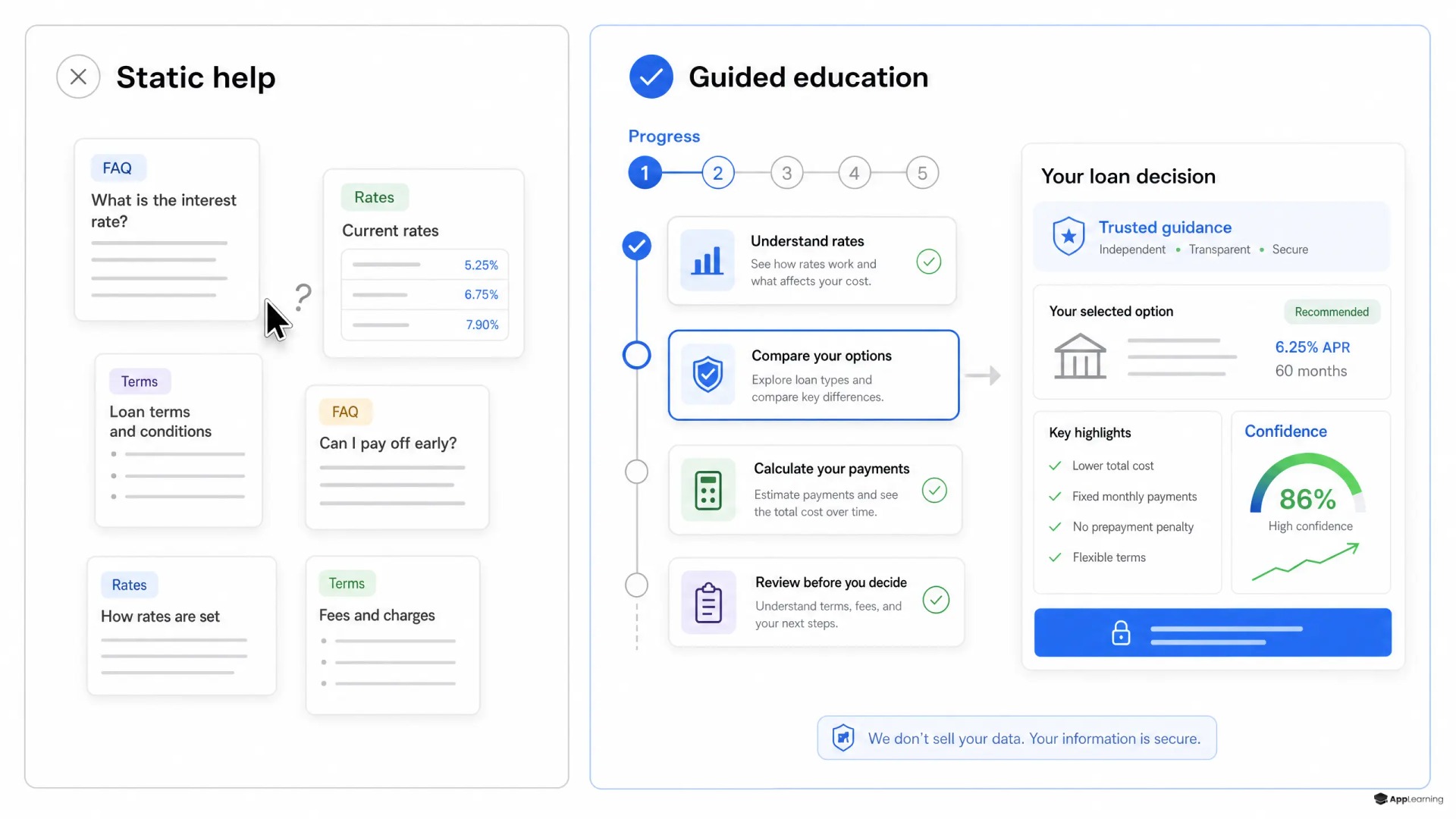
Structured learning turns trust into product behavior
Trust improves when the product shows structure. A clear path reduces cognitive load. Short lessons reduce avoidance. Quizzes expose misconceptions before money moves. Progress markers show the user that competence is building. This matters because financial confidence is not created by content volume. It is created by repeated, low-risk interactions that make the next action feel understandable.
For Bitcoin companies, the strongest education moments are close to behavior. Teach custody next to wallet creation. Teach recurring buys next to savings plan setup. Teach scams and recovery phrases before a security-sensitive action. Teach volatility before the first buy, not after the user panics during the first drawdown.
Good to know
When is static content enough for financial education?
Static content is enough when the user has a specific question, the risk is low, and the answer does not require sequencing or reinforcement.
When should a Bitcoin company use guided education?
Use guided education around onboarding, first purchase, wallet setup, recurring buys, withdrawals, security actions, and any moment where confusion blocks action.
Does an education platform replace the help center?
No. The help center remains the reference layer. The education platform adds guided progress, quizzes, context, and analytics.
What should a financial education platform measure?
It should measure lesson completion, quiz results, drop-off points, knowledge gaps, activation after learning, and feature adoption by learner segment.
A platform changes the operating model
The static content vs education platform decision is operational. A knowledge base publishes information and waits for search intent. A financial education platform defines learning goals, segments users by knowledge level, triggers modules in context, tests comprehension, localizes content, and measures progress over time.
This changes the work for product and growth teams. Education becomes a system with curriculum, UX, analytics, and maintenance. App-Learning’s platform is built around role-aligned learning paths, completion tracking, assessments, quizzes, short lessons, and gamified mechanics. The same system logic applies to customer education: teach the right concept at the point where understanding changes behavior.
Customer education belongs inside the product
The Invity case shows the practical version. App-Learning delivered an in-app Bitcoin academy in eight weeks with 19 lessons, 6 quizzes, bilingual content, certificates, and contextual product calls to action. The important part is not the number of lessons. It is the placement. Users could learn key concepts without leaving the product environment.
That is where App-Learning fits for Bitcoin teams that need more than static support content. We turn complex product knowledge into guided micro-learning that can live inside onboarding, feature adoption, security education, and retention flows. Internal teams keep focus on product, compliance, and growth while the education layer becomes scalable.
Build Bitcoin education into the user journey.
DemoThe better system
Static content remains the library. It should be accurate, searchable, and easy to maintain. But high-friction financial moments need more than a library. They need a path. When users must build trust, understand risk, and make a product decision with confidence, financial education outperforms static content because it supports progress, not just information access.