

Key takeaways
- Generic help rarely matches the exact product moment.
- AI product education still needs structured learning design.
- Microlearning works best when tied to real user actions.
- Product adoption improves when education and usage data connect.
The help center is not the learning system
Generic help content still has a role. Users need searchable reference material, legal explanations, FAQs, and edge-case troubleshooting. But a help center is usually built around topics. A user is built around intent. That gap matters when someone is trying to activate an account, connect a wallet, make a first deposit, configure permissions, or understand risk before acting.
The problem is sharper in fintech. Digital financial products can create real exposure when users misunderstand security, spending, fees, liquidity, or product mechanics. The OECD notes that digital payments bring convenience but also security risks and reduced control over spending. In that context, education is not a support asset. It is part of the product’s trust architecture.
Personalization moves education into the product moment
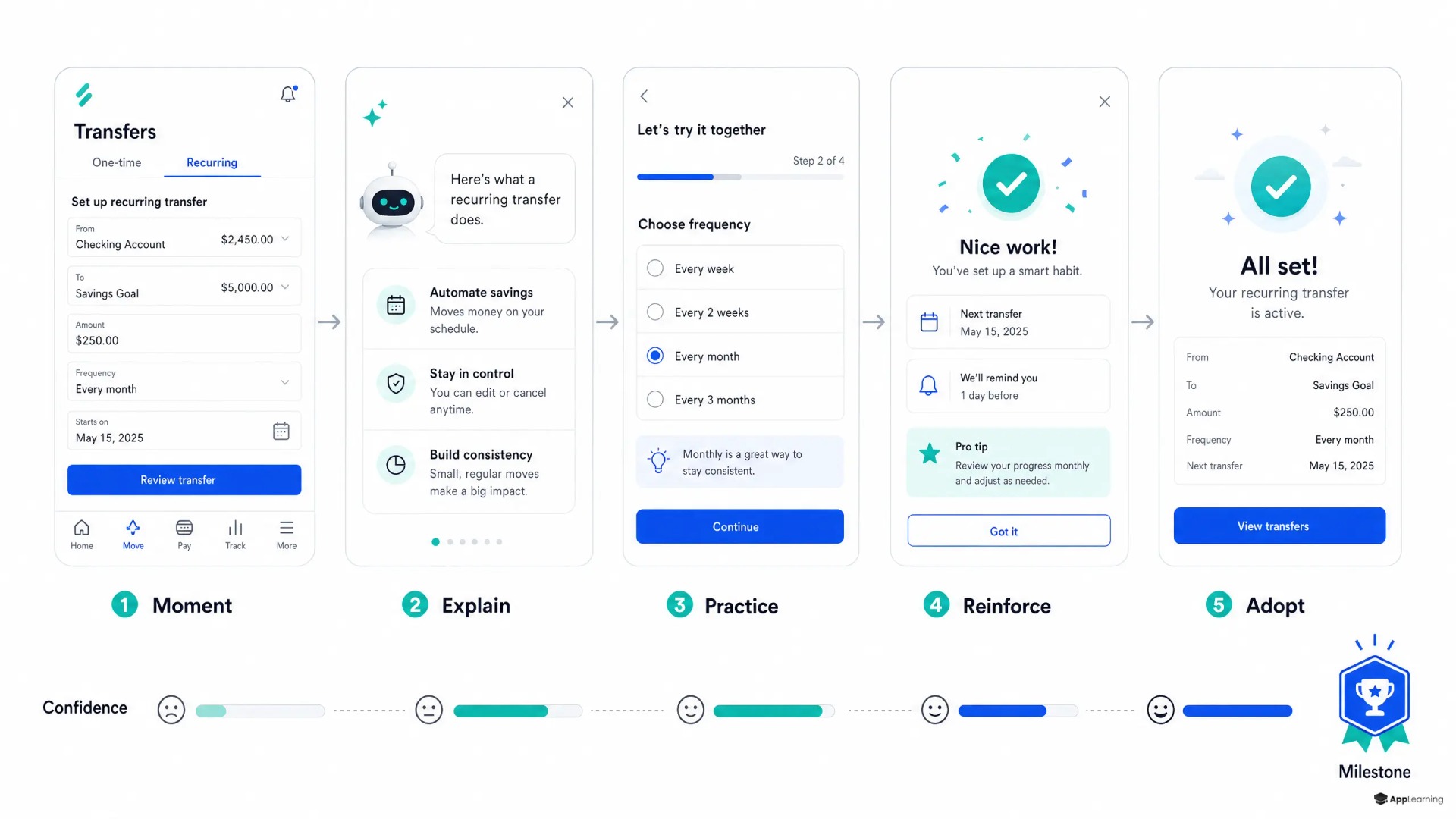
Personalized product education changes the unit of delivery. Instead of sending every user to the same article, the system asks what the user is trying to do, what they already know, where they are in the journey, and what confidence they need before the next action. Nielsen Norman Group’s usability guidance treats help as strongest when it is provided in context at the moment the user requires it.
That does not mean more pop-ups. It means better matching. A beginner may need a plain-language concept. A power user may need a constraint, exception, or advanced setting. A high-risk action may need a short explanation and a confirmation check. A repeated failed attempt may need diagnosis, not another tour.
The teachable moments arrive before action
The highest-value education moments are usually predictable. They appear before a user commits value, changes settings, enters regulated flows, or touches a feature that has strong downstream effects. Teams should map these moments like product events, not content topics.
- First value moments where the user must understand the benefit before continuing
- Risk moments such as deposits, withdrawals, leverage, approvals, or irreversible actions
- Configuration moments where one wrong setting creates later support demand
- Expansion moments where adoption depends on understanding a new feature
- Recovery moments where the user has failed, paused, or contacted support
AI needs a learning design layer
AI product education can make guidance more adaptive, but only if it runs on a controlled learning system. AI should retrieve approved content, select the right lesson, adjust the explanation level, and trigger a short practice step. It should not invent policy, fees, risk statements, or product behaviour. NIST’s generative AI profile is a useful reminder that teams need risk management actions for generative AI, especially when users rely on output to make decisions.
Microlearning provides the operating format. One screen can explain the concept. One interaction can show the action. One quiz can check understanding. One follow-up can reinforce the behaviour later. This matters because retrieval practice is a learning event, not just an assessment, and Carnegie Mellon’s teaching guidance summarizes evidence that recall tasks improve longer-term retention.
Good to know
Does personalized product education replace the help center?
No. The help center remains useful for reference and compliance. Personalized education handles the product moments where users need timely explanation, practice, or reinforcement.
Where should a fintech team start?
Start with the moments where users hesitate before value or risk. Map the action, the knowledge gap, the required confidence, and the metric that should improve.
What role should AI play?
AI should route, adapt, and summarize approved learning content. It should not become an uncontrolled source of product, legal, or financial guidance.
Adoption metrics must connect learning and usage
A customer education platform should not be judged by completions alone. The useful question is whether education changes product behaviour. Teams should connect learning events with activation, first successful action, time to value, feature adoption, repeat usage, support tickets, escalation rates, and retention by cohort.
This creates a better operating loop. Product sees where users hesitate. Growth sees which learning paths improve conversion. CX sees which explanations reduce repeat tickets. Content teams see which lessons fail. Education stops being a library and becomes a measurable part of the product system.
Map your highest-friction product moments into teachable steps.
PlanStatic help gives way to operated education
App-Learning fits this shift by turning complex product knowledge into branded microcourses, quizzes, learning paths, analytics, and embedded access points. Its platform supports customer education and product training across web and mobile, with deep links, embeds, SSO, progress data, and gamified mechanics that make learning easier to place inside real journeys.
The replacement of generic help will not happen because AI writes more answers. It will happen because product teams stop treating education as a library and start operating it as part of the product. In complex fintech, that shift is not cosmetic. It changes when users understand value, when they feel safe enough to act, and which behaviours become measurable enough to improve.