
Key takeaways
- Support content often arrives too late to save hesitation moments.
- Users rarely know the right search query while they are stuck.
- Contextual product education keeps users moving inside the workflow.
- Complex fintech journeys need guidance built into the product experience.
Help arrives after intent has already weakened
Users do not usually pause because the product has no value. They pause because the next action has weight. In fintech, that action might mean uploading an ID, linking a bank account, confirming source of funds, accepting a risk disclosure, approving a transfer, or choosing an investment setting. The user is not just confused. They are assessing trust, cost, privacy, risk, and consequence.
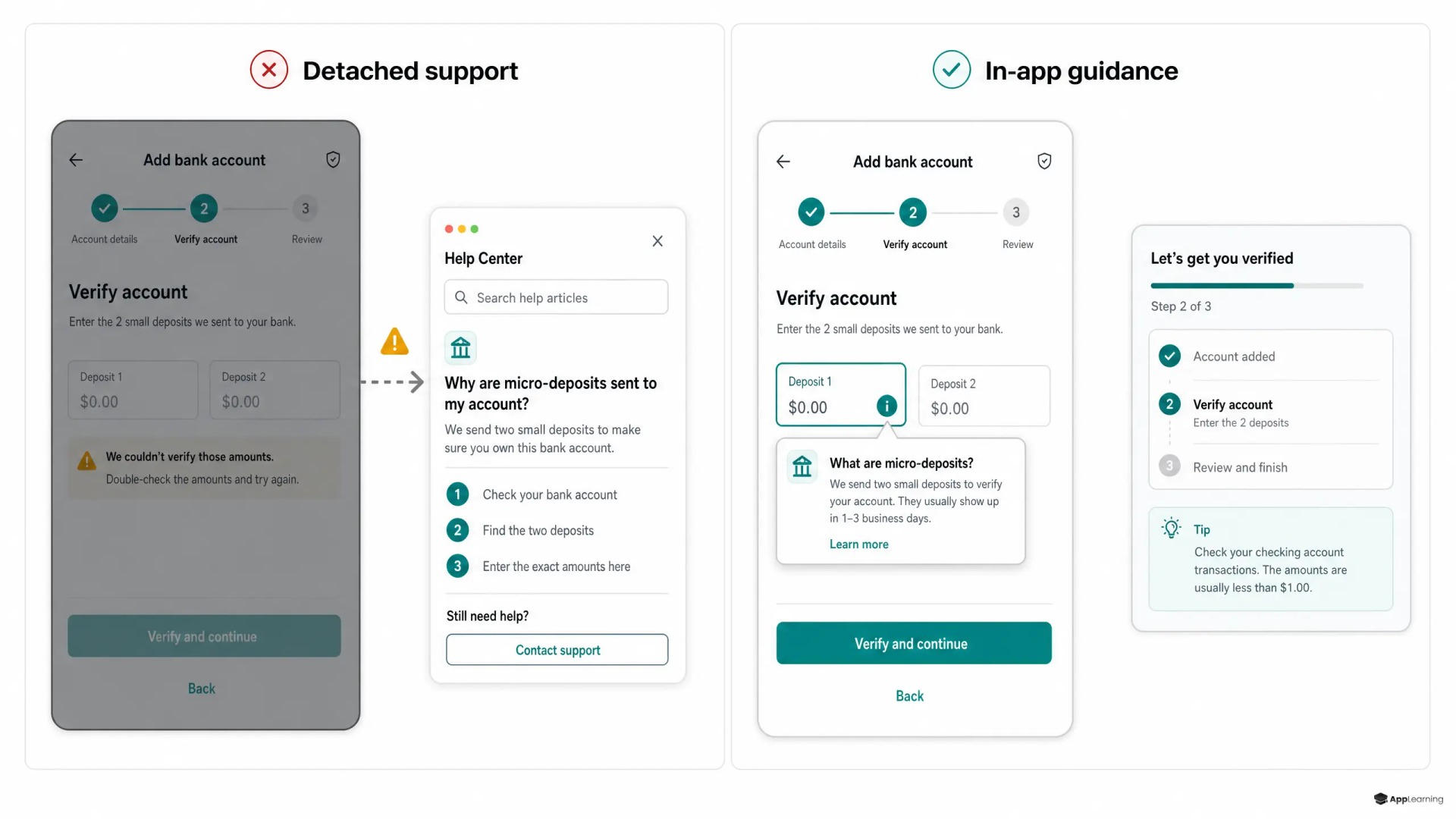
This is where static support content breaks. The help center assumes the user can name the problem, leave the screen, search with the right phrase, interpret an article, and return without losing confidence. At a high-friction moment, every extra step competes with completion. Product education has to live where the decision happens.
This is not a new usability principle. NN/g’s help and documentation heuristic says help should be focused on the user’s task and, where possible, presented in context at the moment the user needs it. The principle is simple. A user who is trying to continue should not be forced into a separate research task.
The help center model is structurally late
Help centers, documentation pages, and FAQ libraries are useful repositories. They are poor rescue systems. They are organized for storage, support deflection, and search. Product friction is organized by state, timing, emotion, and consequence.
A static article can explain what “source of funds” means. It cannot see that a user has already completed six onboarding steps, hesitated for 38 seconds on one field, failed one document upload, and is now deciding whether the product is worth the effort. The article may be accurate. It is still too far from the action.
- It waits for the user to decide that they need help.
- It turns a product problem into a search problem.
- It uses article structure instead of journey state.
- It cannot react to the current field, error, segment, or user risk level.
- It moves ownership from Product to CX after the moment has already failed.
That does not make help centers obsolete. It makes them the wrong first line of support for activation-critical steps. They should remain as reference layers, audit-friendly explanations, and fallback material. But they should not carry the burden of helping users through the moments that decide conversion, trust, and retention.
Fintech friction carries more weight
Fintech journeys fail faster because the user cannot separate product friction from personal risk. A delayed ecommerce checkout is annoying. A delayed identity check can feel suspicious. A failed card verification can feel like rejection. A crypto transfer warning can trigger fear of irreversible loss. A risk questionnaire can make the user worry that one wrong answer will lock them out.
Regulation adds necessary complexity. In the United States, FinCEN’s Customer Due Diligence rule clarifies due-diligence requirements for covered financial institutions, while the European Banking Authority’s remote onboarding guidelines set expectations for remote customer onboarding under AML/CFT and data protection rules. These obligations create real product work, but users often experience that work as unexplained questions, repeated uploads, waiting states, or vague errors.
The business cost is visible. Fenergo’s 2025 survey of 600 financial-services decision-makers found that 70% of financial institutions lost clients in the past year because of slow onboarding. That is not only an operations problem. It is a product education problem when users do not understand why the friction exists, what is expected, and how to move forward.
Context turns support into continuation
Better support starts from the action, not the channel. The product already knows where the user is, what they are trying to do, and which step carries the most risk. That state should trigger the right explanation before the user exits the flow.
A source-of-funds field does not need a long AML lesson. It needs a short explanation of why the question appears now, what counts as a valid answer, how the information is used, and what happens next. A wallet transfer confirmation does not need a generic crypto safety article. It needs a clear reminder about network fees, address accuracy, finality, and the user’s next safe action.
Public service design has understood this pattern for years. GOV.UK Forms guidance says teams should explain anything that is not obvious with hint text or guidance attached to the question. The lesson for fintech teams is operational. If a user needs explanation to complete a task, the explanation belongs inside the task.
- Trigger help at the step where friction appears.
- Explain the consequence in plain language.
- Show examples of acceptable inputs or decisions.
- Offer a deeper learning path without forcing a context switch.
- Return the user to the task with progress preserved.
Product education needs a content system
In-app education is not a layer of random tooltips. It is a system for turning product complexity into timely understanding. The system needs a content model, triggers, review ownership, analytics, and a feedback loop from support tickets and funnel data.
This changes team behavior. Product defines the moments that need education. Growth measures activation, completion, and return rates. CX brings the language users use when they get stuck. Compliance reviews regulated explanations before launch. Content turns expert material into short, usable guidance. Engineering exposes the events and surfaces that make the guidance contextual.
- Which journey moments are worth teaching.
- Which user states should trigger guidance.
- Which format fits the moment, from hint text to micro-lesson.
- Who owns accuracy, updates, and approval.
- Which metric proves the education worked.
The key shift is ownership. If a high-friction step drives drop-off, the answer is not only a better article or a larger support team. The answer is a product requirement. The user must understand enough to continue before the product asks them to commit.
Good to know
Should fintech teams remove the help center?
No. Help centers are still useful for reference, audit-friendly explanations, and long-form support. They should not be the primary rescue mechanism for activation-critical product moments.
Where should contextual product education start?
Start where drop-off, support tickets, and user hesitation concentrate. Common fintech examples include KYC, bank linking, risk disclosures, first transactions, failed verification, wallet transfers, and re-verification.
Who should own in-app product education?
Product should own the moment and the metric. Content should own clarity. Compliance should review regulated language. CX should feed in user objections. Growth should test impact on activation and retention.
How is this different from tooltips?
Tooltips usually label interface elements. Product education explains meaning, consequence, and next action. It can include hint text, embedded lessons, quizzes, decision support, and deeper learning paths.
Learning inside the journey
For fintech teams, the practical model is a connected education layer. Some explanations are small and local. Others need richer treatment, especially when the product depends on concepts users do not already understand, such as ETF mechanics, fraud prevention, wallet custody, tax events, chargebacks, staking risk, or portfolio rebalancing.
This is where App-Learning fits. The App-Learning platform supports short lessons, quizzes, learning paths, analytics, deep links, embeds, and SSO for internal and external education, according to its platform overview. For fintech teams, the important point is not to create another destination. It is to create a reusable product education engine that can be launched from onboarding, lifecycle messages, support surfaces, and in-product friction points.
A team might use the same learning system to teach a new user before their first investment, explain document requirements during KYC, prepare a customer before re-verification, or train support teams on the same concepts users see in the app. That alignment matters. When Product, Growth, CX, Compliance, and Content use the same educational building blocks, the user hears one clear explanation instead of five fragmented ones.
Put learning where users hesitate.
TalkThe support metric that matters is saved momentum
Support content often fails for a simple reason. It is separated from the moment it is meant to save. The article may be correct. The help center may be searchable. The FAQ may be complete. But if the user has to abandon the workflow to understand the workflow, the product has already added friction to friction.
The better model is not louder support. It is contextual product education. Teach the user enough to continue at the point of hesitation. Keep the explanation close to the action. Preserve state. Reduce uncertainty before it becomes abandonment. In complex fintech products, the strongest support experience is the one that helps users move forward without feeling like they ever left.