

Key takeaways
- AI customer onboarding works best when it supports understanding, not only Q&A.
- Complex fintech products need confidence-building before users take consequential actions.
- Structured microlearning keeps AI tutor onboarding relevant, safe, and measurable.
- User activation should measure confidence and quality, not only completed steps.
Navigation is not the hard part
Most onboarding tools solve for movement. They point to the next button, push a checklist, and reduce the number of clicks between signup and setup. That helps in simple products. It is not enough in fintech, crypto, insurance, trading, lending, or any product where the user must understand a concept before they trust the action.
The hard part is not always finding the screen. It is knowing whether the action is safe, relevant, reversible, compliant, or worth the effort. A user may abandon KYC, funding, wallet connection, or first investment setup because the product feels unclear, not because the interface is broken. NN/g’s work on onboarding tutorials and contextual help makes the same operational point: help works better when it appears in context, at the moment the user needs it.
The tutor belongs near the decision
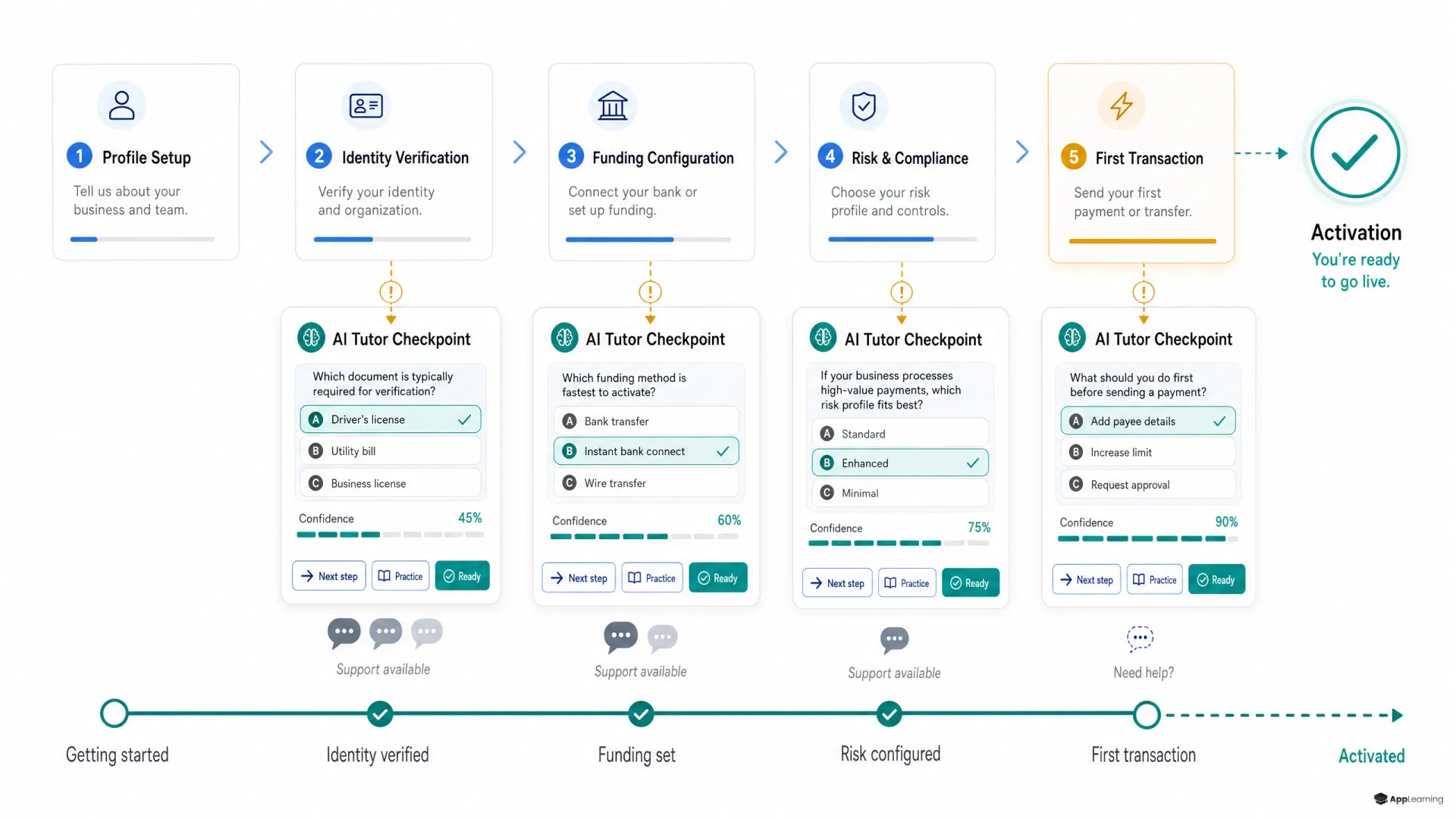
AI tutor onboarding is useful when the tutor sits close to the activation moment. It should explain the next step in plain language, ask one diagnostic question, give a short example, and let the user practice a decision before committing. That is different from adding an open chat box to the product and hoping users ask the right questions.
A good AI tutor can reduce hesitation in three ways. It can translate product language into user language. It can connect an action to the user’s goal. It can surface the risk or trade-off that the user needs to understand before moving forward. The U.S. Department of Education’s report on AI and the future of teaching and learning is useful beyond schools because it frames AI as a system that detects patterns and automates decisions. In onboarding, that means teams must design the learning goal first, then decide what the AI should and should not do.
Recent education research also points in this direction. A 2025 Scientific Reports randomized controlled trial on AI tutoring in an authentic learning setting found stronger learning outcomes when the tutor was designed around pedagogical best practices, not treated as a generic chatbot. For customer onboarding education, the lesson is simple: the tutor needs structure.
Microlearning gives the tutor a spine
Structured microlearning keeps AI customer onboarding focused. Each activation barrier becomes a small learning object: one concept, one example, one decision, one check for understanding. The tutor can then guide the user through the right object instead of improvising from a vague prompt.
This matters because onboarding is not a content library. It is a sequence of user states. A user who has not funded an account needs a different explanation than a user who funded but has not made a first allocation. A user exploring leverage needs different guardrails than a user comparing savings products. An Institute of Education Sciences practice guide on organizing instruction and study supports principles that translate well here: spacing, examples, quizzes, and explanatory questions help learners build usable knowledge.
The best moments are high-friction and consequential
AI tutor onboarding should not appear everywhere. It should be reserved for moments where misunderstanding blocks user activation or creates downstream risk. In a fintech product, those moments often include identity verification, bank connection, wallet setup, deposit flows, first transaction, recurring plans, risk settings, fees, limits, fraud warnings, tax context, and recovery procedures.
The tutor’s job is not to persuade the user to continue at any cost. It is to help the user understand enough to make a good next move. That distinction matters. If onboarding optimizes only for completion, it can push users into actions they later regret or reverse. If it optimizes for confident activation, it creates better early behavior and fewer avoidable support cases.
Good to know
How can AI tutors improve customer onboarding in fintech products?
They can explain complex steps in context, answer user-specific questions, and help users practice decisions before actions like funding, trading, connecting accounts, or changing risk settings.
Why combine AI tutor onboarding with microlearning?
Microlearning gives the AI tutor a clear curriculum. It keeps guidance short, relevant, measurable, and aligned with the onboarding goal instead of becoming open-ended chat.
Which onboarding metrics matter most?
Track step completion, confidence, lesson performance, support load, activation quality, repeat use, and whether educated users complete key actions with fewer errors or reversals.
Where should teams avoid using AI tutors?
Avoid using them for vague persuasion, regulated advice without controls, or moments where a simple product fix would remove the need for explanation.
Activation quality beats step completion
Teams should measure AI tutor onboarding as a learning system, not as a widget. The basic dashboard should show where users learn, where they hesitate, and whether education changes behavior.
- Step completion for core onboarding flows
- Confidence before and after high-friction actions
- Quiz or scenario performance inside micro-lessons
- Support tickets linked to educated versus uneducated users
- Activation quality such as funded accounts, first successful use, repeat use, and fewer reversals
This creates a better operating rhythm for Product, Growth, Lifecycle, Content, and CX. Product sees the friction points. Growth sees which education paths improve activation. CX sees which explanations reduce repetitive tickets. Content teams stop producing disconnected help articles and start maintaining onboarding education as part of the product system.
Build onboarding that teaches before it asks.
TalkEducation becomes part of the product system
This is where App-Learning fits. The platform is built around microcourses, quizzes, gamified learning, branded academies, learner analytics, and product-connected access through deep links or embeds. App-Learning’s microlearning platform helps teams turn source material into short, structured learning paths that can support onboarding, compliance, product education, and customer education at scale.
For a fintech team, that means the AI tutor does not need to carry the whole education burden. It can route users into the right micro-lesson, explain a term in context, check confidence, and bring them back to the product flow. The academy holds the curriculum. The tutor provides the moment-of-need guidance. Analytics connect both to user activation.
AI tutors will not fix weak onboarding by themselves. They improve onboarding when they are tied to clear learning goals, real product friction, structured microlearning, and metrics that reward informed action. The goal is not to make users move faster through a funnel. The goal is to help them understand enough to activate with confidence.