

Key takeaways
- Academy offboarding is a product requirement, not only a contract event.
- Content ownership and exportability should be clear before launch.
- Learner access, reporting data and hosting need explicit transition rules.
- A clean exit reduces LMS vendor lock-in and makes managed delivery easier to trust.
The launch bias leaves a lifecycle gap
Founders rightly assess an LMS on setup speed, learner experience and the effort needed to keep onboarding current. But an academy is not only a launch project. It can be paused, retired, handed to another team or moved to a new delivery model. If those outcomes were never designed, LMS offboarding becomes an improvised operations project at the worst possible time.
This matters most in growing companies. A lean team cannot afford to reconstruct course files, untangle learner records and answer access questions while also managing a vendor change or academy shutdown. The managed academy lifecycle needs an exit path as deliberate as the implementation plan.
Five connected decisions shape the shutdown
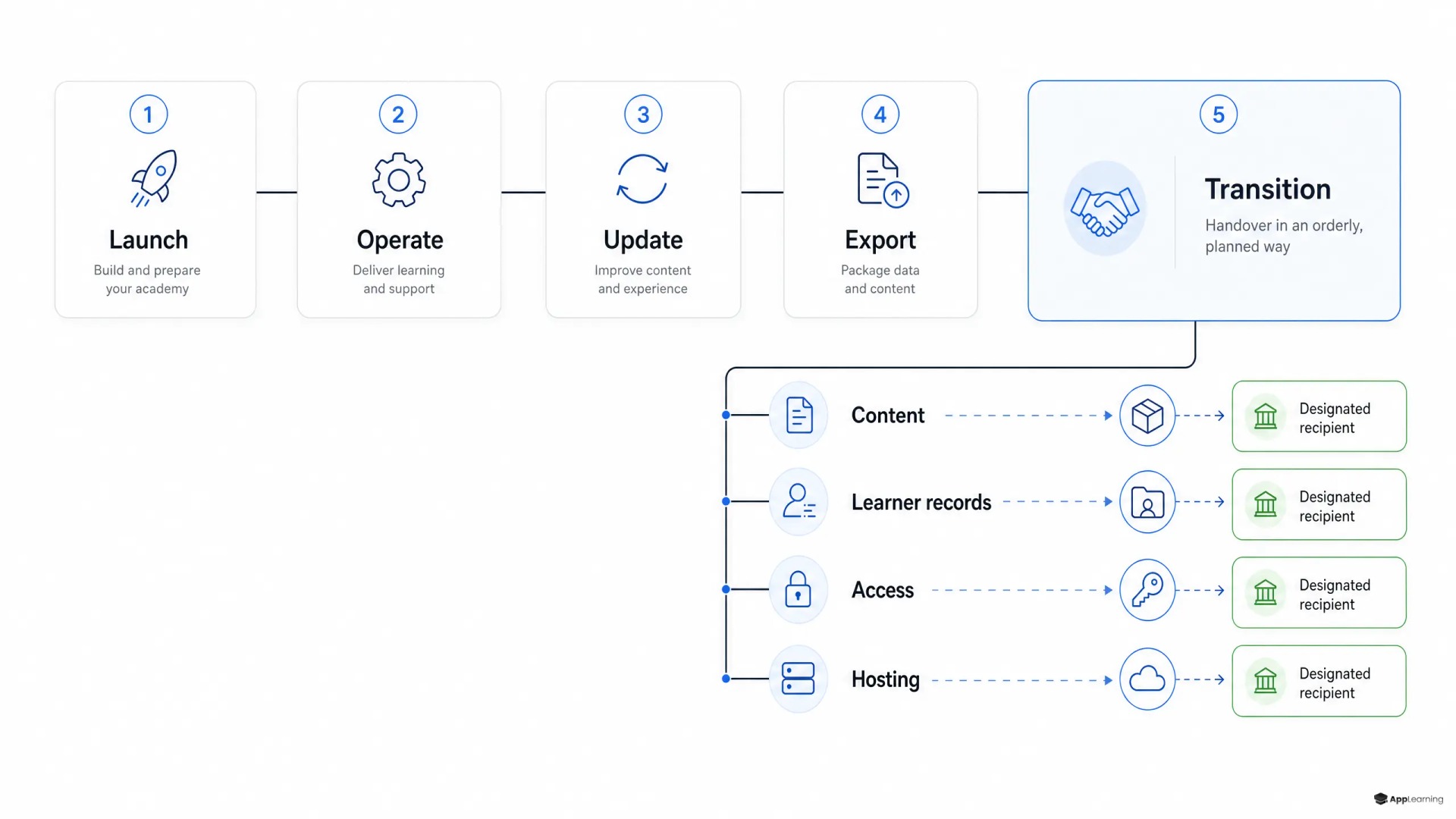
A recent managed academy shutdown made the dependency clear. A request for an academy content export immediately raised four more questions: which learner records must be retained, when access ends, where hosted assets go and who owns each part of the academy. These are not separate administrative tasks. They are coupled by the platform architecture.
- Content — Which source files, media, assessments, translations and course structures are handed over, and in what format?
- Data — Which completion, progress, enrolment and reporting records are exported, retained or deleted?
- Identity — What happens to single sign-on, learner accounts, administrator roles and certificates?
- Hosting — When do URLs, embedded media, domains and platform services stop working?
- Ownership — Who controls the course IP, raw assets, configurations and export archive?
The answers should not live only in a contract appendix. They need to be reflected in the working setup: account structure, asset storage, identity integration, reporting design and shutdown runbook. That is where LMS vendor lock-in either becomes manageable or turns into a real business risk.
An export package does not create portability
A ZIP file is useful, but it is not a transition plan. A course may depend on hosted video, external links, custom templates, authoring-tool licences, API connections or platform-specific logic. Learner history can be exported as rows in a file, yet still lose its meaning if course IDs, status definitions and report fields are undocumented.
Open formats help, but they do not remove the need for an implementation decision. Common Cartridge provides a standard way to package and exchange learning materials and assessments between learning systems. It cannot guarantee that every design choice, integration or reporting model will behave the same way after migration. Learning platform portability therefore needs both export files and a clear map of what those files contain.
The same distinction applies to learner data. Under Article 20 data-portability guidance from the European Data Protection Board, qualifying individuals can obtain certain personal data in a structured, commonly used and machine-readable format. That right is narrower than a full academy migration. A professional exit plan must define the broader operational handover without confusing it with an individual data request.
Good to know
What should an academy content export include?
It should include the published course package where available, raw authoring files, media assets, assessments, translations, content inventory and documentation of external dependencies. The required set depends on who owns the content and how it will be reused.
Can learner reporting data be moved to another LMS?
Usually, core records can be exported, but import quality depends on the target system's data model. Preserve field definitions, course identifiers, completion rules and timestamps so the receiving team can interpret the records correctly.
When should an LMS offboarding plan be defined?
Define it before launch, then review it when hosting, identity, reporting or content ownership changes. A small documented runbook is more useful than a last-minute export request.
The exit path belongs in the launch design
Before the academy goes live, define the operating rules that make a clean exit possible:
- Name the content owner for every course, asset and translation.
- Specify export formats for course packages, raw source files, media and learner reports.
- Document the learner-data schema, retention period and deletion responsibilities.
- Set an access transition: learner notice, final access date, certificate availability and administrator handover.
- Record hosting dependencies, including domains, video storage, identity providers and third-party tools.
- Assign a shutdown owner and test the export process before it is urgent.
This is not extra process for its own sake. It reduces rework when a company changes its onboarding model, consolidates tools or brings content work in-house. It also forces better choices at launch: portable asset storage, understandable reporting fields and fewer hidden dependencies.
Design your academy exit path before it becomes urgent.
Plan exitManaged delivery should preserve continuity
App-Learning treats managed academy delivery as a lifecycle responsibility. That means agreeing early on how content is maintained, how learner access is administered and how an academy can be archived or transitioned when its purpose changes. The goal is not to make departure difficult. It is to make continuity orderly for the team that remains responsible for knowledge and onboarding.
For a founder, that is the practical test. Your learning platform should help new hires become productive now without creating a hidden migration project later. A well-designed exit path protects the value already invested in content, learner progress and operational knowledge. It is evidence that the academy was built as a system, not rented as a temporary interface.