

Key takeaways
- Approval should cover a defined field-level change set, not a whole course object.
- Check the live value against the reviewed baseline before publishing.
- Keep IDs, media, ordering and unaffected learning objects unchanged.
- Stop on conflicts instead of guessing which version should win.
- Treat curriculum deployment with the narrow-change discipline used in software delivery.
Whole-course saves create hidden risk
A whole-module save looks harmless when one author owns a short course. It becomes risky when a learning academy has reusable components, compliance reviews, translations, media assets, several editors and CMS integrations. An editor may intend to correct one outdated policy sentence but publish an older copy of an entire module. That can silently replace a newer assessment, a revised legal disclaimer or a reordered learning path.
The core problem is not that teams make corrections. It is that the unit of editorial approval and the unit of technical publication often differ. Approval may cover one sentence. The LMS may write back an entire course object. Safe course updates close that gap.
Approval belongs to the exact reviewed field
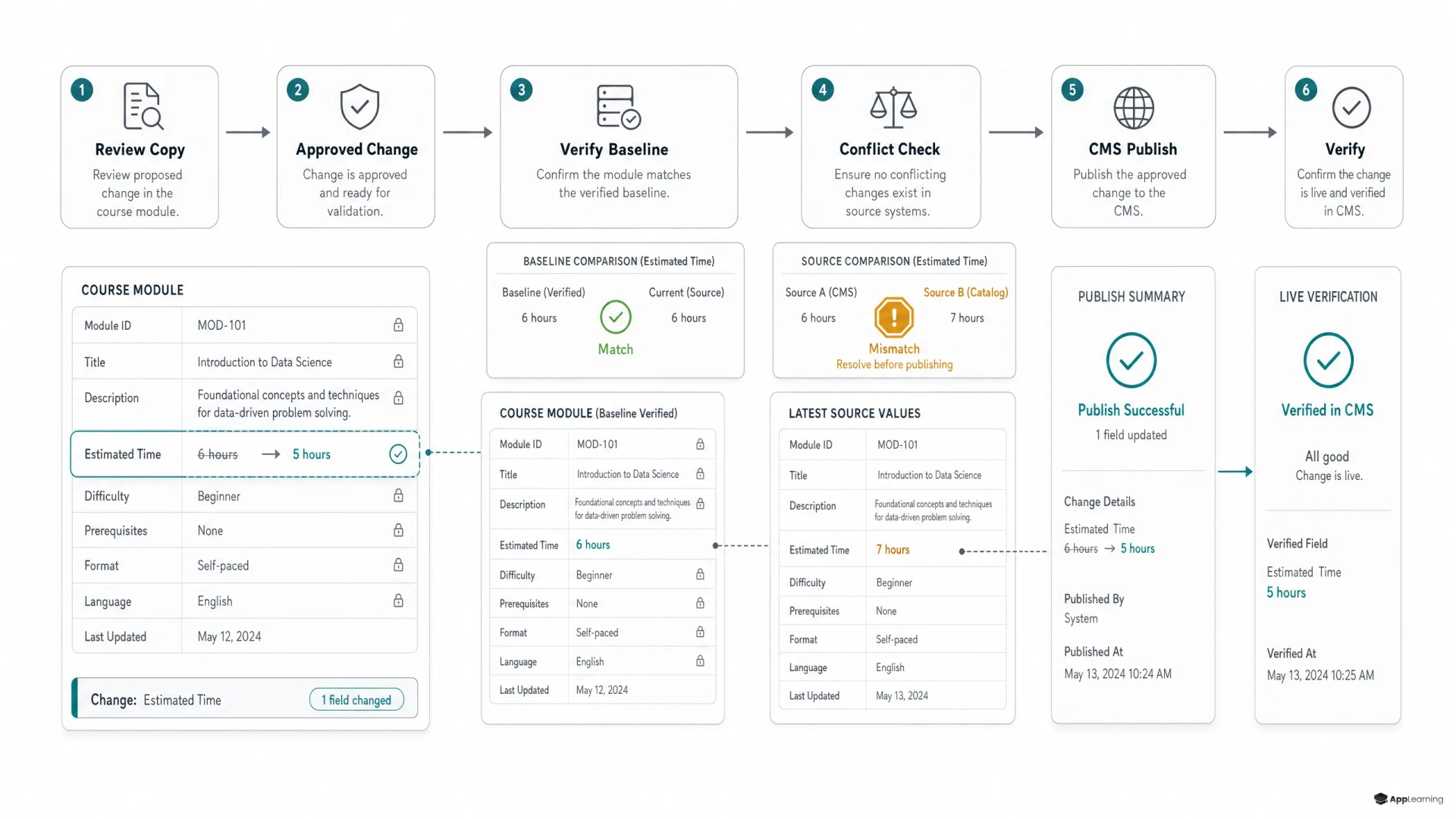
A reviewed correction should become a small, explicit CMS content patching operation. It should name the course and component, identify the precise field, retain the reviewed original value, and state the approved replacement. The operation is not an instruction to recreate the module from memory.
- Stable course and component IDs
- The field path, such as a lesson-body paragraph or quiz-feedback label
- The reviewed baseline value or its cryptographic checksum
- The approved replacement, reviewer, timestamp and change reference
This is learning content version control in practical form. It gives editorial teams a clear approval object and gives delivery systems a limited write permission. A factual correction in one component should not authorize changes to every other field in the course.
Every write needs a live baseline check
Before curriculum deployment, the publishing service should read the current CMS value again. It then compares that value with the approved baseline. If the values match, it applies the replacement. If the replacement is already live, it records a no-op and moves on. If a different value is present, it stops and marks the item as a conflict.
That last outcome matters most. A conflict means another person or process changed the content after review. The system cannot reliably infer whether the approved edit should override that newer work. Stopping protects the newer contribution and sends the decision back to an accountable reviewer.
Unchanged structure must stay unchanged
A narrow patch preserves the rest of the learning object by design. Component IDs, media references, accessibility settings, completion rules, assessment logic, ordering and unrelated text remain intact. This reduces the operational blast radius of a routine correction and makes regression checks much simpler.
The principle mirrors the discipline behind NIST configuration change control guidance, which calls for defined controlled changes, review and approval, implementation and documentation. Learning content is not software code, but regulated training deserves the same care when a changed sentence can affect employee decisions or compliance evidence.
Conflicts are decisions, not technical errors
Teams often treat a failed update as friction. In a controlled workflow, it is useful information. The review was based on one version; the live academy now contains another. The correct next step is to compare both versions, decide deliberately, create a new approved patch if needed and publish that new patch against its own baseline.
This prevents a familiar failure mode in finance and crypto learning operations: an urgent compliance correction lands safely, while an unnoticed older draft later restores outdated wording through a broad save. Speed does not require blind overwrites. It requires small changes with clear preconditions.
Good to know
What is a safe course update?
A safe course update is a field-level publication that changes only the reviewed content value after confirming the live value still matches the approved baseline.
Why should an LMS stop when content has changed?
A different live value may reflect a newer approved edit. Stopping prevents an older review from silently overwriting that work and requires a deliberate resolution.
Which content elements should a narrow patch preserve?
It should preserve unrelated text, component IDs, media links, ordering, assessment logic, completion settings and all other fields outside the approved change set.
How does this improve compliance training operations?
It creates a clear record of the reviewer, exact field, prior value, replacement, publication time and outcome, including skipped updates and conflicts.
The audit trail should explain one change clearly
An audit-friendly record should show who requested the update, who reviewed it, which component and field changed, the expected baseline, the replacement, the time of publication and the result. It should also record skips and conflicts. ISO guidance on controlled documented information includes identification, review and approval, protection, change control and retention as parts of a sound control system.
This record is more useful than a vague course-level version number. It lets L&D, compliance and platform teams answer a concrete question quickly: what changed, where, under whose approval and against which prior value?
Build a safer publishing path with App-Learning.
TalkEditorial review and CMS publication need separate controls
App-Learning can support this operating model by separating the editorial workspace from controlled publication. Reviewers approve bounded replacements. The platform retains component identity and unaffected content, verifies the live baseline before a write, and logs the exact result. Editorial speed remains high because routine corrections do not require manual reconstruction of complete modules.
For regulated academies, the standard should be simple: an approved correction changes exactly what was reviewed, and nothing else. That is the difference between editing content and operating a dependable learning system.