

Key takeaways
- Framework choice and product consistency are separate decisions.
- Define learning behavior outside any one mobile or web runtime.
- Authentication, progress, completion and analytics are common sources of costly drift.
- AI can change implementation economics, but it raises the value of explicit tests.
- A modular academy can survive a host technology change without redefining learning.
The Runtime Is Not the Product
The one-codebase debate asks the wrong first question. A cross-platform learning app can still give learners different completion rules, broken return paths and mismatched analytics. A native learning app can remain coherent across iOS, Android and web when each client implements the same product decisions. The framework determines how a surface is built. It does not determine what the learning product means.
For a fintech product, that distinction is material. A learner who finishes a required module on mobile should unlock the same next step on web. The product team should not have to infer whether a quiz pass, a last-screen view or a server-side state change counts as completion. That definition belongs in a shared product contract.
The Contract Holds the Learning Journey Together
Define the behaviors that must be identical before selecting client patterns. The contract is not a design document that is forgotten after launch. It is a versioned set of rules that product, design, content, engineering and analytics can test.
- Identity and access rules, including single sign-on, learner identifiers, entitlements and logout behavior.
- Learner-state semantics, including started, resumed, passed, completed, expired and reset states.
- Completion rules, including prerequisites, assessment thresholds, retries and the precise completion signal returned to the host.
- Navigation and deep-link behavior, including the destination after a learner enters from an activation prompt.
- Analytics events, required properties, event timing, consent handling and idempotency rules.
- Failure behavior, including offline states, expired sessions, unavailable content and recovery paths.
The critical rule is simple: the academy owns learning truth. The host application may display progress or trigger a reward, but it should receive an unambiguous event such as `course.completed` with a course ID, learner ID, timestamp and contract version. It should not reconstruct completion from partial learner state.
Academy State Must Outlive Its Container
A durable in-app academy architecture separates course data, learner state and integration messages from the host implementation. The academy exposes stable interfaces; each client handles its own rendering, navigation shell and device capabilities. The OpenAPI Specification provides a formal way to describe HTTP APIs, which makes this boundary reviewable and testable before every client is complete.
This also makes LMS integration architecture less fragile. A change from a web view to a native module, or from one cross-platform framework to another, becomes an adapter change rather than a rewrite of completion logic, progress records or analytics definitions. The stable layer is the academy contract, not the technology used to draw the screen.
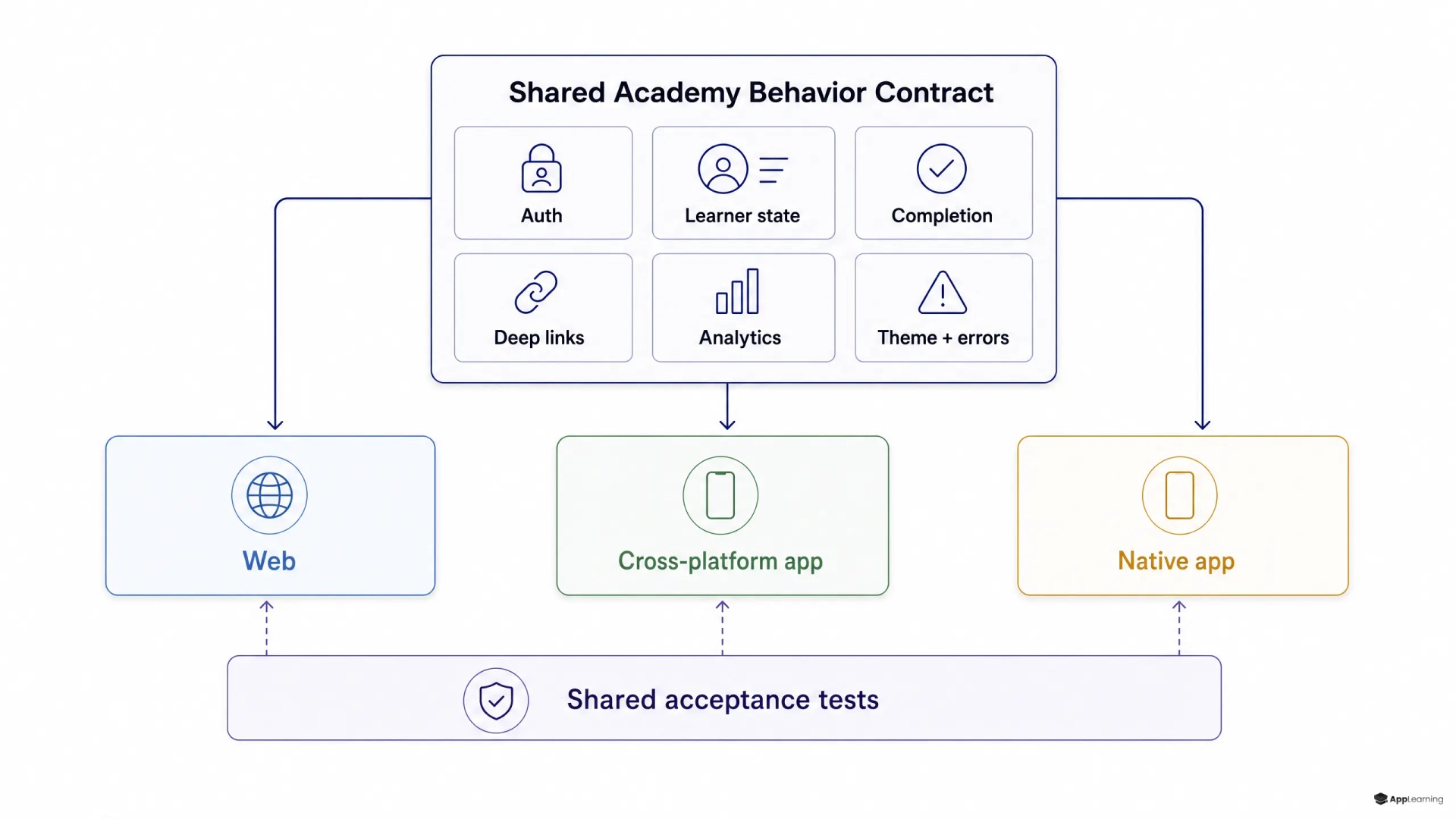
Make the Contract Executable
Write event schemas, semantic design tokens and acceptance tests as first-class delivery assets. The xAPI data model describes learning statements as machine-readable evidence of tracked experiences; whether or not a product adopts xAPI, the same discipline applies. An event name without a defined actor, object, timing and meaning is not a reliable analytics contract.
Use tokens for the parts of the experience that must remain recognisably yours across surfaces. The Design Tokens Format Module specifies a file format for exchanging design tokens between tools. Pair those tokens with interaction requirements such as focus states, error copy, progress feedback and accessible touch targets. Visual consistency without behavioral consistency is still fragmentation.
- Given an authenticated learner with one required lesson remaining, when the lesson passes, then the academy emits one completion event.
- Given the same learner opens the academy on another device, then progress resumes from the canonical learner state.
- Given a deep link targets unavailable content, then the host receives a defined error code and a recoverable destination.
- Given an analytics event is retried after a network failure, then reporting counts it once.
Consistency Allows Deliberate Local Differences
A shared contract does not demand identical screens. Native biometric re-authentication, Android back navigation, iOS sheet behavior, web keyboard shortcuts and host-specific notifications can differ. Classify each decision as invariant, platform adaptation or approved exception. If a difference changes learning meaning, entitlement, completion or measurement, it needs an explicit contract decision rather than an implementation shortcut.
Good to know
What belongs in a shared product contract for learning?
Identity, access, learner-state rules, completion semantics, navigation outcomes, event schemas, error handling, theming requirements and acceptance criteria should be explicit and versioned.
Should the host app calculate course completion?
No. The academy should own the completion rule and issue a precise result. The host can respond to that result with activation flows, rewards or next-step guidance.
Can native and cross-platform clients use the same academy contract?
Yes. The contract defines outcomes and interfaces, while each client can use the implementation approach that best fits its performance, accessibility and product constraints.
AI Changes the Cost Curve Not Accountability
AI-assisted engineering may make multiple clients cheaper to build and maintain, especially where implementations are repetitive. It does not make ambiguity cheaper. The evidence on productivity is mixed across settings, and the highlighted trial is a useful warning against treating code generation as governance. Faster implementation can spread an unclear rule across more runtimes before anyone notices.
The answer is not to freeze technology choice. It is to make the specification executable. Shared fixtures, contract tests and release gates give teams a way to validate every client, including AI-generated changes, against the same learner outcomes.
Keep your academy behavior stable as product platforms evolve.
TalkAn Academy That Survives the Next Rewrite
Frameworks will change. Product surfaces will multiply. A fintech may add a new mobile client, a partner portal or an embedded onboarding flow long after the first academy launch. App-Learning works best as the stable academy layer beneath those choices: define course behavior once, expose clear integration signals and let each host use the runtime that fits its constraints. That is how education remains part of the product instead of becoming another platform-specific system to repair.