

Key takeaways
- Large skilling programs are distribution networks, not course libraries.
- A canonical core needs controlled local adaptation.
- Partner-scoped administration becomes essential as delivery decentralizes.
- Activation, utilization and completion reveal different operational failures.
- Credentials and application evidence create comparable outcome signals.
The academy becomes a network
A small academy can run on a course catalogue, a single admin team and informal reporting. A global AI skilling program cannot. Once delivery spans countries, public institutions, local partners and distinct learner groups, the operational unit is no longer the course. It is the distribution network around the course.
That shift matters for any founder building learning beyond one internal audience. The same pattern appears when a startup trains new hires across markets, enables resellers, certifies implementation partners or supports a franchise network. The challenge is not simply putting content online. It is giving each group the right access, context, controls and evidence without creating a separate academy for every group.
Partner-led delivery changes the product requirement
On 22 September 2026, Google and the ITU announced the scholarship program as a partner-led initiative under the AI Skills Coalition. The announced design combines local governments, the Giga network and national leaders who can tailor training to workforce priorities. This is an announced delivery model, not outcome evidence yet, but it makes the operating logic clear.
A central team can define the learning offer, fund access and set outcome rules. It cannot realistically run every cohort, translate every use case or understand every local employment context. Partners must be able to activate learners and shape delivery. The central organization must still retain quality, data integrity and a common definition of success.
One core with controlled local variants
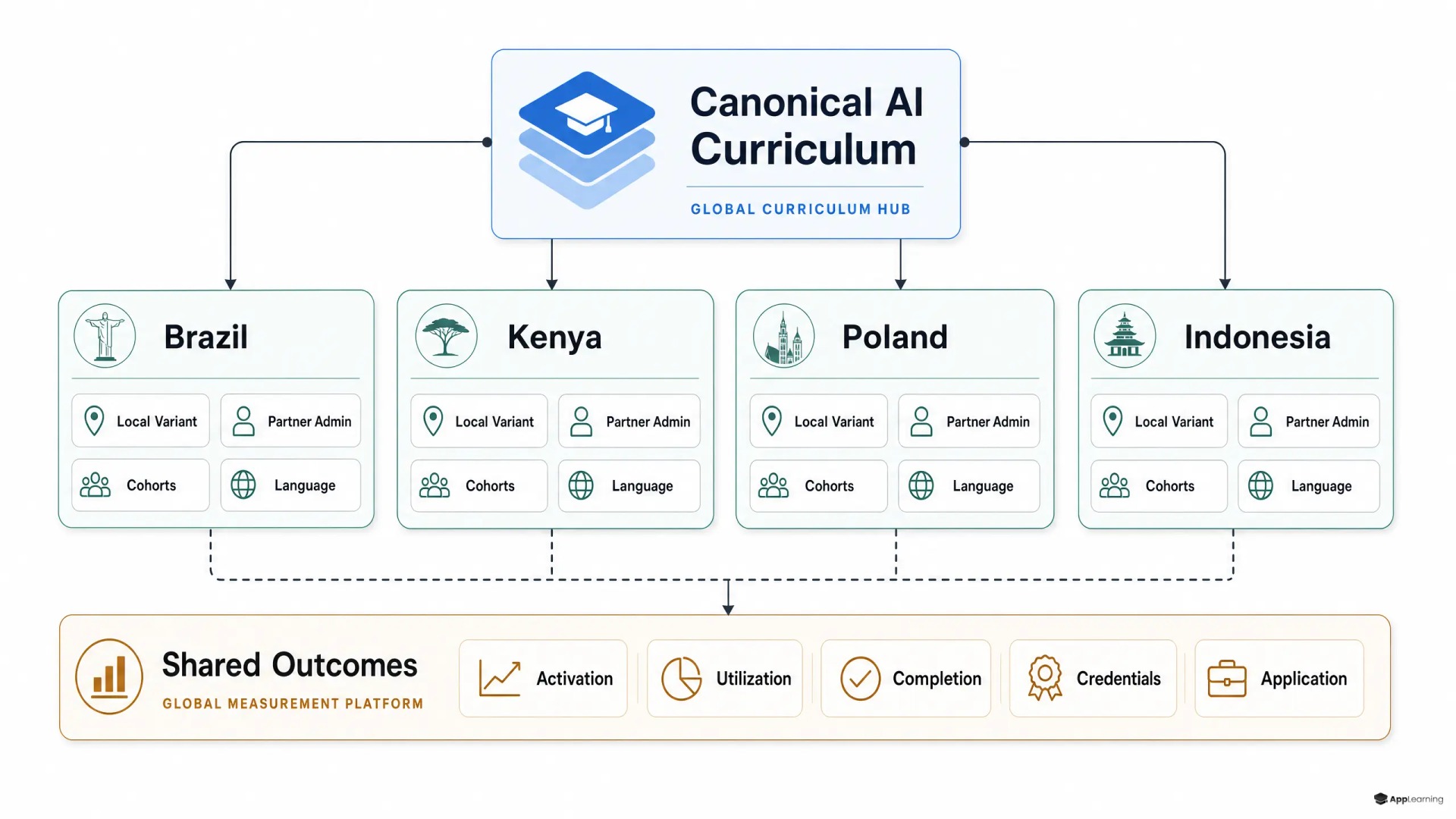
The answer is not full standardization or unrestricted localization. It is a canonical curriculum with controlled local program configuration. The canonical layer defines the learning objectives, core modules, assessment logic, credential rules and version history. It is the part that makes outcomes comparable.
The local layer configures language, examples, job-role pathways, cohort dates, facilitation, communications and approved elective modules. A public-service cohort may need cases about service delivery. A bank partner may need governed examples of customer operations. A startup onboarding cohort may need product knowledge and working norms. The core stays stable while the learning experience becomes relevant.
- Keep core learning outcomes and assessments centrally versioned.
- Allow local owners to configure cohorts, audiences, pacing and approved content variants.
- Record each local variant against the canonical version it uses.
- Require approval when a local adaptation changes assessment or credential conditions.
Administration needs real boundaries
A multi-country training platform needs more than folders and regional filters. It needs explicit tenant and partner boundaries. A global owner should see the full network. A country lead should manage only local programs. A delivery partner should enroll and support its own learners without accessing another partner’s people or performance data. Managers need visibility into their teams, not the entire system.
These boundaries reduce manual administration and prevent the spreadsheet work that follows shared access. They also make a white-label academy network practical. Each partner can use its own brand, learner journeys and local communications while the platform preserves the same curriculum backbone, permission model and impact framework.
Measurement must follow the learner journey
Completion is too late and too blunt as a sole measure. The program announced by Google and ITU plans to track activation and utilization alongside participation, completion, certificates and priority-group reach. Those are distinct signals, and they should remain distinct in reporting.
- Activation shows whether allocated access was claimed or provisioned.
- Utilization shows whether learners used the learning access after activation.
- Participation shows meaningful starts, attendance or activity against a defined threshold.
- Completion shows whether learners finished the required pathway.
- Credentials show whether learners met the published standard.
- Reach shows who the program actually served across intended groups.
For a founder with a 50-person-plus company, this distinction can expose the real bottleneck. Low activation points to invitation and access design. Low utilization points to relevance, time allocation or manager support. Low completion may indicate pacing or workload. Treating all three as one metric hides the intervention that is needed.
Good to know
When does a startup need partner-scoped learning administration?
Use it when different managers, resellers, franchisees or regional teams need to enroll learners and monitor progress without seeing data outside their own group.
What should remain central in a white-label academy?
Keep learning outcomes, core curriculum versions, assessment criteria, credential rules and impact definitions central. Local teams can then configure delivery without breaking comparability.
How should a lean team start measuring learning impact?
Start with activation, utilization, completion and one evidence-of-application signal. Define each metric before launch and review it by cohort rather than only in aggregate.
Certificates need an evidence layer
A certificate is useful because it creates a common record across heterogeneous cohorts. It is not proof that learning changed work. The ITU frames its coalition around localized delivery and recognition models, which points to the next design task: connect credentials to evidence of application.
That evidence can be lightweight. Ask learners to submit a work-based use case, have a manager confirm a new task is being performed, capture a portfolio artifact or run a follow-up survey after 30 and 90 days. The point is not to create burdensome evaluation. It is to separate attendance from demonstrated use.
Assess your learning architecture with App-Learning.
Assess itInfrastructure determines whether scale stays manageable
Global AI skilling requires AI skills program infrastructure that behaves like a multi-tenant operating system. It needs a canonical curriculum, governed local variants, partner-scoped administration, multilingual delivery, cohort analytics, certificates and shared impact metrics. Without that architecture, each expansion adds exceptions, admin effort and incomparable reporting.
App-Learning can apply this model to an internal academy, a partner ecosystem or an international program. The scale may differ, but the design principle does not: centralize what must remain consistent, decentralize what must be locally useful, and measure the full path from access to applied capability. That is how learning remains manageable as the organization and its network grow.