
Key takeaways
- Catalog breadth is becoming infrastructure rather than the main buying decision.
- Business priorities and skill gaps should determine learning assignments.
- Microlearning needs competency mapping and evidence to create usable skills data.
- Verified application is more useful than completion data alone.
- Portable skills records give enterprises more control over workforce capability data.
The catalog has reached its ceiling
A large course library solves an access problem. It does not solve a capability problem. HR and L&D teams can offer thousands of titles, yet still struggle to answer basic operational questions: Which skills does a team need for a new control, product launch, AI workflow, or regulatory change? Who has reached the required standard? Where does risk remain?
For finance and crypto firms, the gap is sharp. Compliance learning often produces completion records, while business leaders need evidence that people can make sound decisions, follow a process, handle exceptions, and apply policy under pressure. A catalog can support that work, but it cannot be the system of record for it.
Project Helix makes the next layer visible
On September 9, Coursera previewed Project Helix as an AI-native enterprise skills platform intended to connect business goals, critical skills, adaptive learning, verification, and a portable skills record. It is expected to become broadly available in the first half of 2027. (investor.coursera.com)
That announcement is not proof that this model improves business performance. It is, however, a clear market signal. Coursera is positioning the higher-value platform layer above content: a system that identifies what matters, guides development, captures proof, and keeps capability data current. Its product framing explicitly moves beyond static libraries and course completion as the primary measures. (blog.coursera.org)
Capability runs as a closed loop
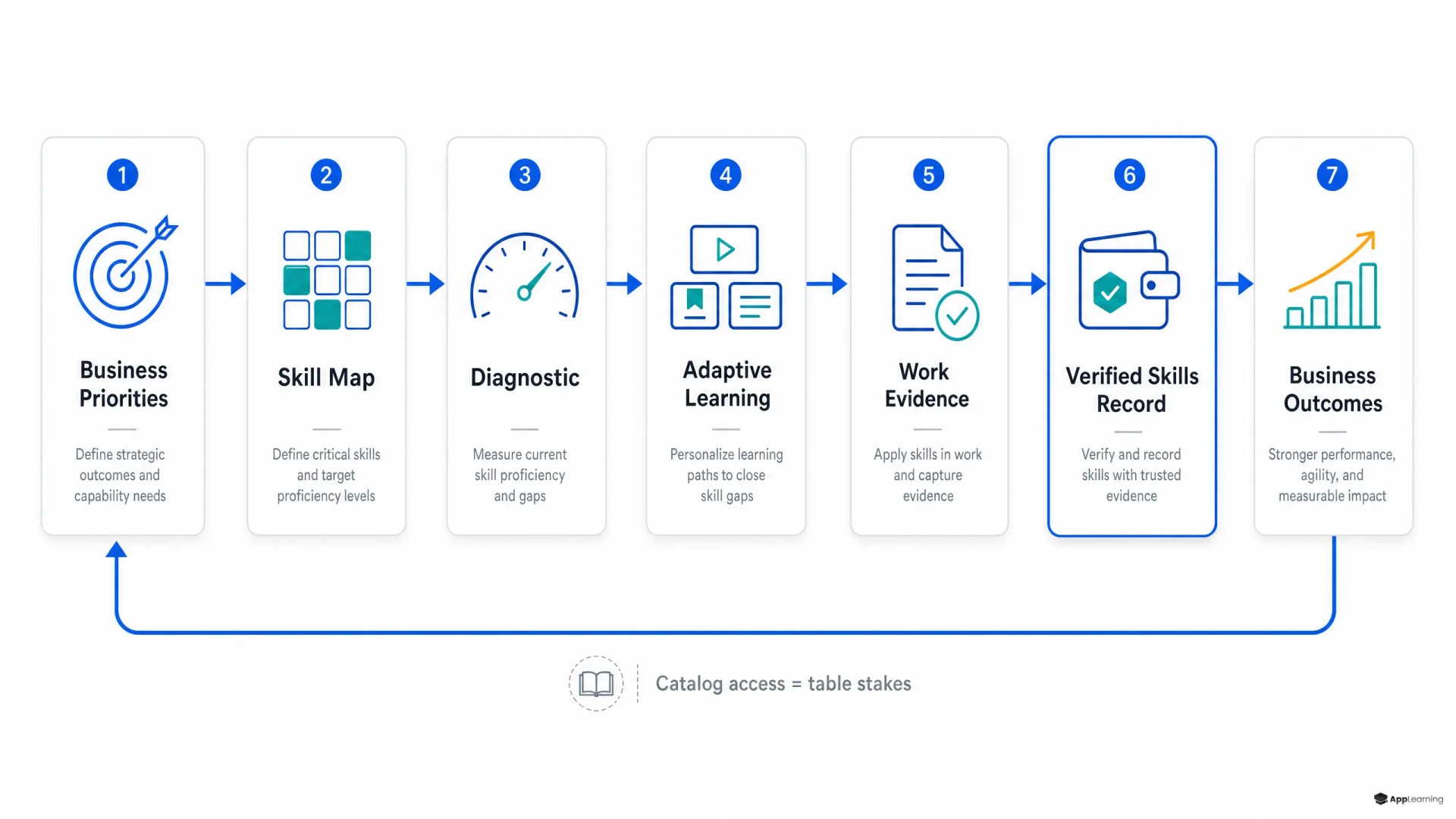
A skills operating system should not start with a content search bar. It should start with a business priority and translate it into a repeatable capability loop. That is the practical core of skills-based learning.
- Define the priority, such as secure AI adoption, conduct risk, onboarding quality, or a new payments process.
- Map the roles, competency definitions, and proficiency standards required to deliver it.
- Use a baseline diagnostic to route each learner to the right level and learning path.
- Capture evidence through knowledge checks, scenario decisions, simulations, manager observation, or work outputs.
- Write validated results into a durable record that can inform staffing, mobility, remediation, and future learning.
The loop does not require perfect skills data on day one. It requires a controlled starting taxonomy, clear standards for high-risk capabilities, and a process for improving the model as evidence accumulates. That is more useful than waiting for a complete enterprise ontology that never arrives.
Microlearning needs an evidence model
Microlearning is often treated as a format choice: shorter lessons, faster rollout, better mobile use. Its larger value is modularity. A short learning object can become a reliable building block when it is tied to a defined competency, a proficiency level, and an assessment or application signal. That turns microlearning skills data into something an enterprise can use rather than a stream of viewing events.
- Map each module to a customer-owned skill or competency definition.
- State the observable behavior or decision the module prepares learners to make.
- Attach a short diagnostic, knowledge check, scenario, or practical task.
- Store the result separately from the content object so the evidence survives a course redesign.
- Review the evidence model with compliance, operational, and people stakeholders.
Good to know
What is the difference between a course catalog and a skills operating system?
A catalog organizes content. A skills operating system connects business priorities, competency requirements, diagnostics, learning paths, evidence of application, and a durable capability record.
Can microlearning support regulated training requirements?
Yes, when each module has controlled content ownership, version history, mapped competencies, appropriate assessment, and reporting that distinguishes completion from demonstrated capability.
What should an L&D team measure beyond completion?
Measure baseline gaps, assessment performance, scenario decisions, applied-task results, manager observations, skill freshness, and readiness by role or business-critical population.
Does every skill need a complex assessment?
No. Match the evidence method to the risk and importance of the skill. A simple knowledge check may suit awareness, while high-risk decisions need scenarios, practice, or observed performance.
Verification must reach the job
Completion is an activity measure. It can show that a learner opened, viewed, or finished material. It cannot, by itself, show whether that person can apply a control, identify a suspicious pattern, explain a product risk, or use a new workflow correctly. Verification should therefore match the capability: a policy may need scenario judgment, a technical process may need a graded task, and a customer-facing behavior may need observation against a rubric.
This also changes reporting. Instead of presenting one completion rate, L&D can show readiness by role, confidence gaps before and after intervention, recurring failure points, and the proportion of a population that has produced acceptable evidence. Those signals give business owners a basis for action.
Portability protects the buyer
The skills record is the control point. Enterprise buyers should own the competency definitions, evidence rules, and resulting records even when they change content partners, assessment tools, or learning platforms. Portability prevents a vendor catalog from becoming the only place where the organization can understand its own capability.
The record should connect cleanly to HR and operational systems, but it should not depend on a single provider’s course structure. A course can be retired. A module can be revised overnight after a policy update. The verified capability record should remain intelligible across those changes.
Build a learning system that produces evidence, not just completions.
PlanApp-Learning as a capability system
App-Learning can make this model practical without turning every programme into a large transformation project. Map modular content and assessments to the customer’s competency definitions. Start with baseline diagnostics. Route people to the next best learning action. Capture evidence of mastery and application. Then expose the resulting data to the systems where workforce and operational decisions happen.
That is capability-based learning in operational form: engaging mobile learning for the learner, controlled rollout for compliance teams, and usable evidence for leaders. The stronger enterprise story is not that learning is shorter. It is that every learning interaction can strengthen an independent, measurable record of workforce capability.