
Key takeaways
- Licensing milestones create staged learning requirements, not one compliance course.
- Product, support, operations, compliance, and sales teams need different timing and depth.
- Training versions must match the product perimeter that is actually approved and live.
- Readiness assessments can control who supports or launches regulated capabilities.
- Academy data can become a practical signal for rollout governance and change management.
A charter changes the knowledge system
On September 2, 2026, the Office of the Comptroller of the Currency recorded Corporate Decision 1390 for the application to charter Revolut Bank US, N.A. The following day, Revolut announced conditional approval and said it was still working through FDIC, Federal Reserve, and final OCC approvals toward a proposed 2027 launch. That sequence matters because a bank charter is not a single launch date. It is a moving set of permissions, conditions, operating capabilities, and customer commitments.
This makes bank charter training a release-management problem. New controls may be designed before a product is enabled. A support team may need guidance before customers see a new option. Product and operations may need to demonstrate a process before a launch owner grants access. If learning trails these decisions, teams fill gaps with old playbooks, informal chats, and guesswork.
Launch gates need learning gates
A fintech regulatory expansion should be broken into explicit gates rather than treated as one large programme. The proposed U.S. bank would eventually allow Revolut to directly offer products including loans, credit cards, FDIC-insured deposits, stablecoins, and cryptocurrencies, according to its September 3 announcement. Each capability creates a different operating model, and each should have its own learning gate.
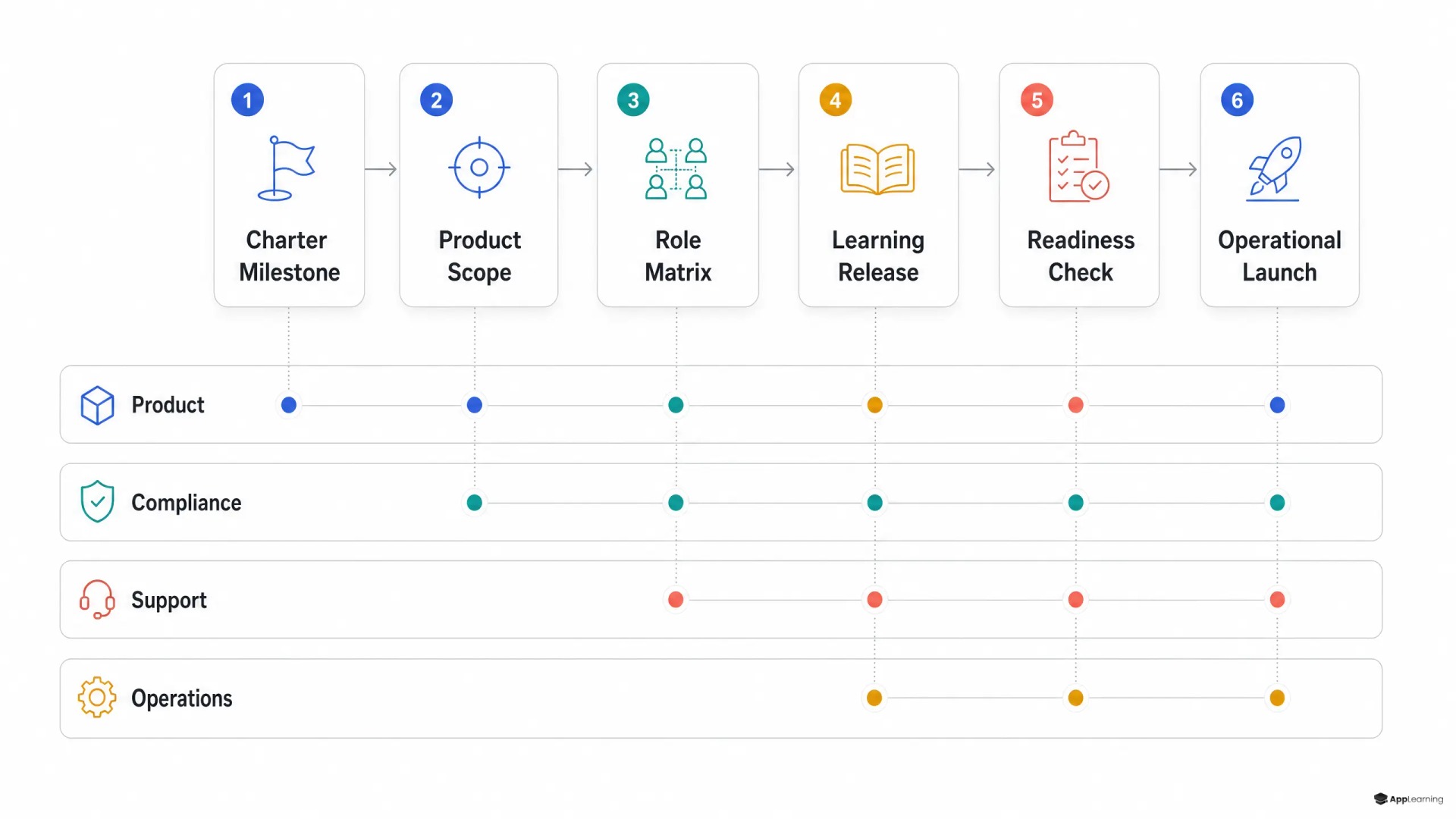
For every gate, define four things: the product or control entering scope, the decision that permits activation, the roles affected, and the evidence required to show readiness. This avoids the common failure mode of assigning everyone the same broad compliance module while the actual work changes by team and by product state.
- Charter and control design requires shared regulatory context for accountable owners and control operators.
- Pre-launch testing requires detailed process knowledge for product, risk, operations, and engineering teams.
- Customer activation requires accurate workflows for support, sales, lifecycle, and dispute-handling teams.
- Post-launch change requires fast, versioned updates when policy, eligibility, or product behaviour changes.
Role depth follows operational exposure
Not every employee needs the same knowledge. A support agent needs to explain eligibility, escalation routes, and customer-safe language. An operations specialist needs to execute exceptions and evidence controls. A product manager needs to understand the guardrails that shape journeys and disclosures. A compliance owner needs deeper command of policy, monitoring, and breach response.
That distinction is the core design principle for a fintech compliance academy. Build role-specific launch tracks from one source of truth, then assign only the modules, scenarios, and assessments that each role must complete. Shared foundations still matter, but they should not hide the role-specific decisions that determine whether a customer receives a correct outcome.
The approved perimeter must define the curriculum
Training content should mirror the exact product perimeter that is approved and active today. It must distinguish between a capability that is proposed, one that is approved but not enabled, one available to a limited segment, and one live at scale. This is especially important where product scope may expand in stages across deposits, cards, lending, payments, or digital assets.
Use clear curriculum versions tied to release identifiers, policy dates, and market scope. Retire or archive superseded guidance rather than leaving it searchable beside current material. When a customer-facing team opens a module, it should be obvious which product state it covers and when that guidance was last valid.
Readiness becomes a launch permission
Completion is weak evidence. A person can finish a module without being able to resolve a realistic case, identify a prohibited action, or follow an escalation path. Bank launch readiness needs assessment formats that test decisions under the conditions people will face in the work.
Use short scenario assessments before operational activation. Test the point where a role can create customer harm, control failure, or a misleading promise. Set a pass threshold, route failed attempts into focused remediation, and make readiness visible to the launch owner. In this model, learning is not an after-launch communication task. It is part of the permissioning workflow.
Good to know
Which roles should enter bank charter training first?
Start with the roles that approve, build, operate, explain, monitor, or escalate the first capability entering scope. Prioritise by operational exposure and customer impact, not by job title alone.
How should training reflect an expanding product scope?
Create a versioned module set for each approved product perimeter. Assign updates when a permission, customer segment, market, policy, or workflow changes, and remove superseded guidance from active use.
Can learning data support launch decisions?
Yes. Assessment results, current-version acknowledgements, and readiness by role can show whether a team is prepared for activation. The data should inform launch decisions alongside product, risk, legal, and operational evidence.
Support education protects the product promise
For product and growth leaders, the same system supports customer education. Complex financial products lose users when the value, eligibility, risks, and next actions are unclear. Internal support guidance and external onboarding should share the same approved language and product logic, even if they serve different audiences.
That creates a tighter feedback loop. Support contacts, failed assessments, and repeated customer questions reveal where a product journey or explanation is unclear. Financial services learning operations can then update internal guidance, in-product education, and lifecycle messages from the same release change instead of letting each team create a separate interpretation.
Build launch tracks that keep every regulated release ready.
PlanAcademy data belongs in launch governance
A useful academy dashboard does not stop at enrolments and completion rates. It shows readiness by launch gate, role, market, manager, and critical workflow. It identifies who has passed the required assessment, which teams still have knowledge gaps, where guidance has not been acknowledged, and whether the active module version matches the live product scope.
This gives release owners a practical control signal. They can delay a narrow activation, restrict access to trained teams, or target remediation before a problem reaches customers. App-Learning can support this operating model with role-specific tracks, versioned modules, readiness assessments, and dashboards that connect learning evidence to product activation.
A bank charter changes the organisation before it changes the customer interface. Fintechs that treat knowledge as release infrastructure can turn regulatory complexity into a controlled launch system, where each new permission is matched with the people, decisions, and guidance required to use it safely.