
Key takeaways
- AI efficiency creates value only when saved time has a named next use.
- Move human time toward coaching, practice, discussion, feedback and work application.
- Platforms should trigger human interventions rather than end at content completion.
- Pilot transfer and manager activity alongside time saved and assessment scores.
Instruction Time Is Becoming a Design Variable
The emerging AI tutoring operating model is not only about better explanations or faster test preparation. It changes the timetable. Alpha Schools plans to expand to roughly 50 campuses in the 2026 school year while using a model built around short AI-supported core-learning blocks, according to Axios reporting. Houston ISD is also piloting Alpha’s platform at two elementary schools and says it will monitor outcomes before making future decisions. These are early market signals, not proof that compressed instruction improves results. (axios.com)
The pilot does not replace classroom teachers.
For L&D, the useful question is simpler and more demanding. If AI-assisted training reduces time spent explaining policy, product knowledge, or process steps, where does that recovered time go? Without an answer, the programme has merely removed learning time. With an answer, it can create more opportunities to rehearse judgment, receive feedback, and apply knowledge in the work itself.
Compression Is Not the Result
Completion in less time is an efficiency metric, not a capability outcome. This distinction matters in banking, fintech, and crypto firms, where employees must interpret rules, handle edge cases, escalate risks, and communicate clearly under pressure. A learner can pass an adaptive module on a new control and still struggle to apply it during a customer case, transaction review, or product decision.
The failure mode is predictable. L&D uses AI microlearning to make a course shorter, reports higher completion, then leaves the learner alone with the difficult part. Managers see training as finished. Coaches have no prompt. Practice never occurs. The organisation saves content-delivery time but loses the transfer mechanism.
Human Time Belongs at the Point of Judgment
Human coaching in AI learning should concentrate on work that needs context, challenge, and accountability. A meta-analysis of 89 studies found that a supportive work environment is positively related to training transfer. A later review of soft-skills transfer also identified management support, feedback or debrief, and simulation or practice as recurring factors. (doi.org)
- Coaching on decisions that involve risk, customer impact, or competing priorities
- Deliberate practice in realistic scenarios with an observer or peer
- Team discussion that exposes different interpretations and escalation thresholds
- Feedback on a live work sample, case note, conversation, or decision record
- A manager commitment that creates a near-term opportunity to use the skill
This does not make the manager a substitute instructor. The manager’s role is to make application visible: set the practice task, ask for the learner’s reasoning, inspect evidence, and remove barriers to use. The AI handles repeatable explanation and retrieval. People handle judgment and reinforcement.
Handoffs Must Be Designed
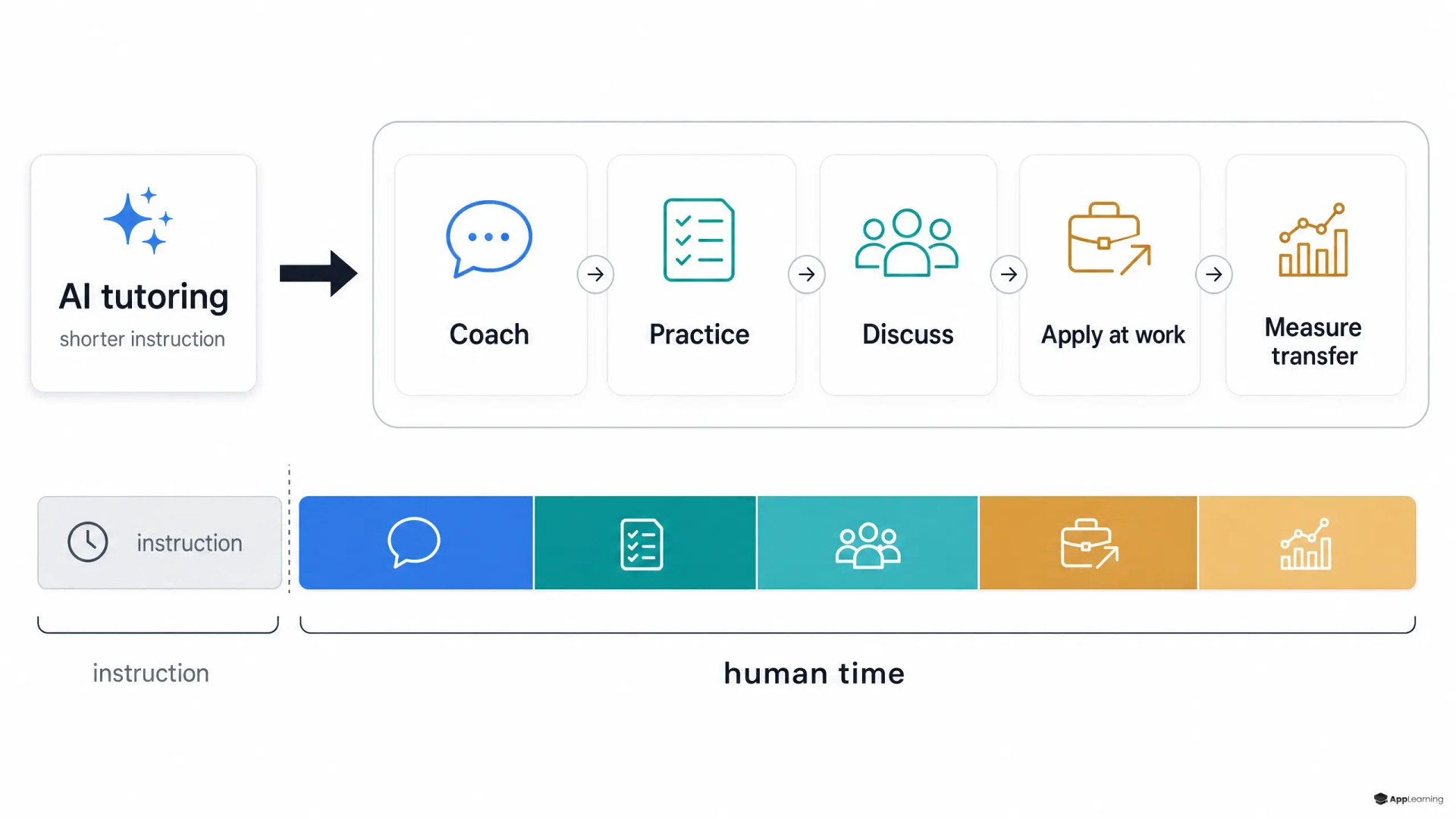
A learning time reallocation plan needs explicit handoffs. Every AI module should end with a defined next action, an owner, a deadline, and evidence of application. Do not send a generic “discuss this with your manager” prompt. Trigger a specific action based on the learner’s role, performance, and current work.
- AI diagnoses a gap or confirms a baseline level of understanding.
- The platform assigns one role-relevant scenario or work task.
- The learner records a decision, response, or short reflection against clear criteria.
- A manager, coach, or peer reviews the evidence and gives focused feedback.
- The system schedules a follow-up prompt to confirm use in live work.
For regulated teams, the handoff should distinguish knowledge checks from performance evidence. A policy module may need an auditable completion record. Capability building needs something else: a documented scenario response, a reviewed work sample, or a manager confirmation that the employee used the new behaviour appropriately.
Good to know
What is an AI tutoring operating model?
It is a defined model for deciding what AI handles, what people handle, and how time saved on instruction is reassigned to practice, coaching, feedback, and work application.
Which activities should remain human-led in AI-assisted training?
Human-led time is most valuable for context-dependent decisions, feedback on real work, difficult discussions, practice under realistic constraints, and manager accountability for application.
How should L&D measure learning time reallocation?
Measure instruction time saved alongside manager interactions, completed practice tasks, feedback speed, quality of scenario responses, and evidence that the learner used the skill in work.
Can this model support compliance learning?
Yes. Keep auditable knowledge and completion requirements in the digital path, then add role-specific scenarios and manager review where correct application and judgment matter.
Completion Metrics Miss the New Work
Pilot metrics must reflect the new operating model. Track time saved, but treat it as an input. The more important question is whether the saved time produced observable human activity and better transfer. Research on management-training evaluations found stronger transfer where training matched task requirements and included opportunities for practice. (pubmed.ncbi.nlm.nih.gov)
- AI instruction time per learner and time recovered
- Manager prompt completion and feedback turnaround time
- Scenario quality and decision accuracy before and after coaching
- Practice-task completion in the flow of work
- Transfer evidence after 30 and 60 days, including escalation quality or error reduction where appropriate
Use a small pilot cohort first. Compare an AI-only path with an AI-to-human path for the same role and topic. The aim is not to prove that every minute with a manager is valuable. It is to identify which human intervention changes performance enough to justify the time.
Map your AI-to-human learning loop with App-Learning.
TalkThe AI-to-Human Loop
App-Learning can turn this model into a repeatable learning system. Short adaptive modules can prepare employees for a specific decision or scenario. Manager prompts, practice assignments, peer discussion, and next-action nudges can then move the learner beyond completion. The platform becomes a coordination layer between content, practice, and human support rather than another place where training ends.
That is the real promise of AI-assisted training in regulated organisations. Use automation to reduce low-value delivery time, then invest the recovered capacity where people create value: interpreting ambiguity, practising under realistic constraints, receiving feedback, and carrying better decisions into work.