

Key takeaways
- AI assistants are becoming a new front door to learning.
- Agent access requires governed actions, not only searchable content.
- Identity, permissions, completion and assessments must remain in the learning system of record.
- A headless academy reduces context switching without removing the LMS back end.
- Separate the learning system of record from the learner interface.
Learning Platforms Need an Agent Interface, Not Another Portal
For a growing startup, a learning portal still has value. It gives new hires a reliable place for onboarding, policies and role training. But it should not be the only place employees can access learning. When knowledge lives in chat, project tools and AI assistants, asking people to stop work, find the portal and search again creates friction at the exact moment they need help.
The Portal Is No Longer the Only Front Door
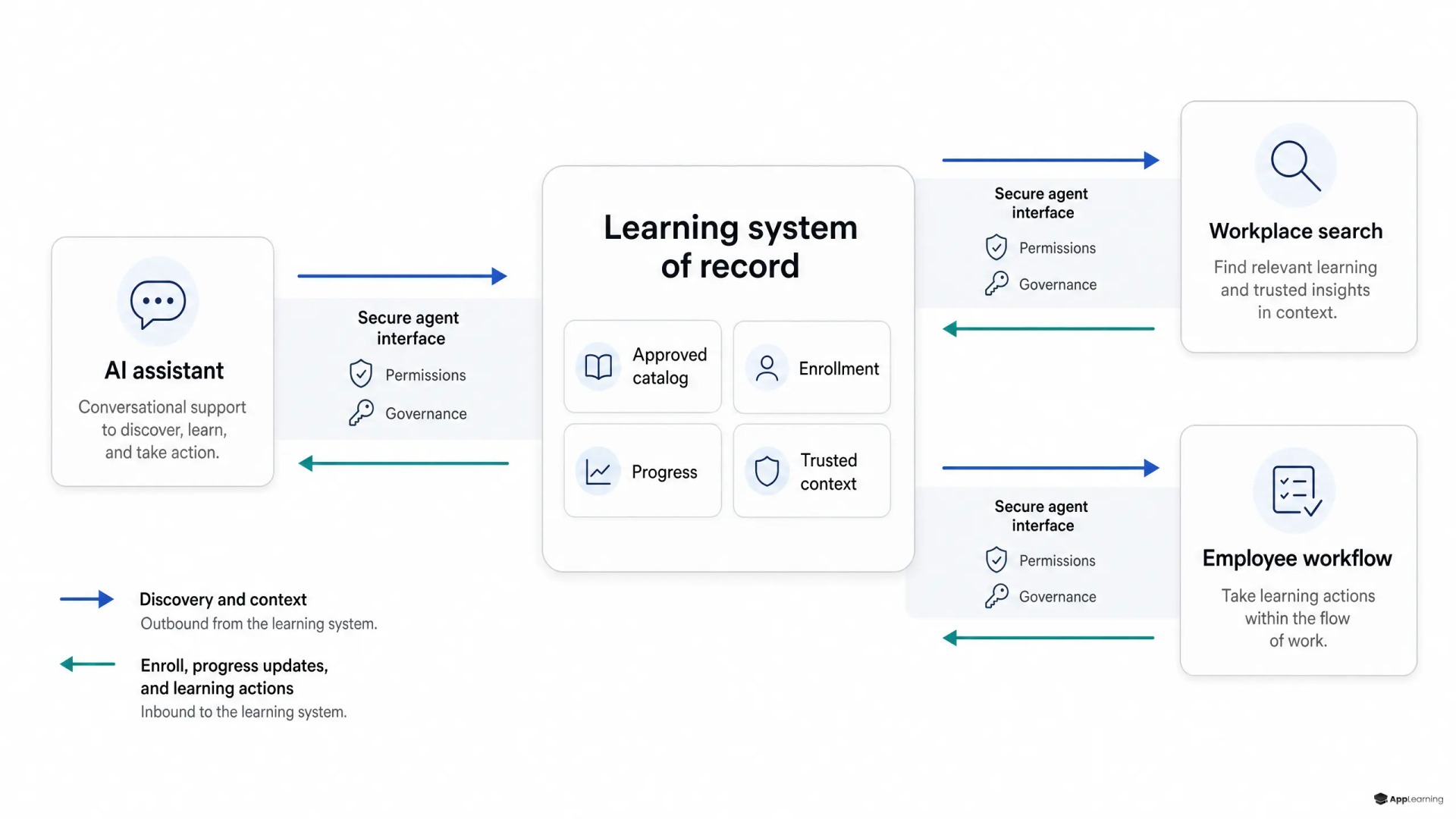
The shift is from destination to capability. An employee should be able to ask an approved workplace assistant for the sales onboarding they still need, a short lesson on a tool they are using, or their certification status. The assistant becomes the interface. The platform stays behind it as the governed source of content, enrolment, progress, assessment and reporting. That is learning in the flow of work without abandoning structure.
MCP Turns Learning Into a Callable Service
This pattern is moving from concept to product. Udemy’s Glean integration uses work signals such as role and search intent to surface relevant learning. Thrive’s certified MCP integration with Leena AI supports finding learning, enrolling and checking progress through conversation. Docebo’s July 2026 release made its MCP Server generally available with learner and admin tools in major enterprise AI assistants. These releases show an interface change, not proof that any implementation will improve adoption on its own. (business.udemy.com)
An MCP learning platform exposes selected capabilities in a form an approved agent can call. This is more useful than indexing course titles in enterprise search. A well-designed AI learning integration can retrieve the right programme for a role, explain its relevance, enrol the learner after confirmation, and return the current status from the same authoritative record.
Read Access Is Not Action
Many early integrations stop at search. Search matters, but it does not complete onboarding or build a skill pathway. An agentic LMS needs a narrow set of safe actions with clear rules. Read actions can return course metadata, trusted summaries, prerequisites and a learner’s own status. Write actions can request enrolment, assign a manager-approved pathway or book a required session.
The boundary matters. An assistant may recommend a module, but it should not mark it complete because a learner read a summary. Assessments, evidence, attempts and completion events must run through the learning platform. The agent requests work; the platform decides whether the work counts.
Governance Cannot Move Into the Prompt
A conversational interface does not remove the need for identity and access control. It increases it. The MCP authorization specification uses OAuth-based authorization and requires servers to validate tokens intended for them. In practice, the academy should apply the same user identity, group memberships, audience rules and content visibility that it applies in its own interface. (modelcontextprotocol.io)
- Expose only approved tools and fields.
- Use least-privilege scopes for each action.
- Require confirmation for consequential write actions.
- Log the user, agent, action, outcome and timestamp.
- Keep assessment and completion logic in the platform.
This is also why vendor setup details matter. Docebo’s implementation guidance requires both a learning-platform superadmin and an administrator of the target AI client. An agent interface is an integration between governed systems, not a browser extension that one employee installs. (developer.docebo.com)
Good to know
What makes an agentic LMS different from a learning chatbot?
A chatbot answers questions. An agentic LMS can retrieve governed learning context and carry out approved actions such as enrolment or status checks.
Should a startup build an MCP server now?
Usually not from scratch. First create clean learning records, clear permissions and useful APIs, then adopt an integration when the team has an approved AI workplace interface.
Can an AI assistant replace the learning platform?
No. The assistant is a convenient interface. The platform should remain the source of truth for identity, pathways, assessments, completion and analytics.
The Headless Academy Has a Clear Boundary
For App-Learning, the practical position is a headless academy that separates the learner interface from the learning system of record. This keeps onboarding simple for a 50-person company now, while avoiding a rebuild when the company later adopts an enterprise AI assistant.
- Keep content, pathways, assessments and analytics in the academy.
- Connect identity through the company’s existing access layer.
- Expose a small MCP or API tool set for approved agents.
- Return trusted learning context in the employee’s working tool.
- Write every action and completion event back to one record.
Make learning usable wherever your team already works.
TalkBuying Criteria Must Move Below the Interface
Founders should not buy a platform because it has a chat feature. Ask whether the vendor can expose governed learning actions, preserve permissions across interfaces, distinguish recommendations from completions, and provide an audit trail. Also ask which actions are available today, which require custom work, and how the integration behaves when an employee changes role or leaves the company.
- Which learning actions can an agent call today?
- How are user permissions enforced outside the portal?
- Can the platform return progress without exposing private data?
- Where are enrolment and completion events recorded?
The portal is not disappearing. It remains the place for administration, deep learning journeys and complex assessment. But it is losing its monopoly as the learner interface. The academy that wins will make trusted learning available at the point of work while keeping the rules, records and accountability where they belong.