

Key takeaways
- Learner agency and cognitive effort are product design variables.
- Use attempt-before-assist when the learner must perform the skill independently.
- Graduated hints preserve momentum without handing over the reasoning.
- Measure assistance dependency, transfer and unaided performance alongside completion.
- Keep human escalation for ambiguous, sensitive and high-stakes decisions.
Automation Can Erase the Practice
Agentic AI learning changes the product question. The issue is no longer how much work an AI can complete. It is what work the learner must still perform to build reliable judgment. An agent that drafts, explains, searches and decides without restraint can make training feel fast while turning the learner into an observer.
A June 2026 review of agentic AI and pedagogy identifies this tension directly: proactive systems can undermine learner agency and cognitive effort unless they use intentional friction, dynamic scaffolding and human oversight. For L&D teams, this is an operating-model decision, not a prompt-writing detail.
The Line Between Useful Effort and Bad Design
Productive friction learning is not a defence of clumsy software. Wasteful friction is effort spent finding the right screen, decoding vague instructions, waiting for approval or repeating irrelevant content. Remove it. Productive friction is effort spent retrieving a policy, comparing evidence, explaining a decision, applying a rule to a new case and reflecting on an error.
The distinction matters because completion is not competence. The What Works Clearinghouse guidance on instructional design recommends active retrieval, deep explanatory questions and a mix of worked solutions with independent problem solving. AI tutor design should protect those actions when they are the skill being trained.
- Remove interface, search and coordination friction.
- Preserve retrieval, explanation, application and reflection.
- Give the answer immediately only when the answer itself is not the learning target.
Five Tutor Patterns That Retain Agency
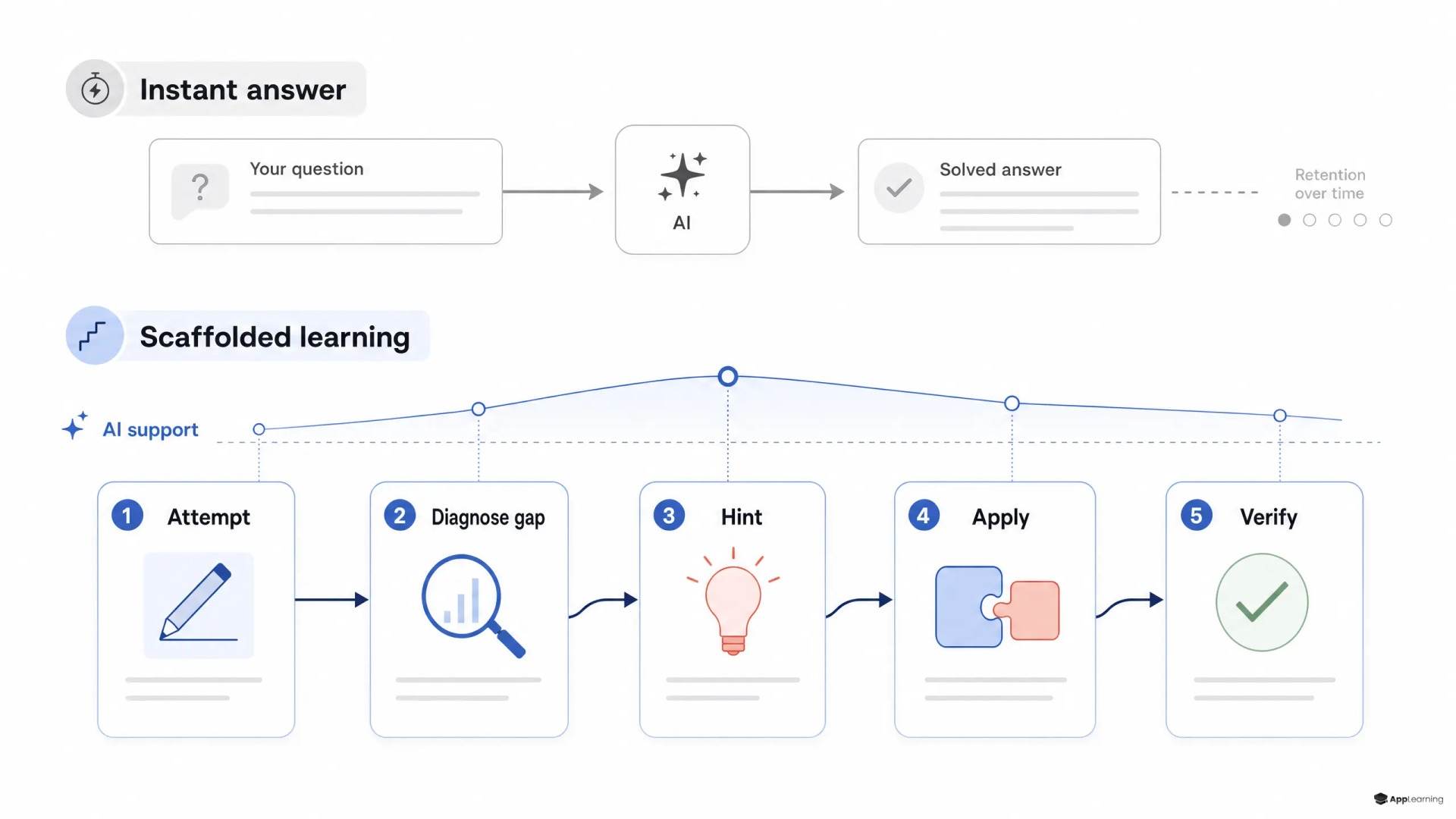
A good agent does not merely decide whether to help. It sequences help so that support follows visible learner thinking.
- Attempt before assist. Require a committed answer, decision path or first draft before the agent reveals targeted support.
- Graduated hints. Start with a cue or relevant rule, then offer a partial structure, then a worked step. Reveal the full solution last.
- Explanation gates. Ask learners to explain why an AI suggestion fits the case before they can accept or submit it.
- Application switches. After an explanation, change the facts, constraint or customer context and require a new decision.
- Unaided checks. Re-test the same capability later without AI access, using a fresh scenario rather than a copied question.
Evidence After the Agent Leaves
An AI-assisted training assessment should not end when the learner accepts the agent’s answer. Verify learning in three stages: performance with support, a later unaided check and transfer to a changed scenario. The final two stages show whether the learner built a usable mental model or only followed a well-timed prompt.
Do not treat every wrong first attempt as failure. It is diagnostic evidence. The agent should identify the missing distinction, select the smallest useful scaffold and record whether the learner can recover. That creates a feedback loop for the learner and a content-quality loop for the L&D team.
Metrics That Expose Dependency
Completion, satisfaction and time spent are useful operational signals, but they can conceal over-assistance. Learner agency in AI-assisted training becomes measurable when analytics connect support to later independent performance.
- Assistance dependency rate by role, skill and scenario type.
- Average hint depth before a correct decision.
- Unaided retention after a delay.
- Transfer performance when facts or constraints change.
- Human escalation rate for ambiguous or high-risk cases.
Good to know
Does productive friction make learning slower?
It can make a single task take longer. That is appropriate when the task rehearses a capability employees must later perform without AI support. Remove effort that does not serve that capability.
When should an agent provide the answer immediately?
Provide it when speed, safety or navigation is the objective, or when the learner has already demonstrated the underlying skill. Do not withhold help in an urgent operational situation merely to create a training moment.
Which signal most clearly shows over-assistance?
Watch the gap between supported performance and later unaided performance. A large gap means the experience may be producing completion without durable capability.
High-Stakes Scenarios Keep Humans in the Loop
In a finance onboarding module, an agent can ask an employee to triage a transaction-monitoring case, name the evidence that matters and justify the next step. It can then point to the relevant internal policy or expose a missed clue. It should not autonomously certify judgment in an ambiguous case. Route uncertainty and sensitive decisions to a qualified human reviewer.
The same pattern works in a product academy. Give a team a new payments, custody or account-recovery workflow and ask them to identify the customer impact, operational risk and escalation path. The agent can challenge assumptions and generate variants. The learner still has to make the case.
Design training that builds judgment without creating AI dependence.
DiscussAttempt Scaffold Verify
App-Learning can encode this pattern across tutors, scenario practice and assessments: attempt first, scaffold only to the next productive move, then verify unaided performance. That keeps automation where it belongs—accelerating feedback, adaptation and content operations—while preserving the practice that creates competence. The strongest agentic learning systems will make learners faster because they think better, not because the system learned to think for them.