

Key takeaways
- CMS count is an operational metric, not just an architectural detail.
- Self-hosting the editor does not necessarily mean controlling the content backend.
- Editorial workflows, structured APIs and deployment control belong in one evaluation.
- Reusable integrations and established support routines have economic value.
- Another CMS needs enough product value to justify another long-term support surface.
Every CMS You Add Becomes a System You Have to Operate
A polished editor can make a CMS look like an obvious choice for a bank’s academy. The harder decision sits behind the demonstration. Who maintains the integrations, tests updates, restores content and investigates failed publishing? Enterprise CMS selection should end with an operating commitment, not a feature score.
Launch costs hide the longer commitment
The evaluation should distinguish implementation effort from recurring work. A useful content platform TCO model includes licensing, hosting, editorial administration, integration maintenance, security work, performance testing, support and eventual migration. The comparison should cover several years under the same service expectations, rather than comparing one system’s subscription with another’s development estimate.
The editor, backend and delivery need separate boundaries
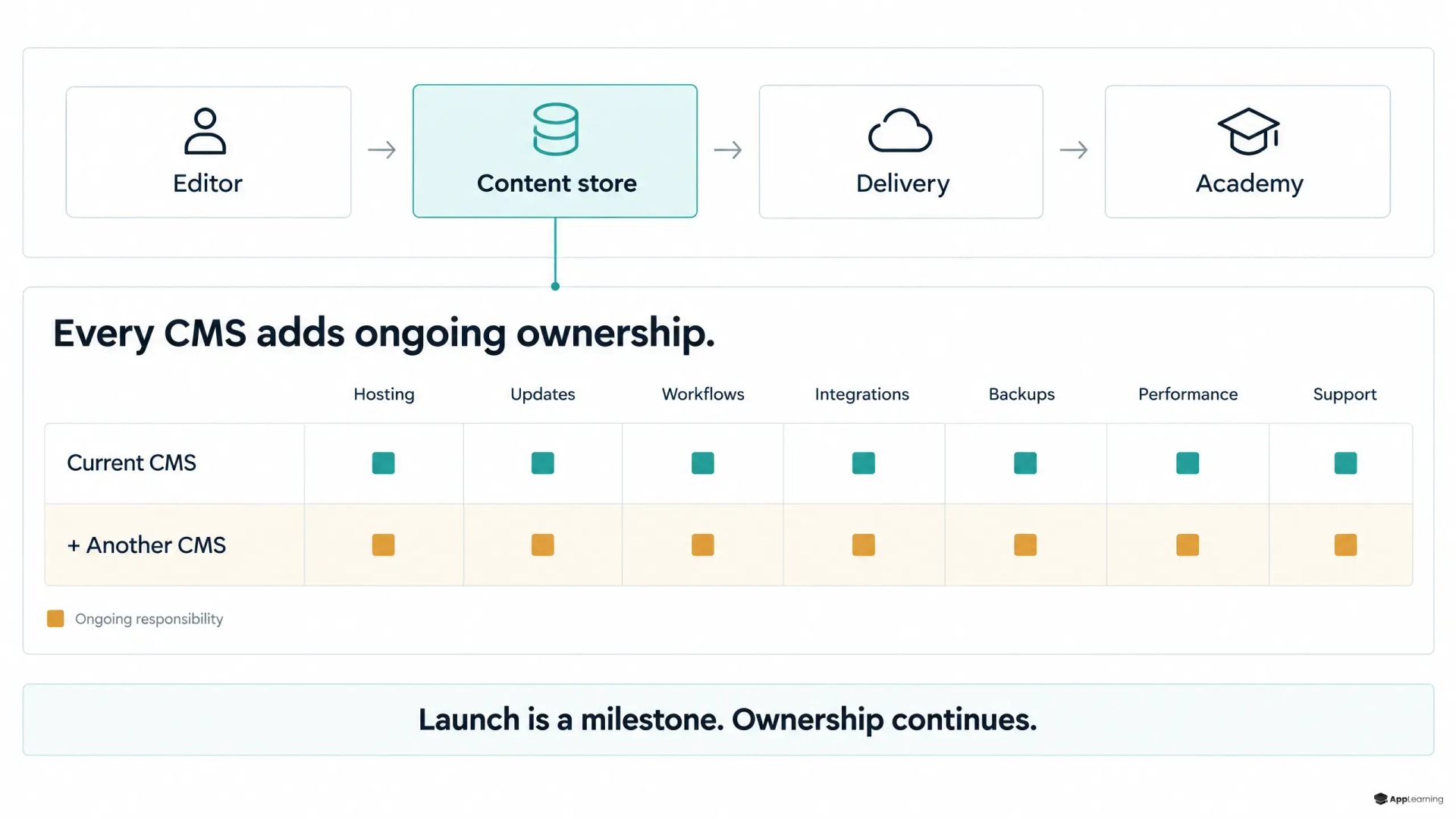
A useful LMS CMS architecture map separates three responsibilities.
- The editor covers authoring, review, permissions and preview.
- The content backend covers storage, assets, versioning and APIs.
- Delivery covers publishing, caching and presentation inside the academy.
Each layer needs a named operator and a documented failure path. Learning records and completion evidence should remain explicit responsibilities rather than assumptions hidden inside the CMS choice.
Self-hosting needs a precise boundary
Sanity, for example, documents a self-hosted Studio that connects to its hosted APIs and Content Lake. (sanity.io) Hosting that editor is therefore not equivalent to hosting the complete content backend. A self-hosted learning CMS requirement should specify which components must run under the bank’s control, where content may reside and which external services remain necessary.
Automation changes the work rather than removing it
WordPress’s backup guidance distinguishes database content from files such as plugins, themes and assets. (developer.wordpress.org) The operating model should therefore define the complete recovery unit, acceptable recovery time and responsibility for testing restoration.
WordPress also provides automatic updates and recommends keeping software current for security. (developer.wordpress.org) Automation deserves credit in the evaluation, but the proposal still needs owners for compatibility checks, rollback, monitoring and incident response. Managed hosting should be assessed against those responsibilities, not treated as their disappearance.
Existing tooling has value without becoming a veto
WP-CLI supports scripted tasks including plugin updates and database exports. (make.wordpress.org) Where a delivery team already operates such tooling, its tested procedures belong in the comparison. So do reusable publishing integrations, deployment pipelines and support knowledge. These are avoided implementation costs, not reasons to preserve an unsuitable platform indefinitely. A new CMS should demonstrate benefits beyond novelty.
API quality and editorial usability need one test
Drupal’s JSON:API module exposes structured content through a REST API. (drupal.org) That capability is useful evidence, but not a complete selection argument. A representative academy pilot should follow one banking lesson from expert drafting through review, role-specific delivery, revision and withdrawal. The test should expose both integration effort and editorial friction.
Review your academy’s CMS operating model with App-Learning before adding another stack.
DiscussA supported portfolio makes exceptions deliberate
For App-Learning, the stronger approach is a small portfolio of supported operating patterns, each with deployment boundaries, reusable integrations and clear ownership. An exception should identify the learning capability the existing portfolio cannot provide, its continuing cost and its accountable owner.
CMS count belongs on the operating dashboard, but count alone is not the target. The goal is justified complexity. Another system earns its place when its value to the academy outweighs the work of keeping it dependable long after launch.