

Key takeaways
- External service roadmaps belong inside academy planning, even when the LMS code stays unchanged.
- A useful ledger connects dependencies to owners, costs, data sensitivity, lifecycle dates and fallback paths.
- Pricing changes and deprecations need impact reviews before deadlines turn them into emergencies.
- CI success requires evidence that required jobs actually ran and passed.
- Shared infrastructure needs client-level impact mapping and migration plans.
The academy roadmap extends beyond the codebase
Consider three signals from separate systems: an automation service announces usage-based billing, a database approaches retirement, and an integration workflow fails without executing any jobs. Each demands the same response—identify the learning capability at risk, its owner and the next viable step.
NIST’s Cybersecurity Framework 2.0 includes supplier-service inventories, (tsapps.nist.gov) a useful baseline for managed LMS operations. The operational extension is a living dependency ledger that connects each external service to the academy’s roadmap and budget.
The ledger connects services to learning capabilities
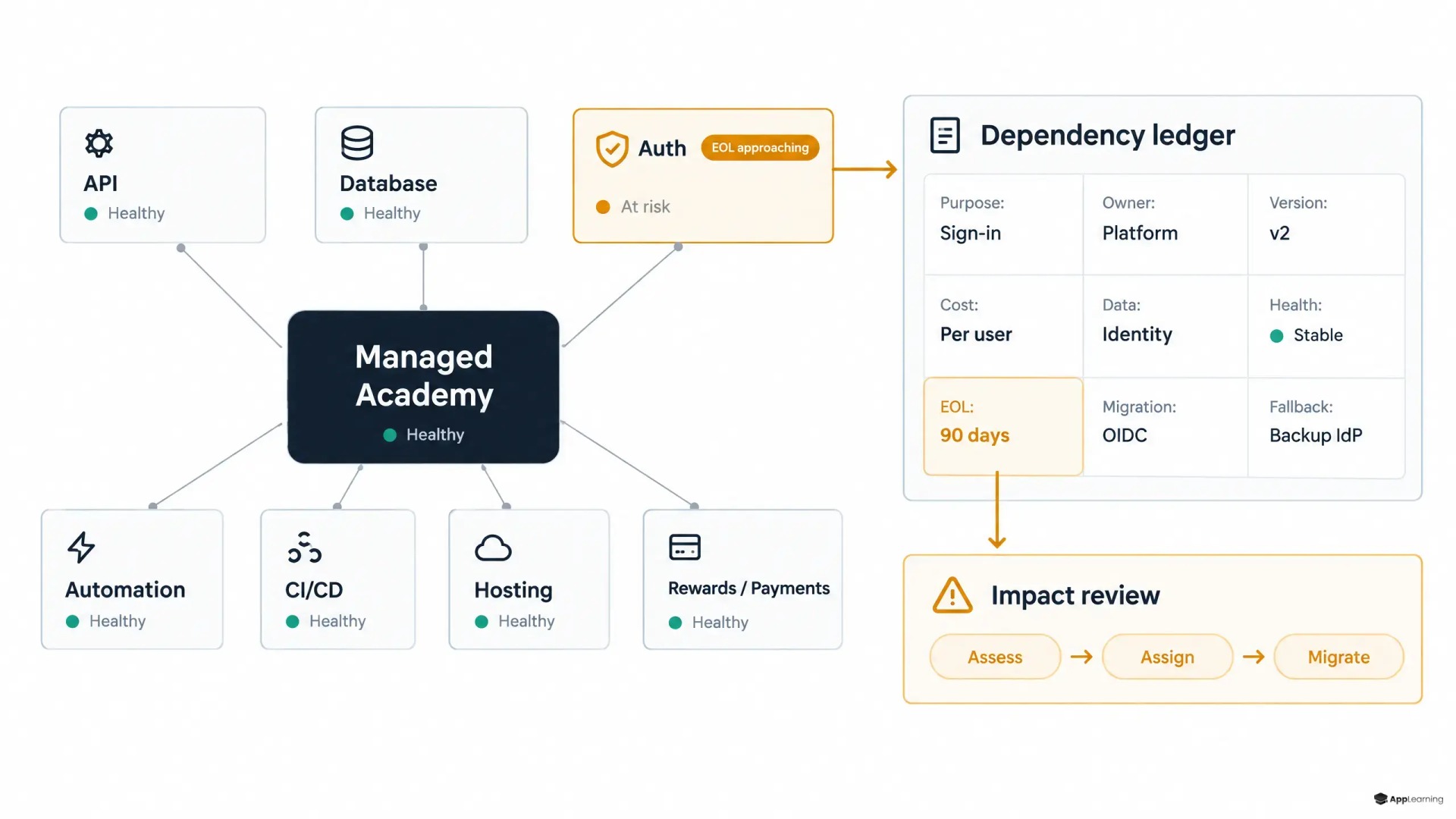
LMS dependency management needs more than package names. The ledger should cover material APIs, databases, authentication, automation, payment and reward services, CI workflows and hosting. An AI content service belongs there too when publishing depends on it.
- Purpose and scope — supported capability, connected systems and affected client academies.
- Ownership — accountable person, deputy and escalation route.
- Version and lifecycle — API, runtime or SDK version, end-of-life date and provider deadline.
- Cost model — billing unit, baseline usage, renewal date and alert threshold.
- Security scope — data sensitivity, access permissions and security requirements.
- Health signal — capability-level check, expected result and last verification.
- Exit path — migration target, fallback, recovery limits and last rehearsal.
For a growing startup, a shared table can be enough. This SaaS dependency register earns its place when an owner uses it to resolve a change, not when every cell looks complete.
Usage pricing belongs in the operating budget
The FinOps Foundation recommends closer monitoring of consumption-based SaaS, (finops.org) making the billing unit an operational concern. If automation moves from a flat fee to per-execution charges, the impact review should model ordinary onboarding, hiring peaks and retries before the new terms take effect.
The ledger should record the decision deadline and options: accept the cost, reduce unnecessary executions or migrate. A cheaper replacement is not cheaper if the comparison excludes implementation and support.
End-of-life dates need delivery slots
PostgreSQL’s versioning policy requires a distinct migration process for major upgrades, (postgresql.org) using pg_upgrade or dump/reload. An upgrade notice therefore needs more than a reminder: it needs capacity for compatibility checks, backup verification and recovery planning.
The ledger should distinguish upstream support expiry from a hosting provider’s cutoff. The same discipline applies to API deprecation management, runtimes and SDKs: a dated notice becomes an owned delivery task.
A green pipeline is not execution evidence
GitHub documents that a skipped job reports success, (docs.github.com) even when it is a required check. CI acceptance should therefore verify that required jobs executed and passed for the intended revision, rather than trusting a workflow’s existence or headline status.
Shared infrastructure needs client-level boundaries
NIST’s supply-chain guidance connects criticality analysis with business dependencies, (nvlpubs.nist.gov) a useful basis for mapping each service’s potential impact. A shared authentication failure and delayed reward delivery should not inherit the same recovery priority.
For shared LMS infrastructure, each client should have explicit downtime tolerance, data boundaries and fallback expectations. A migration plan also needs a sequence that avoids changing every academy at once.
Map your academy’s dependencies with App-Learning.
DiscussQuarterly reviews turn inventory into lifecycle management
A quarterly academy platform maintenance review should reconcile costs, deadlines, ownership and recovery tests. Pricing notices, security changes and incidents should trigger updates immediately rather than wait for that meeting.
This is the App-Learning view of managed academy operations: explicit lifecycle management, not invisible hosting. Founders should not need to understand every integration. They should be able to see who owns it, what it supports and what happens when it changes.