

Key takeaways
- Release improvements cover only part of the host-to-first-question journey.
- Wasm and experimental browser-native text layout need separate validation.
- Content hashing needs correct cache headers and release-safe asset retention.
- Host Web Vitals and quiz readiness measure different parts of the experience.
- Authentication, durable progress and accessible navigation belong in the launch contract.
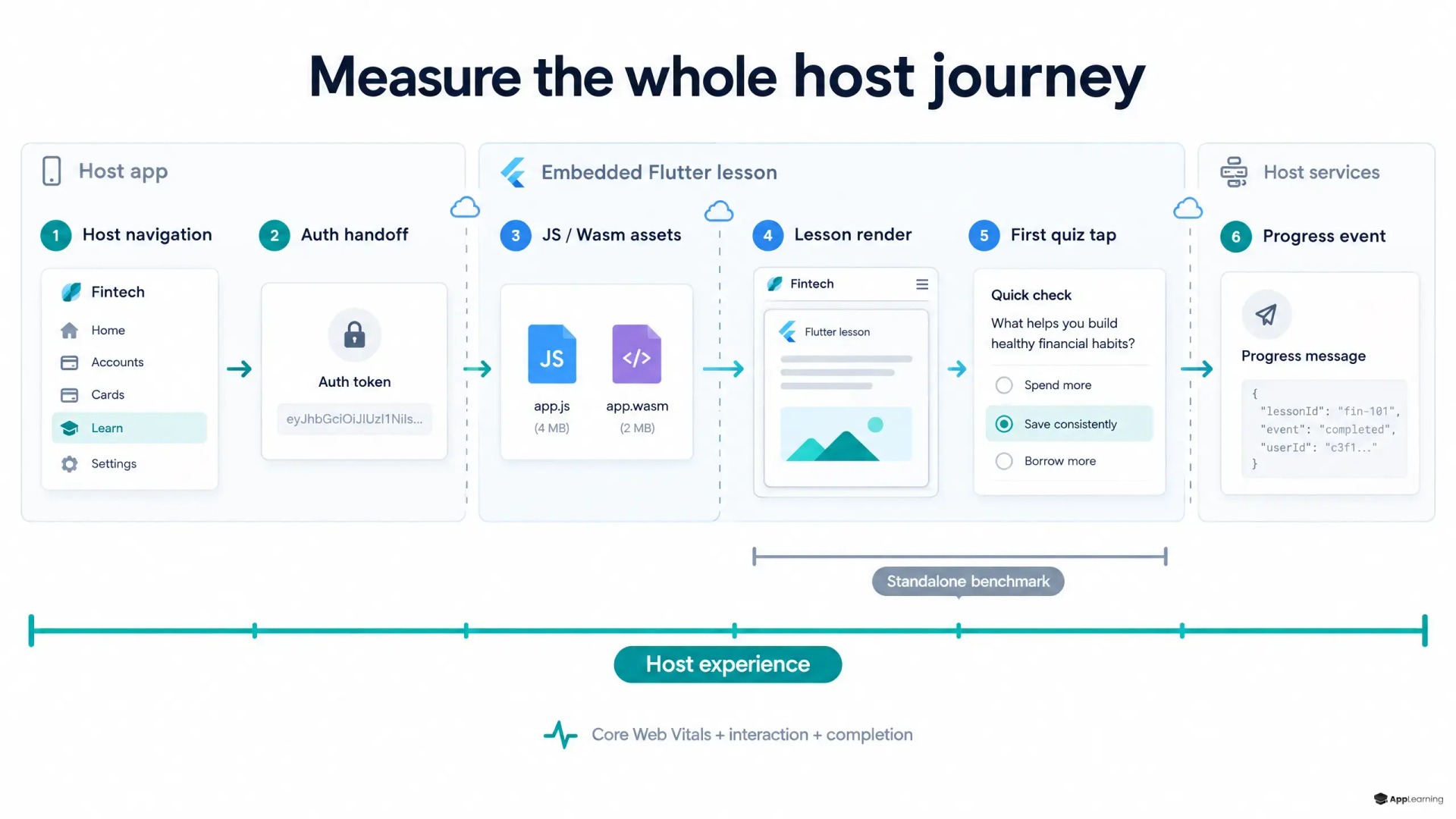
An embedded academy belongs inside the host product’s performance budget. For fintech in-app learning, the useful finish line is a question that accepts input, not a loading screen that appears quickly.
Flutter 3.50 changes components, not the whole journey
Flutter’s release announcement (flutter.dev) confirms that Flutter 3.50 shipped on November 11, 2026 with Dart 3.14, Wasm improvements and built-in content hashing. For a Flutter 3.50 embedded app, these are useful tools—not evidence that the complete learning journey is faster.
The host-to-question trace exposes the real wait
Flutter’s updated embedding guidance (docs.flutter.dev) covers reserved container dimensions, deferred loading and competition with host resources. The operational implication is clear. If host layout, scripts or network requests delay academy startup, faster rendering alone cannot remove that wait.
A useful trace starts at the academy entry-point tap. It marks bootstrap requested, assets available, authentication ready, first frame and first question ready under one journey ID. Overlapping spans should remain visible rather than being added together. Answer-to-feedback latency and server-confirmed progress need separate measurements.
Wasm and multilingual text need separate decisions
The browser compatibility documentation (docs.flutter.dev) distinguishes Wasm capability from default selection. Safari 26.2+ and Firefox 147+ require explicit allow-list configuration in Flutter 3.50; unsupported browsers retain JavaScript fallback. Flutter WebAssembly performance therefore needs testing by browser and implementation, not a universal percentage claim.
The release’s browser-native text layout preview (flutter.dev) uses WebParagraph and an experimental browser API. It is not a stable cross-browser baseline. Multilingual acceptance should still cover long translations, right-to-left text, missing glyphs, emoji and enlarged text on actual target devices.
Content hashes require a release-safe cache policy
Flutter’s deployment guidance (docs.flutter.dev) pairs Flutter web content hashing through `--web-content-hash` with long-lived immutable caching for hashed files and revalidation for bootstrap and other unhashed files. Returning users need the new bootstrap to discover new assets. Active tabs also need old hashed assets retained during rollout, with entry files published atomically last. Hashing does not replace deployment discipline.
There is also a build constraint. Content hashing currently cannot be combined with deferred imports, including Wasm deferred loading. That trade-off belongs in the build decision before launch.
Identity, progress and focus are integration contracts
The host and academy should agree on login handoff, token expiry, logout propagation and recoverable errors. Progress should have a defined server acknowledgement, duplicate-safe retries and a versioned export event for host analytics. A completion animation is not the persistence acceptance test.
W3C’s keyboard guidance (w3.org) requires users to be able to leave embedded components using the keyboard. The launch contract should cover focus entry, visible focus, screen-reader labels and focus restoration when the academy closes—not just navigation within the quiz.
Plan your embedded academy launch with App-Learning.
PlanLaunch gates belong in the representative host
Flutter’s performance guidance (docs.flutter.dev) separates release-build startup testing from runtime profiling and covers LCP, INP and CLS. These host-page metrics should accompany custom readiness marks, not replace them. The following are proposed acceptance checks, not reported customer benchmarks.
- Compare cold and return loads in representative hosts across Chrome, Safari, Firefox and supported mobile WebViews.
- Set millisecond ceilings for tap-to-question readiness and answer feedback, with p75 results segmented by device and network.
- Check host Web Vitals before and after embedding, including layout shifts when the academy mounts.
- Exercise expired login, interrupted connectivity, progress recovery, export retries and releases with an older tab open.
- Complete keyboard, screen-reader, locale and text-scaling checks inside each supported host.
For App-Learning’s modular academies, the implementation boundary should not become the quality boundary. The academy is ready when learners can enter, answer, save and return without degrading the surrounding product. That is the performance budget worth owning.