

Key takeaways
- Off-the-shelf LMS tools launch fast but can still feel like a separate system.
- Custom academies can align product education with brand, audience, and lifecycle journeys.
- Moodle offers control and flexibility but requires real technical ownership.
- App-Learning provides a managed custom academy route without a heavy internal build.
For a fintech product, education is rarely a back-office training task. It helps users understand risk, complete setup, use key features, and build enough confidence to reach first value. That makes the custom academy platform vs off the shelf LMS decision a product and growth decision, not a procurement exercise. The central question is simple: do you need a place to host courses, or a learning experience that works as part of onboarding, lifecycle communication, and trust building?
Two Platforms With Different Jobs
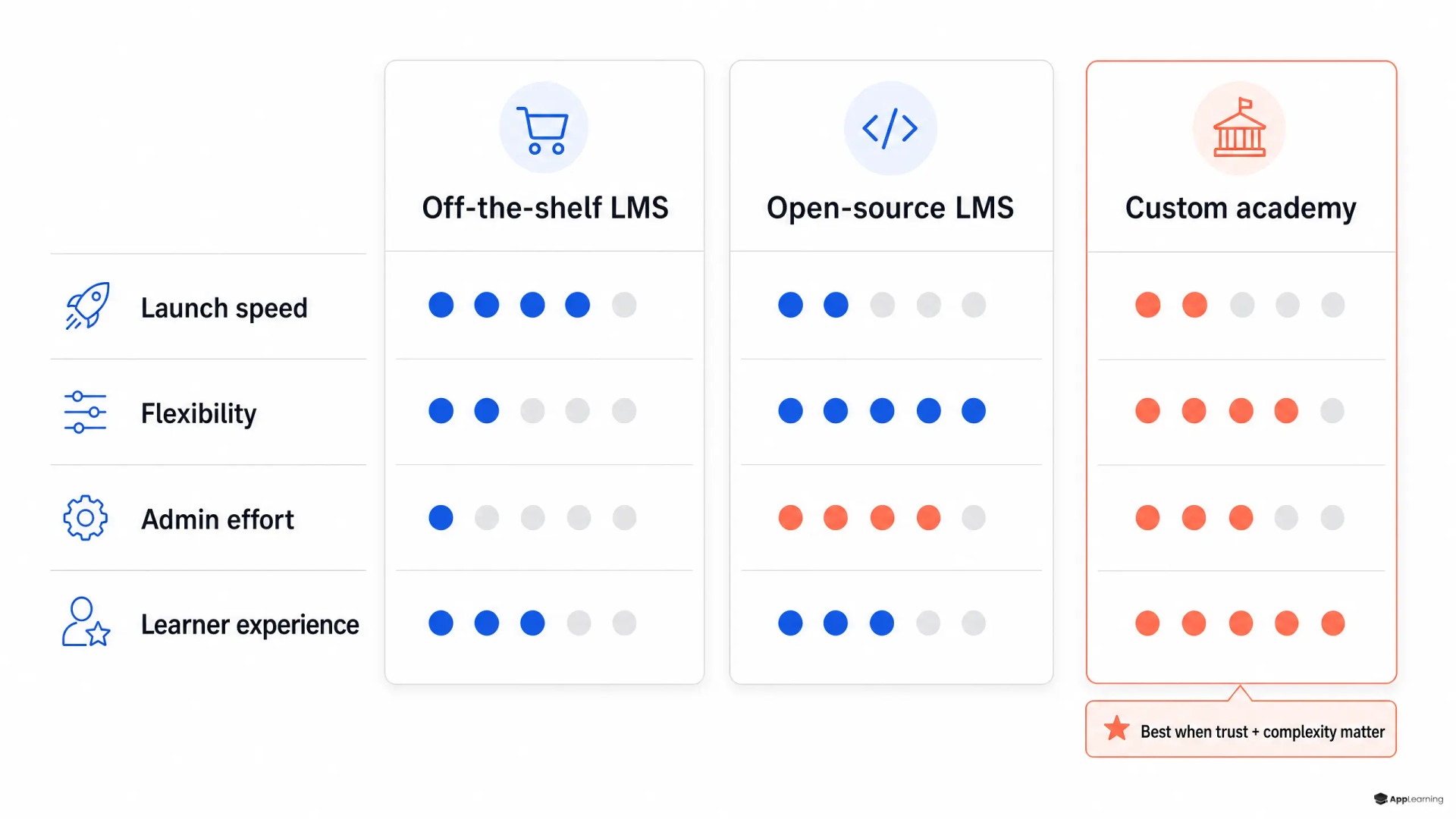
An off-the-shelf LMS is a ready-made system configured through settings, templates, permissions, and integrations. It is often the right answer when the audience is known, the material is stable, and the priority is getting mandatory or internal training live with minimal setup. Modern LMS products can go beyond a default portal: TalentLMS supports custom domains, themes, and white-label options, for example. That can be enough when the learning experience does not need to carry the same weight as the product experience.
A custom academy platform does not have to mean building software from scratch. It means shaping the academy around a specific learning system: the audience, the product moments that trigger learning, the content formats, the brand, and the data needed to improve the journey. For a fintech, this may include a clear path from account setup to security basics, investment concepts, feature education, and advanced use cases. The learner sees one coherent environment rather than a course catalogue attached to the side of the business.
Speed Is Only One Part of the Cost
Off-the-shelf tools reduce time to first launch. But the fastest launch is not always the fastest route to a useful academy. When teams try to force a product-education programme into a generic structure, they often create workarounds in content, design, reporting, and learner communication. The platform may be live, while the operating model remains fragmented.
- Choose an off-the-shelf LMS when training is mainly internal, compliance-led, or based on a stable course catalogue.
- Choose a tailored academy when external learners need a trusted, branded route through a complex product or financial topic.
- Treat brand as more than colours and logos. It includes language, information hierarchy, interaction patterns, and the confidence the experience creates.
- Assess content operations early. Frequent product changes need reusable modules, clear review workflows, and learning paths that can change without rebuilding the whole academy.
This is where a custom LMS alternative earns its place. It gives Product, Growth, Content, and CX a shared system for explaining the product. Instead of publishing one long explainer after another, teams can turn recurring questions, onboarding friction, and feature launches into short learning units that fit a learner’s stage.
The Academy as a Growth Surface
For external users, the academy should not be judged by completions alone. The useful measures sit closer to the product journey: progression through a learning path, quiz results that reveal misunderstandings, return behaviour, and movement toward key product actions. This requires a platform designed for more than course administration. It requires a content system that can connect learning signals to product and lifecycle decisions.
App-Learning is designed for this managed route. Its academy platform supports branded customer and employee academies with learning paths and analytics, while its content-creation service turns source material and expert input into short modules with review and quizzes. The point is not to outsource ownership of education. It is to avoid spending internal product and engineering capacity on commodity platform work while keeping the academy aligned with the product.
Good to know
Does a custom academy platform require a full bespoke build?
No. A custom academy can use an established platform while tailoring the learner journey, content model, brand experience, integrations, and reporting to a specific product and audience. The key distinction is the operating design, not whether every line of software is written from zero.
Can an off-the-shelf LMS be branded enough for customer education?
Often, yes. Platforms can support custom domains, themes, portal pages, notifications, and removal of vendor branding through options such as TalentLMS white-label controls. The limitation appears when the academy needs product-specific journeys or content operations that exceed those configuration boundaries.
When is Moodle the better option?
Moodle is a strong fit when source-code access, hosting choice, and deep technical customisation are strategic requirements. Its official guidance notes that organisations can self-host or work with partners for implementation, hosting, integrations, themes, support, and course design, which makes the ownership model a central selection criterion.
Moodle Changes the Ownership Equation
Moodle belongs in this comparison, but not as a simplistic free alternative. Its open-source model gives organisations access to the code and the freedom to customise how the platform works, including themes, integrations, and functionality. In exchange, Moodle makes ownership more explicit: the organisation needs its own resources for hosting and support, or a service partner to provide them, as Moodle explains in its open-source guidance.
That can be a strong choice when technical control, hosting requirements, or deep platform customisation are strategic priorities. It is less attractive when a fintech team needs to focus on learner journeys and content velocity rather than infrastructure, upgrades, plugin compatibility, and specialist support. Moodle is flexible software; it is not a substitute for a clear academy operating model.
Design education around the moments that drive product confidence.
Talk to usA Practical Build or Buy Decision
Use this checklist before selecting a custom training platform or signing an LMS contract.
- Audience: Are learners employees completing assigned training, or customers deciding whether they understand and trust your product?
- Complexity: Can the subject be taught through independent courses, or does it require progressive paths, repetition, and product-specific scenarios?
- Experience: Is white-label configuration sufficient, or must the academy feel like a native part of the product and brand?
- Operations: Who will update lessons after product, policy, or market changes, and how quickly must those updates go live?
- Ownership: Do you have the technical capacity to run an open-source platform, or do you need a managed service with clear content and platform support?
- Measurement: Can the team connect learning activity to activation, feature adoption, support demand, and retention decisions?
A generic LMS is a sensible tool when learning is contained and operational. A tailored academy becomes more valuable when education must reduce product complexity at scale. For fintech teams, that threshold often arrives earlier than expected: the moment user understanding becomes a condition for trust, activation, and durable retention, the academy stops being a library of courses and becomes part of the product system.