
Key takeaways
- AI training has a shorter shelf life than traditional curricula.
- Communities of practice extend learning into real implementation cycles.
- Peer exchange needs structure, moderation and approved patterns.
- Microlearning and assessments turn community insights into reusable organizational knowledge.
Course completion is only the starting point
AI courses teach a snapshot. They reflect a tool set, a policy position and a set of workflows that may change before learners apply them at scale. That makes one-off training necessary but insufficient. In finance and crypto, a prompt pattern that was acceptable last quarter may be inappropriate after a model, vendor control or internal policy changes.
The learning design is already shifting in this direction. In August 2026, the Day of AI curriculum pathway paired an eight-hour virtual deep-dive with five community-of-practice sessions running into June 2027, with participation required for certification. ServiceNow also scheduled three AI Learning Days in August 2026 around learning alongside experts and peers. These are education programs, not enterprise blueprints, but their design makes sense: formal instruction starts capability; peer practice keeps it usable.
The practice layer makes training operational
An AI community of practice is not a social group attached to a course. It is a working system where people using AI in similar conditions compare workflows, surface exceptions and improve the shared standard. The OECD describes communities of practice as collaborative, hands-on and peer-to-peer groups that build skills while managing practice-based knowledge resources in a specific domain.
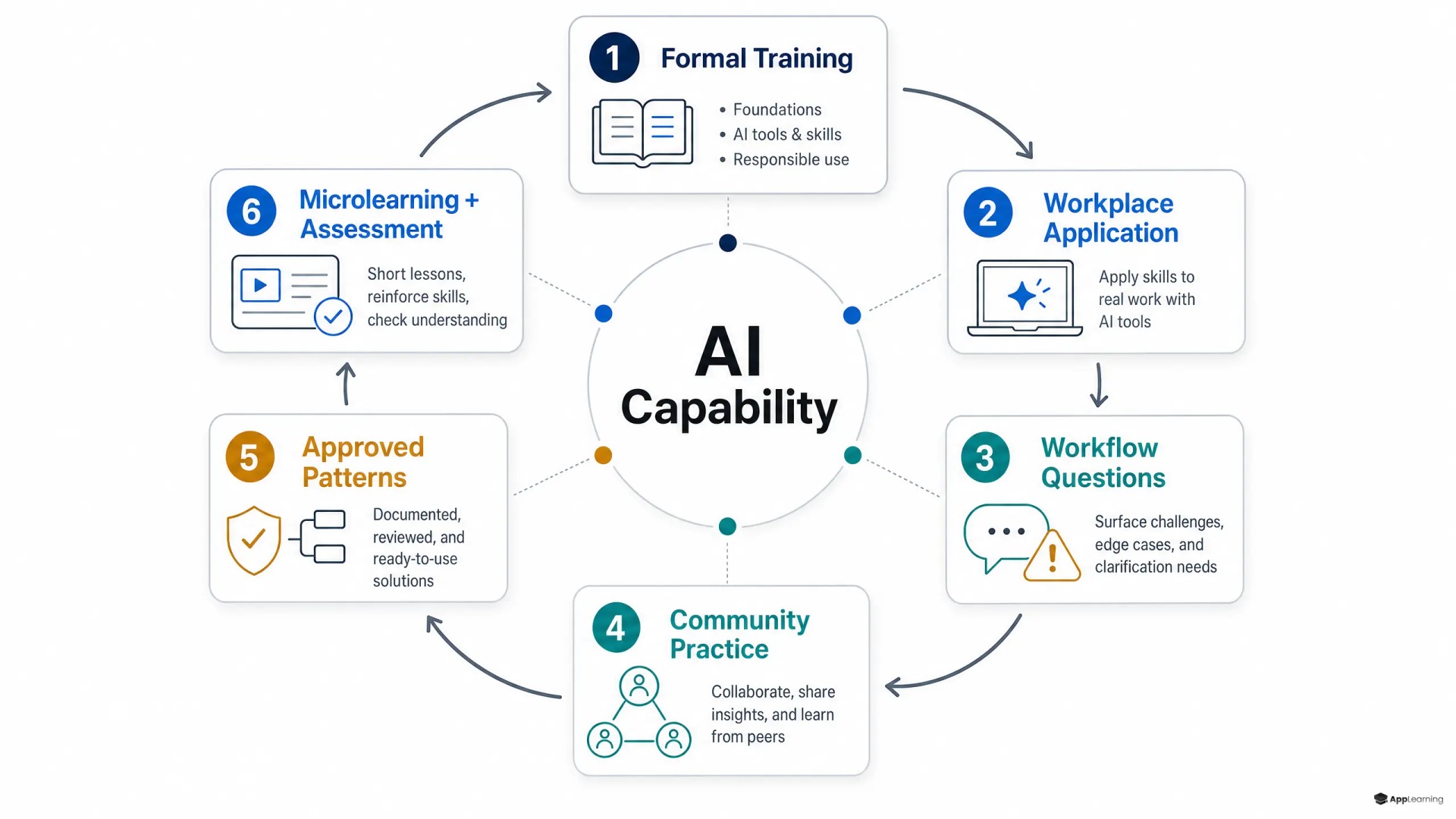
For an AI enablement program, that means the community should create a visible loop between use and learning:
- Employees bring real workflow questions, failures and emerging use cases.
- Peers compare approaches within defined boundaries rather than inventing workarounds alone.
- Subject-matter, risk and legal owners approve or reject reusable patterns.
- Learning teams turn approved patterns into short refreshers, scenarios and assessments.
- The organization retires guidance once it is no longer safe, useful or current.
This is AI training reinforcement, not an optional discussion forum. It moves learning from a completion event into the implementation cycle where skill gaps become visible.
The Slack channel trap
Many organizations start with a dedicated AI Slack or Teams channel. It fills quickly with useful energy and then degrades. Questions repeat. Good answers disappear in threads. Employees cannot tell whether a shared prompt, data-handling tip or vendor recommendation has been reviewed. The channel becomes a record of conversation, not a reliable source of practice.
That failure is more serious in regulated environments. Informal advice can quietly become operating behavior before compliance, information security or model-risk owners have reviewed it. A community needs a searchable home for approved answers, a way to flag uncertainty, and named people who can close the loop. Without those controls, peer learning increases speed but also spreads inconsistency.
Turn recurring signals into learning assets
The most valuable community content is often not a polished playbook. It is the recurring question that reveals where the current training no longer fits the work. “Can I use customer data in this workflow?” “Which model is approved?” “How do I verify this output?” Those questions should trigger a production process, not another thread.
- Moderators tag repeated questions and identify high-risk themes.
- Learning designers turn stable answers into two-minute microlearning modules or role-specific scenarios.
- Control owners validate the content, scope and review date.
- Employees complete a short knowledge check before applying the pattern in sensitive work.
- Analytics show where questions persist, where assessments fail and which guidance needs revision.
This creates continuous AI learning without asking employees to repeat a full course every month. It also gives HR and L&D a better measure than completions. They can see which teams need support, which policies cause friction and which capabilities are becoming part of daily work.
Good to know
Who should join an AI community of practice?
Start with employees who actively use AI in defined workflows, plus learning, compliance, security, legal and subject-matter owners. Expand once the operating model can handle questions and review work.
How is a community of practice different from an AI chat channel?
A chat channel supports conversation. A community of practice has a purpose, moderation, approved knowledge, escalation paths and a process for turning recurring questions into maintained learning assets.
What should HR and L&D measure?
Track recurring questions, time to publish updated guidance, assessment results, certification status for sensitive workflows and differences between teams. These measures show capability gaps more clearly than course completion alone.
Governance keeps shared knowledge safe
Community activity needs a clear operating model. Give each domain an accountable owner, such as customer service, engineering, risk or operations. Assign a moderator who routes questions and maintains quality. Define escalation paths to security, legal, compliance and data protection. Then attach an owner, scope, version and review date to every approved learning asset.
This matters because useful knowledge must also be protected and retired. The OECD's framework for communities of practice links effective knowledge management with creating, sharing, protecting and discarding obsolete knowledge. That is the right discipline for enterprise AI upskilling: keep the useful pattern, protect the controlled one and remove the outdated one before it becomes default behavior.
Build a governed AI learning layer that keeps capability current.
Talk to usA structured backbone for peer learning
The community should remain close to the work. It can live in the collaboration spaces employees already use. But the structured learning layer should sit beside it, not inside an endless message stream. This is where App-Learning can provide the backbone: short refreshers after policy changes, scenario updates by role, assessments for high-risk workflows, certifications for defined capability levels and analytics that show whether knowledge is holding.
The goal is not to formalize every conversation. It is to capture the conversations that matter, turn verified lessons into reusable practice and keep AI capability current as tools, controls and work itself continue to change.