

Key takeaways
- Workforce data prioritises investigation rather than proving an individual skill gap.
- Practice coaching and recorded performance evaluation need separate purposes and access.
- Short scenarios work best around one observable workplace decision.
- SME approval, privacy limits, voluntary coaching and fairness checks belong in the design.
- Retention and workplace behaviour require separate measures; vendor announcements do not establish efficacy.
A catalogue cannot diagnose a failed handoff
A static catalogue can state what employees should know. It cannot explain why exception handoffs fail after a role changes. The academy’s task is to connect a credible signal to a decision worth practising, then check what changes at work.
Surface connects workforce signals with practice support
In its November 17, 2026 announcement, (globenewswire.com) Surface describes workforce intelligence, expert-developed training and personalised AI coaching in one learning offering. That is a product description, not independent evidence of learning impact. A workforce intelligence learning loop still needs a defensible link between a signal, a practice task and workplace behaviour.
For empirical context, a 2026 qualitative study of gamified workplace training, (onlinelibrary.wiley.com) based on interviews with 24 employees in one Spanish public-sector organisation, reports perceived improvements. Its findings do not establish causal effects for banking or AI coaching.
Repeated exceptions are a hypothesis to investigate
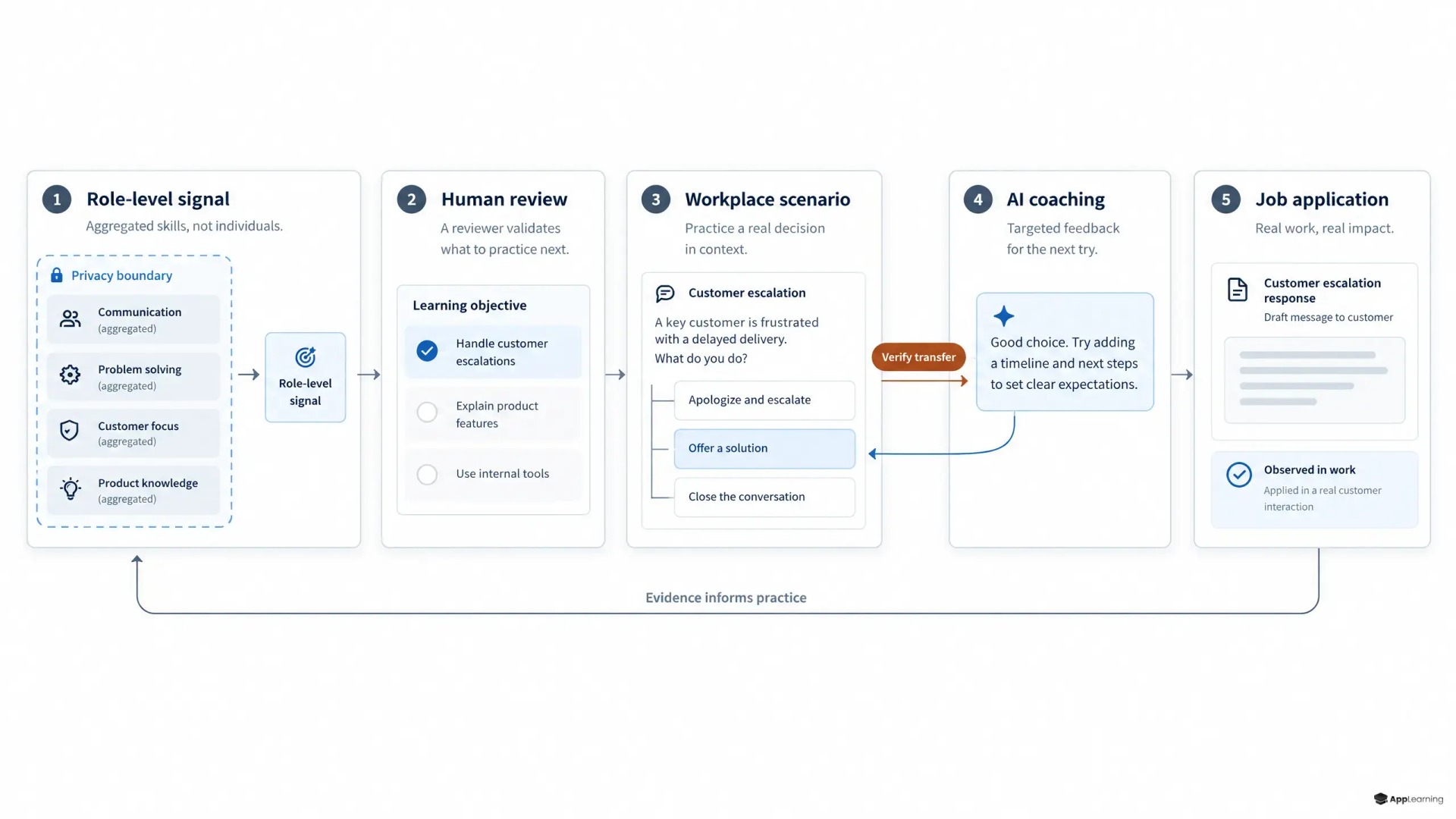
Consider a hypothetical bank academy. Aggregated quality-review codes show repeated missing evidence in payment-exception handoffs, while role records show a team has taken on new exception types. An operations subject-matter expert checks whether the cause is unclear knowledge, broken routing or insufficient capacity. Only the knowledge problem belongs in the lesson. The signal prioritises investigation; it does not label employees.
Three minutes can rehearse one consequential decision
The objective is narrow: select the correct escalation route and required handoff evidence under the bank’s approved procedure. A fictional case presents incomplete documentation near a deadline. The learner chooses a route and identifies the missing evidence. Answer-specific quiz feedback explains the rule and consequence.
At App-Learning, this is the design unit for skills-based microlearning: one decision, not a compressed policy deck. The SME signs off the scenario, answer logic and procedure version before release. This keeps scenario-based upskilling tied to an observable action.
Retrieval and coaching serve different purposes
In an observational workplace study of spaced retrieval, (link.springer.com) practice timing was linked with later knowledge retention, not demonstrated job performance. A pilot could repeat a changed case after seven and 21 days. AI coaching for employee training would support rehearsal using approved material, with uncertainty referred to an SME. It should not make live payment decisions or replace performance management.
Privacy boundaries shape the learning architecture
Under GDPR Articles 5 and 6, (eur-lex.europa.eu) personal-data processing must be lawful, purpose-limited and minimised. The proposed design therefore needs a documented lawful basis, restricted access, retention limits and privacy review before collection.
According to EDPB guidance, (edpb.europa.eu) employee consent is often unsuitable because of the employment relationship. Optional coaching should have a non-AI alternative without penalty; mandatory training remains separate.
Under Germany’s Section 87(1)(6) BetrVG, (gesetze-im-internet.de) works councils have co-determination rights over employee-monitoring technology. Early review belongs before rollout. Proposed safeguards include suppressed small cohorts, no customer data in prompts, coaching logs excluded from appraisal, and fairness checks across roles and shifts.
Design a focused finance-operations learning pilot with App-Learning.
DiscussThirty days can test exception handoff practice
- Days 1–7 establish baseline handoff quality and agreed success criteria.
- Day 8 releases the approved scenario and optional coach to one cohort.
- Days 15–30 assess delayed recall separately from reopened handoffs per eligible case and control breaches.
A staggered comparison group would strengthen interpretation; case mix and staffing changes still need review. Longer follow-up is needed to assess durable learning transfer.
The useful output is not another completion dashboard. It is a traceable chain from an explainable signal to approved practice and evidence of better workplace decisions, without turning learning into surveillance.