

Key takeaways
- Recommendation, user approval, card tokenization and settlement are separate events.
- Tokenization protects underlying card credentials without making a purchase anonymous.
- Wrong items, exceeded budgets and declines reveal whether users understand consent boundaries.
- Question-level comprehension and support contacts matter more than lesson completion alone.
The launch keeps approval with the user
On 13 November 2026, OpenAI introduced ChatGPT Wallet with American Express, Chase, Mastercard and Visa. As of 17 November, its help guidance describes a gradual rollout through dots for US Pro subscribers aged 18 or older with eligible US-issued credit cards and US billing addresses. Even eligible users may lack access.
Agentic payments education should make one distinction unmistakable. Asking an agent to find something is not the same as approving its purchase.
One checkout crosses five responsibilities
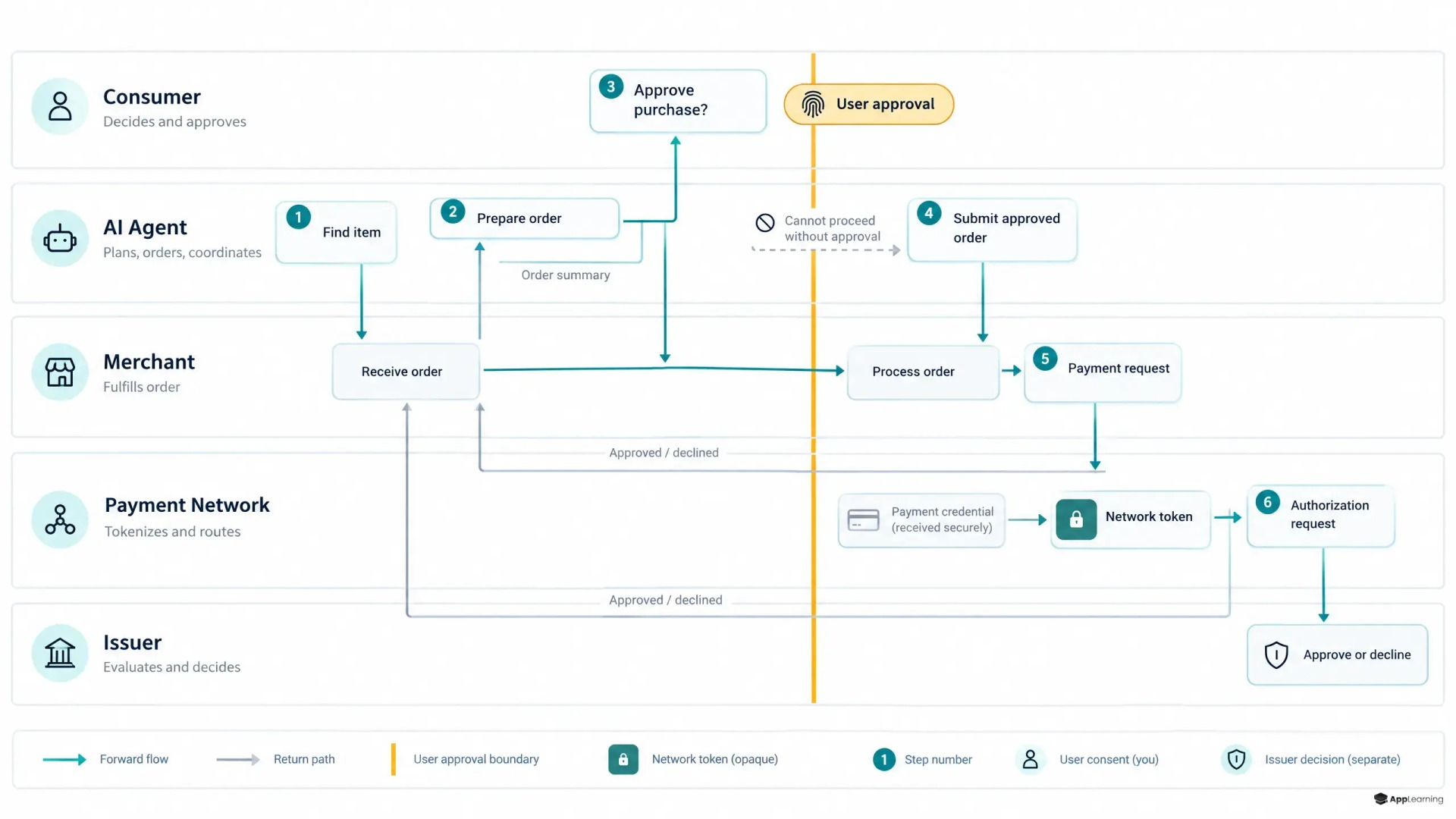
Mapped onto the Treasury’s card-processing model, AI agent checkout needs five visible lanes rather than one success animation.
- Shopping agent researches options and prepares the basket.
- User reviews the merchant, items, total and selected card, then approves through a security check.
- Payment network supplies substitute payment credentials after approval.
- Merchant submits the payment through its payment service provider and acquiring chain.
- Issuer evaluates the transaction and approves or declines it; the merchant separately confirms the order.
Clearing and settlement are separate processing stages. User consent, issuer authorization and the movement of funds should never share one label.
Three shortcuts erase the consent boundary
A saved card is not an open spending mandate. Biometric approval is not an issuer approval or order confirmation. Tokenization is not anonymity.
The Wallet privacy notice says a service provider collects full card details through a secure form, while OpenAI receives a token and limited card information. The agent and merchant receive substitute credentials rather than the underlying card details.
The Wallet terms also contemplate advance authority. That broader contractual language does not establish that autonomous spending shipped in this per-purchase approval rollout.
Three lessons make the boundaries testable
Issuers, PSPs and wallet providers could embed a three-step academy, using Wallet’s operational guidance to anchor the explanations.
- Agent scope separates research and basket preparation from permission to spend.
- Purchase approval explains the displayed merchant, items, amount and card, including any recurring-payment terms.
- Failure and recourse separates merchant returns from issuer charge disputes, with Wallet support for approval errors or purchases differing from what was approved.
A practice basket makes the boundary concrete. The user requested size 9 shoes under $120; the agent selected size 10 with a $132 total.
- Should the user approve because the agent followed most instructions? No. The item and total are wrong; the basket needs correction before approval.
- After correction and approval, the issuer declines. Is the order confirmed? No. Check merchant status before retrying, and contact the issuer about the decline.
Education belongs beside the handoff
Agentic commerce onboarding belongs before enrollment. A card tokenization explainer fits beside credential setup; payment consent UX needs a concise approval summary. Decline and dispute explanations belong beside the relevant status. An App-Learning implementation would structure these as reusable mobile and web modules with approved translations and named content owners.
Build an embedded academy that tests payment consent boundaries with App-Learning.
DiscussComprehension is the claim to test
Visa’s Agentic Ready programme tests payment flows, while Mastercard’s Verifiable Intent addresses evidence of user authorization. Neither announcement demonstrates an education-driven conversion uplift.
The proposed measurement plan should track first-attempt answers by consent boundary, later performance on a changed scenario, and confusion-related help-center contacts per payment attempt. Completion is secondary. Any conversion claim needs a controlled comparison, not a before-and-after assumption.
The academy has done its job when customers can explain who chose, who approved, who processed and who can resolve a problem—even when checkout fails.