

Key takeaways
- Warehouse borrowing capacity depends on eligible collateral, advance rates and facility limits.
- Stablecoin settlement does not improve the credit quality of the financed loans.
- Role-specific scenarios make ownership of monitoring, funding and exception decisions explicit.
- A borrowing-base breach tests coordinated action, not vocabulary recall.
- The announced acquisition is not evidence of a live integrated lending product.
The agreement is not a live lending product
On November 9, 2026, Securitize announced a definitive agreement to acquire River Credit Labs Inc., known as River One. The stated ambition connects stablecoin-sourced capital with warehouse lending, bringing tokenization together with borrowing-base reporting, collateral monitoring, AI-supported underwriting and funding operations.
Securitize’s SEC-filed earnings release gives an expected closing in the fourth quarter of 2026, subject to customary conditions. That supports teaching the proposed operating model, not presenting an integrated customer product as live.
The collateral pool sets the funding limit
Warehouse financing education needs a concrete funding chain. In an illustrative facility, an originator makes small-business loans, pledges an eligible pool and draws a revolving line to fund further lending. Collections repay the line or support further draws under its terms. The OCC’s asset-based lending handbook explains the central constraint behind this example—outstanding borrowing is limited by both the facility commitment and the borrowing base.
Assume €10 million of eligible loans and an 80% advance rate, with no reserves or other deductions. The borrowing base is €8 million. A €7.5 million draw leaves €500,000 available, assuming sufficient facility commitment. A useful reporting exercise traces every exclusion, deduction and outstanding draw rather than displaying only the final balance.
Onchain execution leaves credit judgment intact
The IMF’s discussion of tokenized finance separates programmable transfers and automated rules from legal rights and dispute resolution. It also identifies reserve quality and redemption capacity as stablecoin concerns.
The training implication is straightforward. Stablecoin settlement does not make an overdue loan collectible. A token transfer should not be treated as proof of enforceable collateral rights. For tokenized asset-backed lending, the academy should distinguish ledger events from underwriting, document verification, servicing and authorised exceptions. AI-generated assessments belong inside that accountability map, not above it.
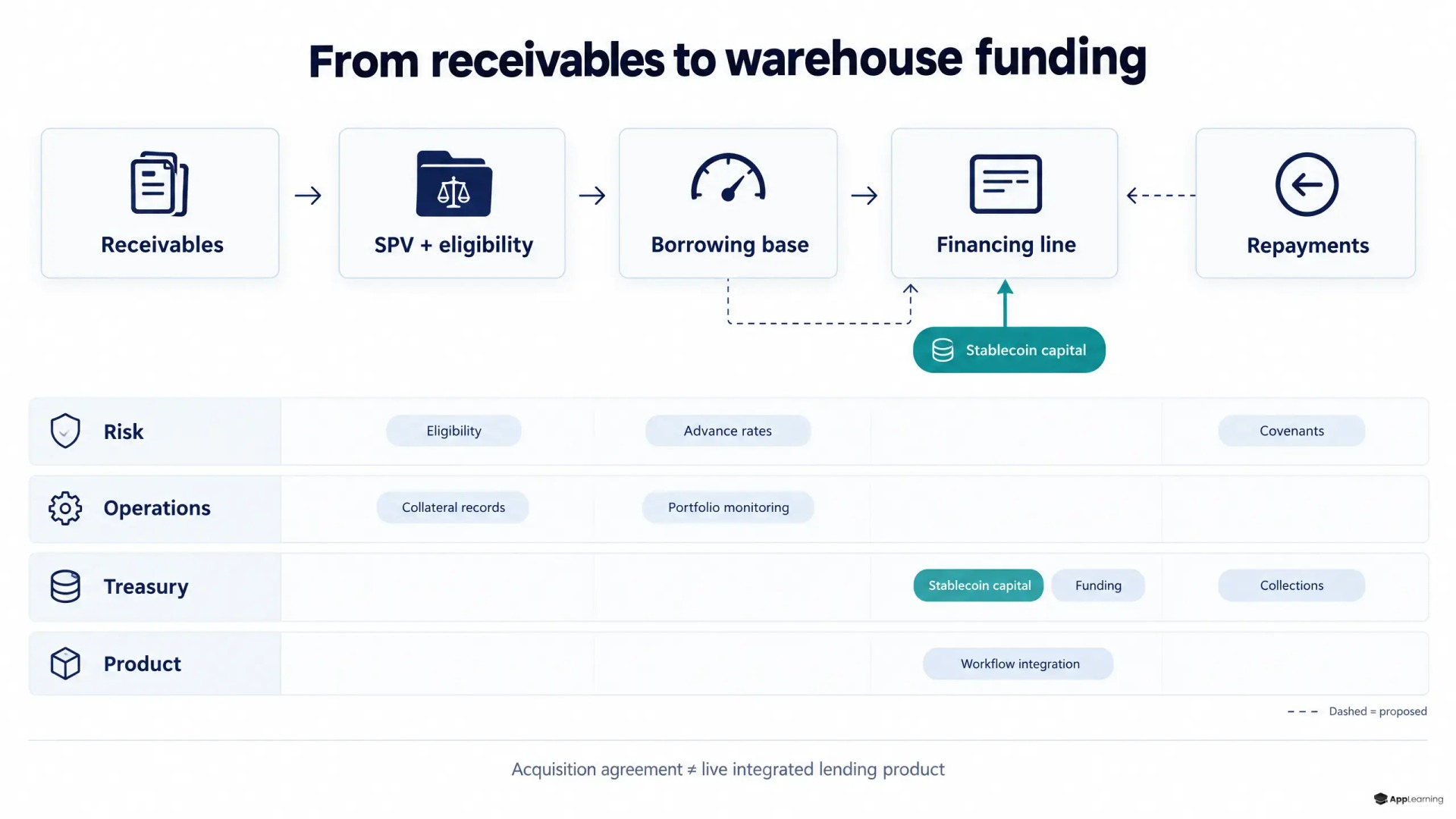
Four learning paths share one control model
A fintech academy could use five-minute modules with a shared facility example and four proposed ownership paths, adapted to the bank’s actual authorities.
- Origination and product teams assemble loan data, understand eligibility and route underwriting decisions to authorised credit owners.
- Treasury plans drawdowns, settlement, conversion and repayment timing, including a funding gap when expected liquidity is unavailable.
- Risk and underwriting teams assess eligibility, advance rates, haircuts and covenants, with explicit limits on exception authority.
- Operations reconciles loan records, collections and borrowing-base reports, investigates discrepancies and records escalations.
A borrowing-base breach exposes weak handoffs
The simulation then removes €1 million of loans from eligibility. At the unchanged 80% advance rate, the borrowing base falls to €7.2 million. Against €7.5 million outstanding, the illustrative shortfall is €300,000.
Learners must identify the trigger, verify the data, apply the facility’s draw restrictions and route a cure proposal. Treasury tests repayment capacity; operations reconciles the revised pool; risk assesses permitted responses. A second branch delays stablecoin conversion. The assessment separates collateral insufficiency from cash unavailability and rewards correct escalation, not improvised approval.
Build a role-based academy around your bank’s credit workflow.
DiscussReadiness needs evidence beyond completion
For App-Learning, the design extends the short, interactive approach behind its Bitcoin academy blueprint into a proposed white-label institutional academy. The learning unit becomes a controlled decision rather than a definition.
A rollout should start with one facility workflow, expert-approved answers and baseline scenarios. Institutional digital asset training can then track time to independently correct decisions, reporting errors, missed escalations and unnecessary escalations. Content needs named owners and review triggers when terms or functionality change.
The capability test is not whether employees can explain a stablecoin. It is whether the right people can detect a shrinking borrowing base, distinguish it from a funding delay and act within their authority. That is the standard an academy should meet before a new financing model reaches production.