

Key takeaways
- Answer accuracy and learning effectiveness are different outcomes.
- Guided prompts, staged hints, retrieval practice and expert escalation form a testable instructional design.
- Equivalent assessments and delayed unaided tests separate immediate performance from retained capability.
- Self-reported engagement is not evidence of independent mastery.
- A short university trial cannot establish workforce retention or enterprise ROI.
Tokyo measured a short-term score gain
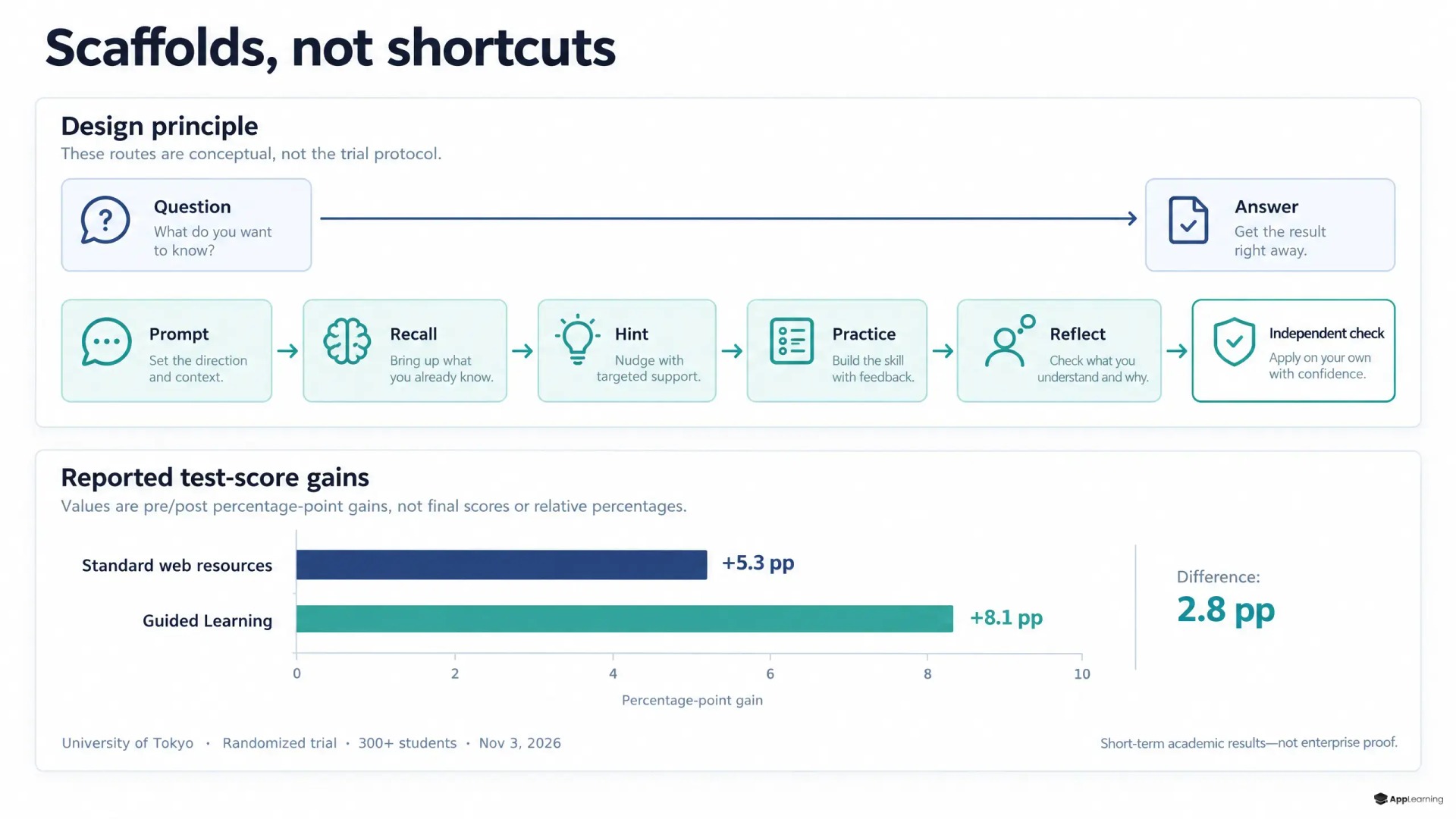
In Google’s November 3, 2026 announcement, (blog.google) the company reports a randomized trial involving more than 300 University of Tokyo students. Everyone had half a day to study statistics using standard online resources; half also received Guided Learning access. Pre/post scores improved by 8.1 percentage points with Guided Learning versus 5.3 without it. The additional gain was 2.8 points—not 8.1. These are Google-reported findings, and the announcement does not provide confidence intervals or delayed retention results.
Guidance is a hypothesis worth testing
This AI tutoring randomized trial compared access to a complete experience, not individual tutoring features. It cannot isolate the effects of hints, quizzes or study behaviour. In a separate randomized mathematics study, (doi.org) answer-oriented AI improved assisted practice but harmed subsequent unaided performance. Teacher-designed hints mitigated that harm without establishing a positive unaided learning gain. The design lesson is caution, not a universal promise that guided tutors work.
A five-minute module needs an instructional sequence
In the IES practice guide, (ies.ed.gov) retrieval quizzes and explanatory questions are recommended learning strategies. For App-Learning, those principles suggest treating guided AI learning as a layer within a module, rather than a separate chat destination. A proposed five-minute customer-onboarding unit could follow this sequence.
- Present an approved rule and a synthetic case, then require an initial decision.
- Offer guided prompts and staged hints after an attempt, without revealing the decision.
- Use practice questions and remedial branching to address the specific misconception.
- Provide expert escalation for ambiguity, then test a fresh case without the tutor.
The learning scaffolding should return responsibility to the employee. Approved, versioned source material, access controls and reviewable tutor logs belong in the pilot design. Synthetic cases keep live customer data outside the exercise.
The enterprise pilot must remove the tutor
A controlled pilot could randomize employees within role and baseline skill bands. Both groups would receive identical approved content, study time and equivalent pre/post assessments; only one would receive tutoring. The primary AI tutor learning outcomes should include a delayed unaided assessment, proposed here at two to four weeks, using unfamiliar but equivalent cases. Sample size, meaningful improvement and stopping rules should be agreed before launch.
Microlearning assessment should distinguish assisted practice, immediate unaided performance and delayed mastery. Engagement and perceived usefulness belong on a separate dashboard. Analysis should account for baseline scores, dropout, actual study time and cross-group tool use, with uncertainty reported alongside the effect.
Workplace claims need workplace evidence
According to Google’s description of its separate UK pilot, (blog.google) four weeks of school use produced survey and interview feedback. That is not the same outcome as measured learning. Neither that feedback nor a short Japanese university lesson establishes better compliance decisions, durable workforce retention or enterprise ROI.
Plan a controlled AI tutoring pilot with App-Learning.
DiscussExpansion depends on evidence and operational control
- A defined skill and an approved content owner.
- A control group and a delayed unaided success threshold.
- Reviewable tutor behaviour and a clear escalation route.
- Measured operating costs and a credible link to workplace performance.
The extra 2.8 points justify a disciplined experiment, not a blanket rollout. The procurement standard should be capability after assistance ends. If employees cannot handle a new case alone, the system has demonstrated useful support—not independent mastery.