

Key takeaways
- Define the capability claim before setting an AI policy.
- Map permitted AI delegation for each assessed task.
- Assess verification, judgment, and correction alongside final output.
- Use practical scenarios and artifacts as competency evidence.
- Make AI-assistance rules part of the credential audit trail.
The output no longer proves the capability
Traditional assessment rests on a simple assumption: if a learner submits strong work, the work evidences their skill. AI breaks that link. A polished risk summary, customer response, controls analysis, or code review may now reflect a mix of human judgment and machine-generated work. That does not make the output worthless. It makes the old inference unsafe.
For AI credentialing, the central design question is not whether AI was used. It is what the credential claims to certify. If a certification says someone can investigate an incident, interpret a policy, or make a defensible escalation decision, the assessment must reveal that capability even when AI helps produce part of the work.
What learners may delegate, what they must still demonstrate, and how institutions will protect fair evidence rather than merely monitor AI use.
Delegation is the unit of credential design
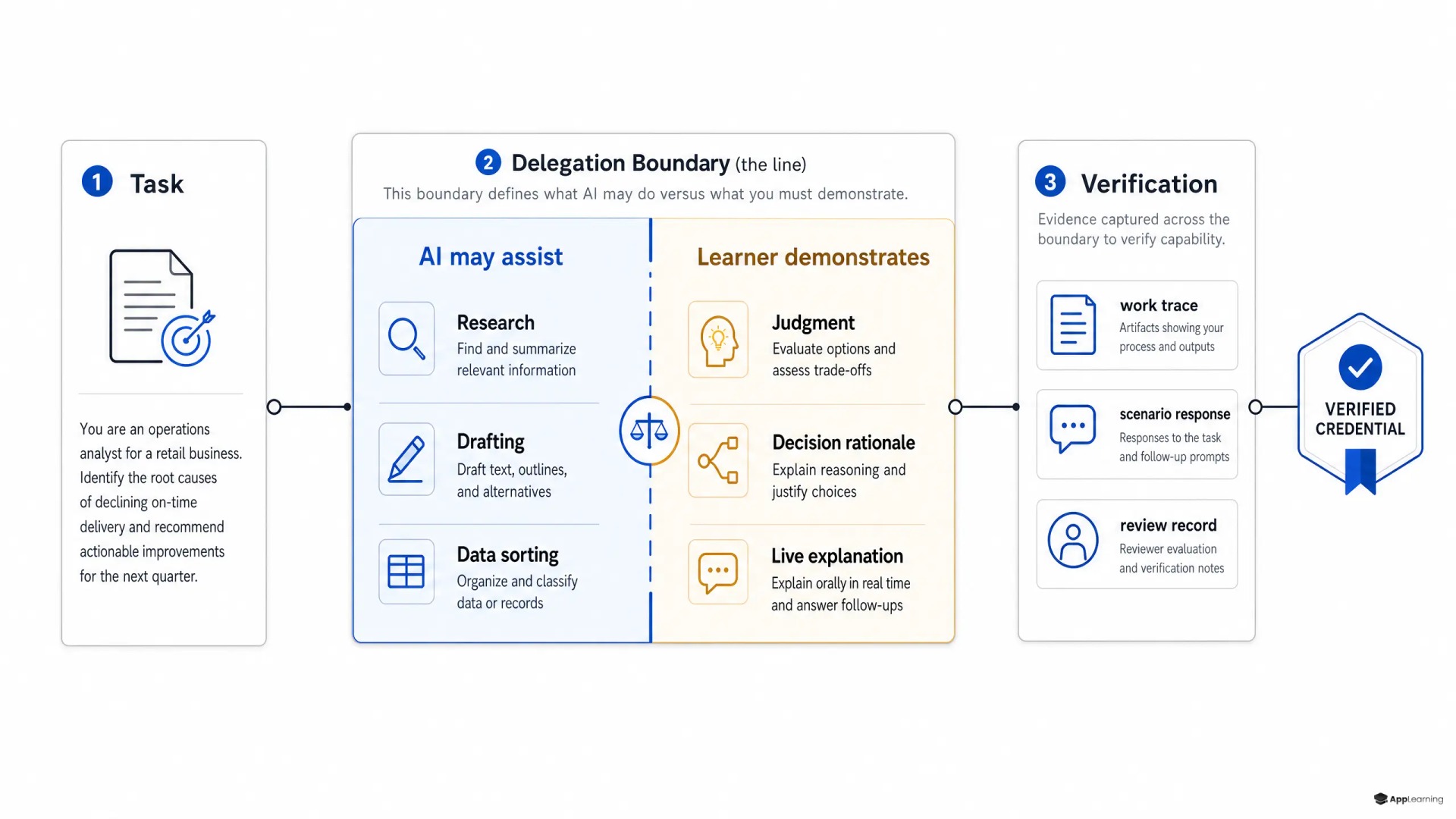
Simple “AI allowed” and “AI banned” rules are too coarse. They treat every task as if it carries the same risk and requires the same human contribution. A delegation boundary is more precise. It names the task, the permitted assistance, the non-delegable judgment, and the evidence required to verify both.
For a financial-crime investigator, AI might be allowed to summarize case notes or suggest lines of inquiry. The learner must still determine whether evidence meets the escalation threshold, identify unsupported claims, and document the final rationale. The credential therefore certifies human AI collaboration with accountable judgment, not unaided drafting speed.
Evidence must expose the human work
A credible AI assessment should collect an evidence packet, not only a final answer. NIST’s AI RMF guidance similarly calls for defined human-AI roles and oversight, personnel training, and documentation that improves transparency and accountability.
- The declared assistance mode, approved tool, and relevant model or version.
- A task artifact that shows the initial AI output, where appropriate and safe to retain.
- The learner’s verification steps, source checks, corrections, and rejected recommendations.
- A decision rationale that explains the chosen action and any required escalation.
- Assessor scoring against observable criteria for accuracy, judgment, and policy alignment.
This does not mean retaining sensitive prompts without limits. In regulated environments, the audit trail must follow data-handling rules. Often, a structured declaration, redacted artifact, verification record, and assessor decision provide stronger evidence than a raw transcript.
Scenario work reveals judgment under assistance
The strongest skills certification patterns mirror the work rather than simulate an exam room. Give learners a realistic scenario, define the approved AI-assistance mode, and assess the checkpoints where professional judgment matters. That could mean correcting a flawed AI-generated transaction-risk summary, checking a proposed policy interpretation against source material, or rejecting an answer that exposes confidential information.
- Use a no-AI baseline when independent recall or procedural fluency is essential.
- Use an AI-assisted production task when the real role requires responsible tool use.
- Insert a flawed AI output to test verification and correction.
- Require a short decision defence for high-consequence judgments.
- Score the process and rationale separately from the final deliverable.
This direction is already entering enterprise certification. In March 2026, SAP described a shift toward practical, AI-enabled assessments focused on real-world problem solving rather than memorisation. The market signal matters, but regulated employers should go further by making the evidence standard explicit.
Good to know
Does AI-enabled assessment mean learners can use any AI tool?
No. Each task should name the approved assistance mode, tools, data limits, and non-delegable decisions. Unapproved tools or undisclosed assistance should be handled as assessment exceptions.
Which capabilities should remain independent?
Keep independent evidence for capabilities where the role depends on recall, professional judgment, escalation decisions, source verification, or accountable sign-off. The exact boundary should reflect the task and its consequences.
What belongs in an AI credential audit trail?
Capture the competency claim, task rules, declared AI assistance, required artifacts, assessor rubric, score, exceptions, and completion decision. Retain only the information needed under applicable data and records policies.
Certification needs an operating model
For L&D teams in banking, fintech, and crypto, AI-aware certification is a design and governance task. Start with the role’s competency framework. Break each competency into tasks, then classify what may be delegated, what must remain human, and which evidence proves the difference. Configure those rules once as reusable assessment patterns rather than rewriting policy for every course.
App-Learning can translate this structure into scenario tasks, assistance modes, rubrics, artifact requirements, and auditable completion records. That gives compliance teams a clearer view of what a credential means while giving learners a more realistic way to demonstrate capability. The model also avoids a false choice between engaging learning experiences and defensible controls.
Role-specific credentials are moving toward applied work as well. SHRM’s AI+HI specialty credential combines hands-on labs with a capstone implementation roadmap, signalling that AI capability needs practical evidence, not awareness content alone.
Design credentials that prove judgment in AI-assisted work.
Talk to usA credential design check before launch
- State the capability claim in observable terms.
- Define the assistance mode for every high-stakes task.
- Mark the judgment, verification, and escalation steps that learners cannot delegate.
- Specify the artifacts and assessor observations required as competency evidence.
- Record the rule set, tool context, assessment result, and any exceptions.
- Review the boundary when role workflows, approved tools, or regulation change.
AI will keep changing the production of work. A meaningful credential must therefore prove more than that a learner can obtain a credible-looking result. It must show where the learner exercised judgment, how they controlled AI assistance, and why an employer can trust the capability claim.