

Key takeaways
- Enterprise learning integrations should move verified outcome data, not just identities.
- Completion, eligible credits, and certificates belong in the compliance system of record.
- Interoperable course metadata makes content-provider partnerships materially more useful.
- Reducing reconciliation work frees L&D and compliance teams to manage risk and capability.
- Credential APIs can make a white-label academy more embedded in daily operations.
SSO opens the door but leaves the record behind
Single sign-on solves a narrow problem. It lets a learner enter a platform without another password. It does not tell the compliance team whether the learner completed the assigned module, whether that module qualified for a credit requirement, or whether a certificate is available for review.
That gap is costly in finance, banking, and crypto. L&D may see a completion in the academy while compliance maintains a separate register, spreadsheet, HR record, or credential tool. Someone must reconcile identities, course names, dates, credit values, and exceptions. The work is slow, hard to audit, and prone to silent mismatches.
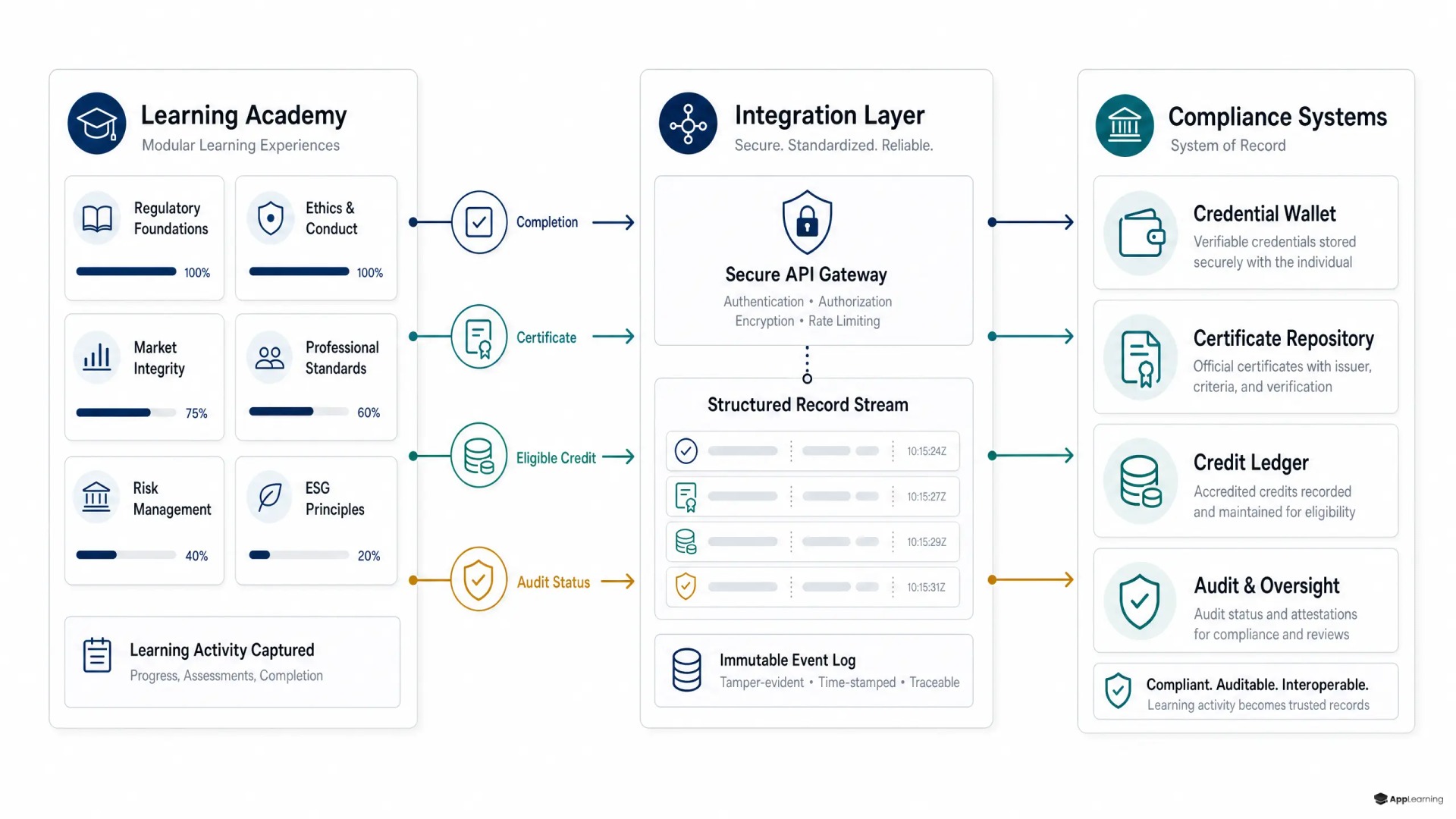
A useful compliance training integration therefore moves verified outcomes. The academy should send a defined completion record into the system that governs the obligation. SSO remains valuable, but it is the access layer. Training records integration is the control layer.
The legal market is joining content and compliance
The Hotshot-Litera memorandum of understanding is a clear market signal. In its August 20, 2026 announcement, Litera said lawyers will be able to discover Hotshot courses, while firms can assign them and track completion and eligible continuing-education credits within CE Manager. The point is not that legal training maps perfectly to financial services. It is that content distribution and professional-record management are converging into one workflow.
That workflow matters because compliance is not only a learning experience. It is an evidence problem. Litera describes CE Manager as a CLE tracking system that manages compliance reporting, certificates, and rules across licenses. When the content experience can reliably update that record, the learner has less administrative work and the firm has a cleaner control surface.
The outcome record needs a stable data model
A robust LMS compliance setup does not begin with an API endpoint. It begins with a shared meaning for each field. Both systems must agree on what a learner, course, completion, credit, and certificate represent.
- Learner: immutable internal identifier, employment status, and the external identity used by the compliance system.
- Course: provider course ID, title, owner, subject area, delivery format, and content version.
- Completion: assignment ID, completion state, completion timestamp, score or attestation where relevant, and evidence reference.
- Credit: credit type, value, eligibility status, awarding rule, jurisdiction or policy scope, and reporting period.
- Certificate: issuer, certificate ID, issue date, expiry date where applicable, verification reference, and revocation status.
- Governance metadata: source system, event ID, schema version, correction history, and the user or service that made a change.
Course version deserves special care. A learner may have completed an approved anti-money-laundering module in March, while the academy now serves a revised version in September. The compliance record must preserve the completed version and its approval context. Replacing history with the latest course metadata weakens auditability.
Choose the transport to fit the control
For a small number of high-value events, a REST API with signed requests and idempotency keys is often the cleanest route. The academy posts a verified completion, the compliance system validates it, and both sides retain a transaction ID. Webhooks work well when the receiving system needs an immediate event after completion, credit approval, certificate issue, expiry, or revocation.
Batch exports remain practical where legacy HR or compliance platforms cannot accept real-time events. They need strict schemas, delta logic, error reports, and a documented replay process. A nightly CSV without reconciliation is not interoperability; it merely moves the manual work downstream.
An LRS and xAPI can add value when teams need a detailed activity trail across learning experiences. The ADL guidance on xAPI describes the standard as a way to capture, communicate, and share learner-performance activity through a Learning Record Store. That trail can support analysis, but it should not automatically become the authoritative compliance ledger. A regulated record needs explicit rules for which events create, amend, or void a formal status.
For portable credentials, the 1EdTech Comprehensive Learner Record standard provides a model for verifiable records of achievements and related metadata. It can inform a future-facing credential interoperability strategy. It does not remove the need to model jurisdiction-specific credit rules and internal approval controls.
Good to know
What should a compliance learning integration send first?
Start with verified completions, course version, completion date, credit eligibility, certificate reference, and a unique event ID. Add richer learning analytics after the compliance record is reliable.
Is SSO enough for regulated training?
No. SSO handles access. It does not create a governed record of completion, credit status, evidence, corrections, or certificate validity.
Should xAPI be the system of record for compliance?
Usually not by itself. Use xAPI and an LRS for rich learning activity data, then apply explicit business rules before writing formal compliance status into the designated system of record.
How can teams begin without replacing their LMS?
Map the required outcome fields, identify the receiving system of record, define exception handling, and launch one high-risk training workflow through an API, webhook, or controlled batch export.
Auditability is designed before launch
A completion sync is trustworthy only if it can answer simple operational questions months later. Which version did the learner complete? Which policy mapped it to a requirement? Was the credit merely eligible, formally awarded, corrected, or revoked? Which system made that decision? Can the receiving team reproduce the record from source evidence?
Build for exceptions from day one. Include duplicate-event handling, failed-delivery queues, manual-review states, access controls, retention rules, and an immutable audit trail. Keep the learner experience simple, but never hide an unresolved sync failure from the teams that carry regulatory accountability.
Design a learning record flow your compliance team can trust.
DiscussAcademies become part of the compliance operating model
For academy providers and content partners, credential interoperability changes the commercial proposition. A course catalogue alone competes on content breadth and interface quality. An academy that reliably writes verified outcomes into the customer’s HR, compliance, or credential system becomes part of the operating model. That reduces reconciliation effort, improves reporting confidence, and creates a more durable integration than a branded learning portal on its own.
This is the practical opportunity for a white-label academy. App-Learning can remain the engaging learner-facing experience for onboarding, compliance, and capability building while a controlled integration returns the records the enterprise needs. The winning architecture is not the one with the most data. It is the one that sends the right verified data, preserves its context, and makes every exception visible before it becomes a compliance problem.