

Key takeaways
- Education works best at the product moment where a user must make a decision.
- A financial education API separates learning delivery from core product engineering.
- Learning events can reveal knowledge gaps behind weak activation or repeated support demand.
- White-label delivery preserves brand consistency without creating a parallel education product.
The resource-center trap
Most fintech customer education still lives in help centres, blogs, or standalone academies. Those formats are useful for search and support, but they sit outside the moment of use. A customer opening an investment account, choosing a Bitcoin custody option, or meeting a credit limit does not need a broad library. They need the one concept that helps them complete the next step with sound judgment.
That timing matters. The Consumer Financial Protection Bureau’s guidance recommends information that is timely, relevant, and actionable because people retain it better when it connects to an upcoming decision. For product teams, that makes embedded financial education a journey-design problem, not a content-marketing project.
An API turns learning into a product service
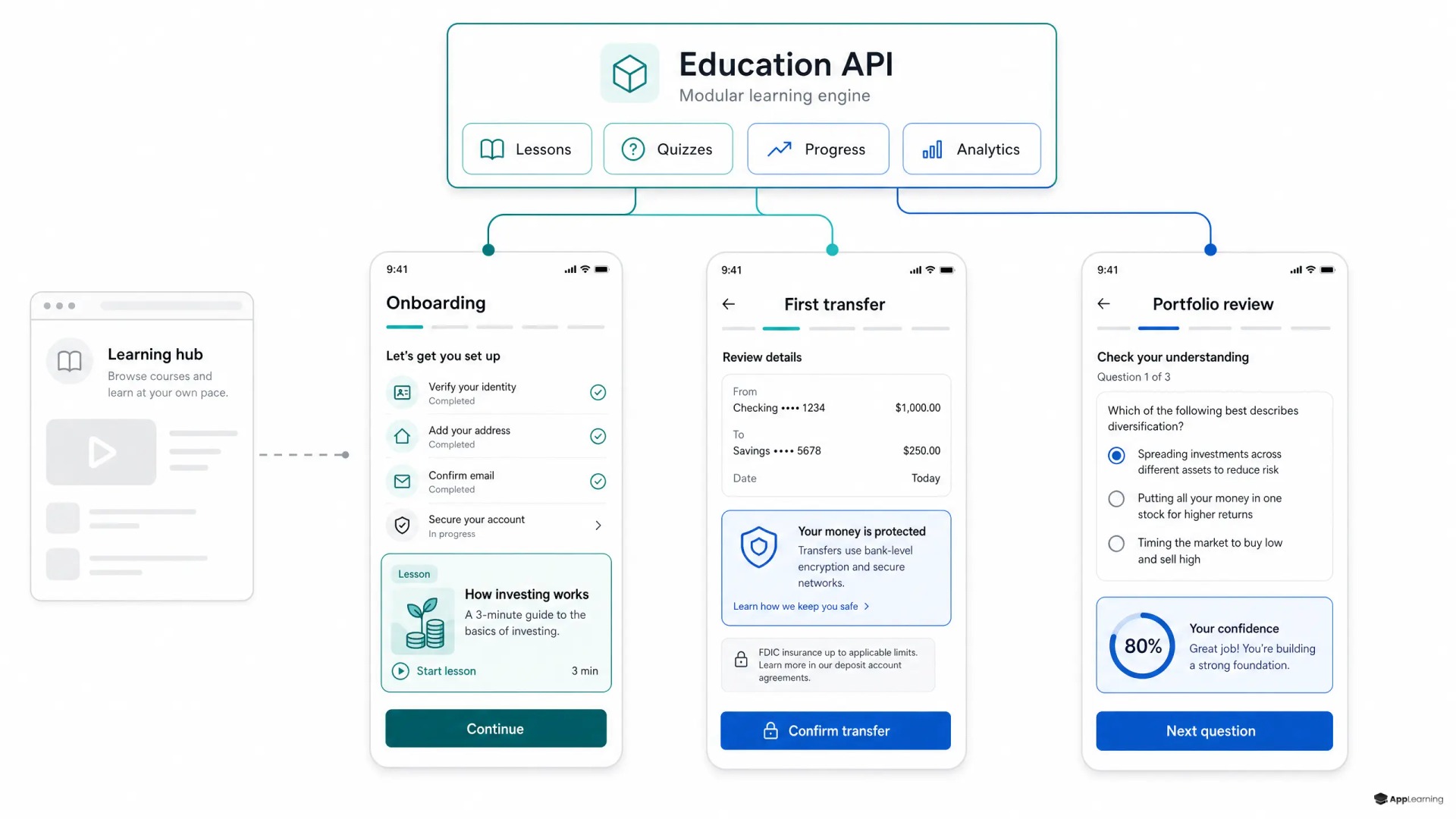
A financial education API changes the operating model. Instead of linking users out to a course, the product calls learning modules into a screen, passes the relevant context, records completion, and receives events back. The education layer becomes a service behind the experience, much like identity verification, payments, or messaging.
- Serve the right lesson or quiz for a product state, market, and user segment.
- Return progress, completion, and knowledge-check events to the product analytics stack.
- Support modular release cycles instead of waiting for app releases to update every lesson.
- Keep learning design, editorial governance, and localisation outside the core engineering backlog.
- Use components, SDKs, or web views according to the required level of UI control.
This is why the fintech education platform category is moving closer to product infrastructure. The technical interface matters, but so do the content model, event schema, permissions, languages, accessibility, and editorial release process. An API without those operating layers is only a content feed.
Learning belongs at points of commitment
The best placements are narrow and deliberate. They appear before a customer commits to an unfamiliar action, after a failed attempt, or when product behaviour signals uncertainty. They should reduce cognitive load, not interrupt a task with a generic course.
- Onboarding flows that explain the first value-producing action.
- Pre-trade or pre-transfer modules for unfamiliar assets, fees, or risk concepts.
- Feature-launch walkthroughs for advanced tools such as recurring investments or card controls.
- Support deflection flows that teach the concept behind a repeated question.
- Re-engagement journeys that rebuild confidence after inactivity or an incomplete setup.
Learning signals need product discipline
Completion is not the outcome. A robust embedded learning system connects exposure and knowledge checks with downstream product behaviour: verified setup, first deposit, feature adoption, reduced repeat contacts, or retention cohorts. That does not prove that education caused the outcome. It creates hypotheses that product teams can test with cohorts, holdouts, and clear success metrics.
Personalisation should remain bounded. Use declared goals, product state, locale, and observed learning gaps to choose the next module. Do not turn education data into an opaque risk score or a substitute for regulated suitability, disclosure, or advice processes. The learning layer should explain decisions and product mechanics; it should not make decisions on the customer’s behalf.
Good to know
What is a financial education API?
It is an integration layer that lets a product request learning content, display it inside web or mobile journeys, and capture progress or assessment events in return.
Where should embedded financial education appear first?
Start with the highest-friction decision that blocks activation or creates avoidable support demand. Use product analytics and customer research to identify that moment.
Can white-label financial education support multiple markets?
Yes, if the operating model includes localisation, regional content review, configurable journeys, and analytics that separate results by market and language.
Buy the operating layer not a content pile
Building internally may suit a fintech with a mature learning-design function, multilingual editorial capacity, a governed content repository, and engineering time for analytics and integrations. Many teams underestimate the ongoing cost. Product changes alter lessons. New markets require localisation. Compliance reviews add dependencies. Static articles soon become stale, while a separate academy becomes another product to maintain.
Buying is sensible when the partner can fit the product architecture without forcing a separate destination. The decision should examine integration effort, data ownership, brand controls, mobile performance, accessibility, content governance, localisation, and exit options. A white label financial education solution is valuable only when it feels native to the fintech, not like a branded detour.
Make product knowledge part of the product journey.
ExploreA branded academy without a parallel product
Specialist partnerships already provide a market signal. Capital One’s partnership with Khan Academy delivers a free financial literacy course through an education specialist rather than treating all learning delivery as an internal content function. The next step for product-led fintechs is to bring that specialist capability closer to the point of action.
App-Learning fits this model as an embedded academy layer: branded learning journeys, gamified modules, knowledge checks, and measurable progress delivered inside an existing web or mobile product. The fintech keeps ownership of its core experience and roadmap while fintech customer education becomes a maintained capability rather than an underfunded side project.
The strategic shift is simple. Do not ask customers to leave the product to understand the product. Put the smallest useful lesson inside the decision journey, measure whether it changes confidence and behaviour, and improve it as rigorously as any other activation surface.