

Key takeaways
- Engagement is not a sufficient success metric in finance.
- Never reward transaction frequency as a proxy for learning.
- Reward mastery, correct risk identification and safe choices.
- Personalise challenge without increasing financial stakes.
- Track risky-choice rates and decision quality alongside completion.
The double edge of fintech gamification
Gamification reduces friction. Progress bars make complexity feel finite. Feedback makes an unfamiliar product feel learnable. Rewards give users a reason to return. Those are useful properties when a financial literacy app needs to move people beyond static help content.
The problem is that financial products do not carry the same consequences as a language lesson or a fitness streak. A June 2026 review of gamification in finance finds that points, badges and leaderboards can improve engagement and financial literacy, while also identifying excessive trading and reduced sensitivity to financial risk as possible negative effects. A mechanic can improve participation while making the underlying decision worse.
That makes engagement an incomplete success measure. In fintech, a high daily active-user count may reflect useful learning, but it may also reflect a loop that normalises checking prices, chasing rewards or taking action without understanding the downside.
Learning loops must not become trading loops
The central design distinction is simple. Trading gamification rewards product activity. Financial education gamification rewards demonstrated judgement. The two may sit in the same app, but they must not share the same incentive logic.
FINRA notes that game-like features such as streaks, points, badges, leaderboards and notifications can influence actions including investment selection and trading. That does not make every mechanic harmful. It does mean the reward target matters more than the mechanic itself.
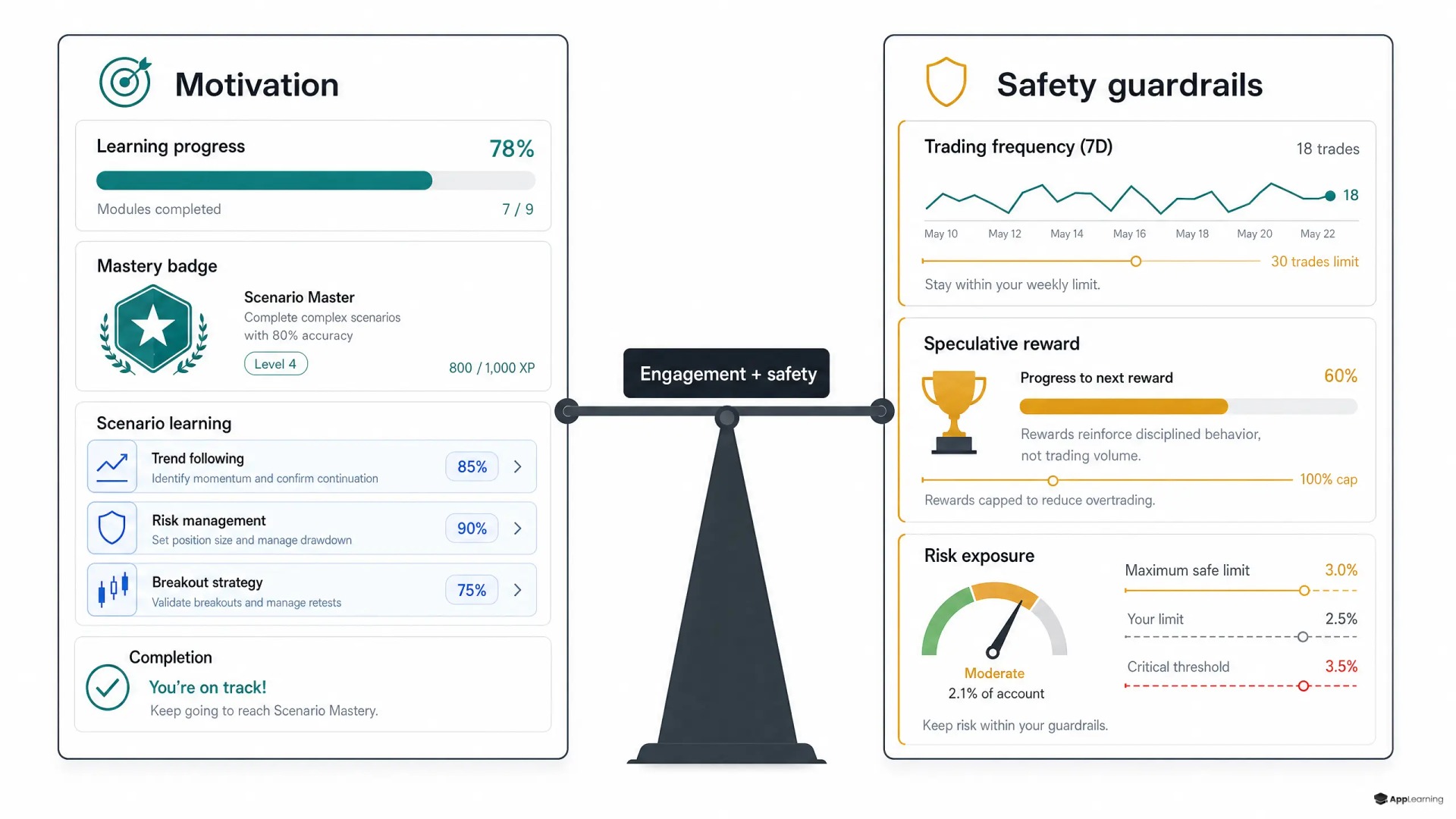
- Do not award points for transaction count, trade frequency, order size, leverage use or exposure to volatile products.
- Do award progress for identifying risk, comparing alternatives, spotting a misconception and choosing to pause when information is incomplete.
- Keep scenario practice separate from live transaction flows, rewards and market prompts.
- Do not treat a completed learning module as permission to access a complex or high-risk product.
A risk budget for product design
A risk budget is a product-level agreement on the behavioural risk a learning experience may not create in pursuit of growth. It is not a financial risk model and it does not replace suitability, appropriateness or compliance controls. It is a practical constraint for product decisions.
Set the budget before a team designs rewards or launches an experiment. Define prohibited incentives, the user groups that require extra caution, the decisions that need a friction step, and the metrics that trigger review or rollback. This turns responsible gamification from a principle in a design brief into an operating rule.
For example, a fintech may accept a modest increase in learning-session completion, but set a zero-tolerance threshold for an increase in risky simulated choices after the lesson. It may personalise practice difficulty, but prohibit personalisation that raises real financial stakes or uses urgency to prompt action.
Mechanics that reward judgement
Safer mechanics do not need to be dull. They shift the game from action to understanding. Scenario practice can ask a user to choose between options, explain the trade-off and see the consequence in a controlled setting. Mastery gates can require a learner to recognise a key risk before progressing through education. They should unlock deeper learning, not bypass a regulated decision process.
- Use branching scenarios to rehearse choices under realistic uncertainty.
- Reward correct risk identification, not fast answers or repeated attempts.
- Show progress by concept mastery and confidence calibration, not by product activity.
- Use calibrated rewards that recognise safe decisions, including choosing not to act.
- Use adaptive feedback to revisit weak concepts with simpler examples or additional practice.
This is where an App-Learning approach has a clear role. An embedded learning layer can separate “learn more” from “transact more” through mobile-first scenarios, adaptive feedback and mastery data. Product teams gain a scalable way to explain complex features without turning every educational interaction into a conversion prompt.
Good to know
Does a mastery gate replace suitability or appropriateness checks?
No. A mastery gate is a learning design tool. It can show that a user understood a concept in that moment, but regulated eligibility and assessment processes need their own controls and governance.
Which behaviours should a fintech reward?
Reward demonstrated understanding, correct identification of risk, comparison of alternatives, completion of scenario practice and safe decisions under uncertainty. Avoid rewards tied to transaction frequency or financial exposure.
Can transaction data inform the learning experience?
Yes, when it helps identify knowledge gaps or moments of confusion. It should not become the incentive target, and it should be handled within the product's privacy, consent and compliance controls.
Measures that make harm visible
Completion, activation and retention still matter. They just need counterweights. Every financial education gamification dashboard should pair motivation metrics with guardrail metrics that reveal whether learners are becoming safer and more capable.
- Mastery rate by concept and risk level.
- Risky-choice rate in scenarios before and after learning.
- Misconception recurrence after feedback.
- Post-learning decision quality in delayed scenario checks.
- Drop-off patterns after warnings, friction steps and risk explanations.
- Changes in live product activity monitored as a safety signal, not as a learning reward.
Define a baseline, segment results by relevant user context, and set review thresholds before release. If a mechanic lifts completion but also raises misconception recurrence or risky-choice rates, it has failed its job. If transaction activity rises without a comparable improvement in demonstrated understanding, investigate the incentive loop.
Build learning loops that increase confidence without rewarding risky activity.
DiscussGovernance before growth experiments
Product, learning, data and compliance teams should review the same mechanic before launch. Name the target behaviour, map the reward, document the foreseeable misuse path and agree on the rollback condition. Keep a versioned record of reward logic, content, targeting and experiment results so that a later review can explain what changed and why.
The key decision is not whether fintech gamification works. It is which behaviour it makes rewarding. When learning systems reward understanding, risk recognition and deliberate choices, they can build confidence without making financial risk feel like a game. That is the standard responsible gamification should meet.