

Key takeaways
- A paid academy add-on separates practical learning from free agenda content.
- Narrow role and technology tracks create stronger reasons to participate deeply.
- Pre-event primers and post-event refreshers extend learning beyond the venue.
- Assessments and CPD evidence turn attendance into measurable progress.
- Sponsor involvement works when curriculum governance and product boundaries stay explicit.
A pass buys access while an academy builds capability
Most conference agendas are built for breadth. They create discovery, conversation and a reason to meet. A conference learning product has a different job. It asks a defined group to practise a job-relevant skill, complete work and leave with proof of progress. For a founder sending a growing team to an industry event, that distinction matters. The expense is easier to defend when the outcome is more than a room full of notes and contacts.
The commercial difference is just as important. Agenda content supports the event ticket. An academy can be a separately priced offer with a clear learner, curriculum, capacity model and completion standard. It gives an organizer a product that can improve with each cohort rather than a session that disappears when the stage is dismantled.
SBC prices practical depth separately
SBC Summit’s Tech Academy programme illustrates the model. On 29 and 30 September 2026, it will run four tracks across AI, player experience, digital marketing and CRM, and Web3 and crypto. The stated format combines expert-led sessions, live demonstrations, case studies, AMAs and workshops, while attendance contributes to its CPD-accredited programme.
The Academy format allows us to get more specific, dig into the details.
The useful design choice is not the label “academy.” It is the constraint. Each track is narrow enough to recruit people with a shared problem and practical enough to justify active participation. That is stronger than placing an advanced workshop beside a keynote and hoping the audience self-selects. A paid academy add-on also creates a clean test of willingness to pay before an organizer invests in a larger education business.
The venue becomes the middle of the learning journey
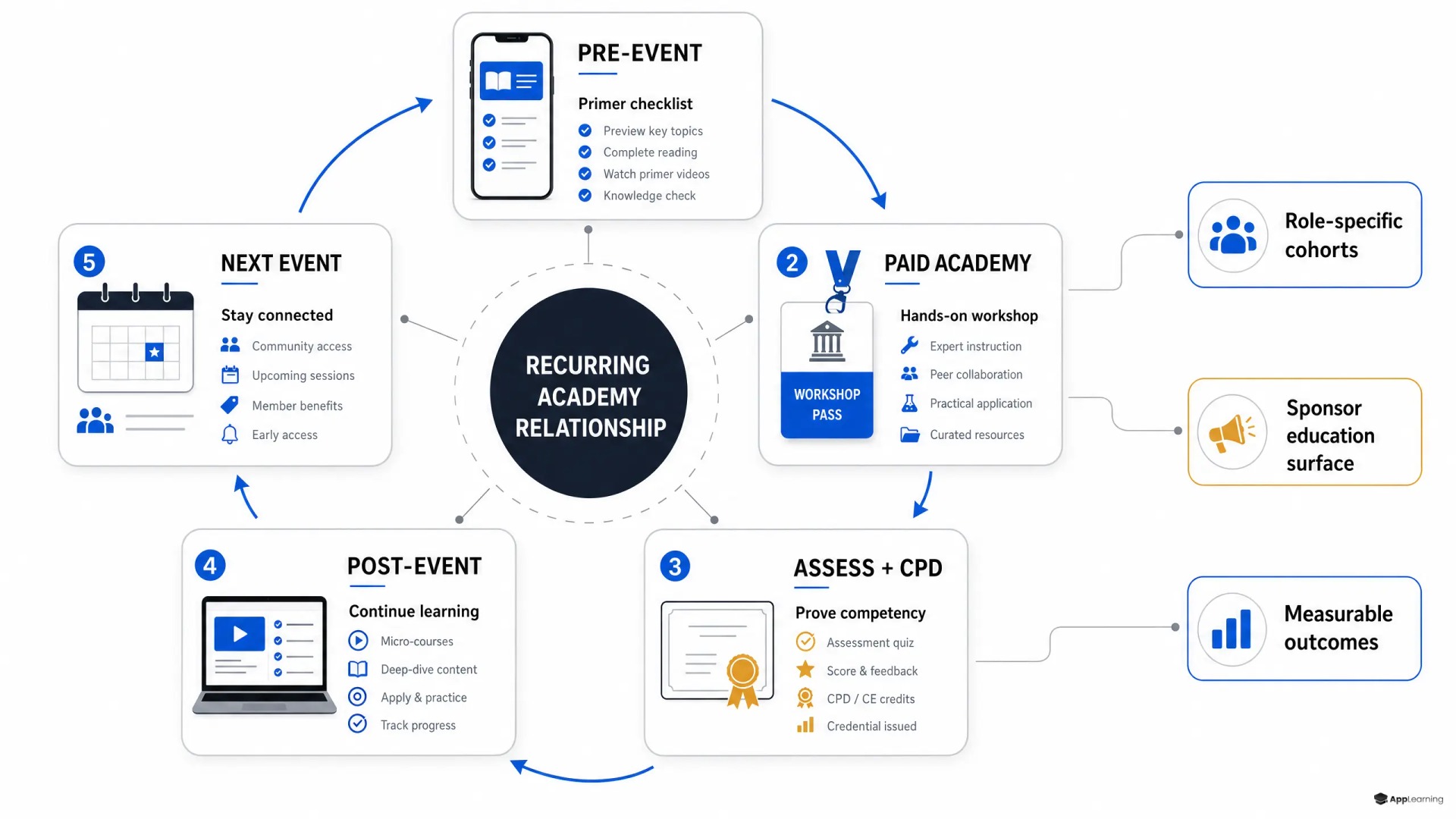
The live event should be the highest-intensity point of the academy, not the whole product. A small digital layer changes the operating model without asking the organizer to become a traditional training provider overnight. It can run on a simple sequence:
- Pre-event primers establish common language and reveal what the cohort already knows.
- Mobile workshop companions hold templates, prompts, polls and practical tasks during the event.
- Post-event refreshers return learners to the decisions, tools and examples that matter in their roles.
- Short conference microlearning modules help attendees retain one concept at a time after travel and inbox pressure return.
This structure protects valuable live time. Speakers do not need to spend the first 20 minutes on definitions. Attendees arrive prepared, work from the same material and can continue after the event without relying on an unsearchable slide deck. The academy also gives the organizer a direct learning relationship with people who may not return until next year.
Cohorts need progression and evidence
A room of attendees is not yet a cohort. A cohort has a starting point, a path and a visible finish. Start with a role-based diagnostic or self-assessment. Then assign a short practical task: draft a CRM experiment, map an AI-assisted workflow or critique a player-journey decision. End with a knowledge check and a completion record. Certificates or CPD evidence should reflect defined requirements, not mere presence.
For lean teams, the benefit is operational. A manager can see who completed the track and what work they produced. For organizers, aggregated results show which topics caused friction, which tasks were completed and where next year’s curriculum needs more depth. This is the same discipline growing companies need in onboarding: turn dispersed expert knowledge into a repeatable path rather than leaving learning to individual managers.
Good to know
When does an academy justify a paid add-on?
When it solves a defined role problem through structured practice, limited cohort capacity and a clear completion outcome. Recorded panels and generic presentations rarely meet that threshold.
What should learners complete before the event?
Keep it short. A diagnostic, two or three foundational lessons and one reflection prompt are usually enough to create a shared baseline without creating drop-off.
Can sponsors participate without undermining trust?
Yes, if the organizer owns the curriculum and makes commercial roles visible. Sponsors should contribute expertise or tools, not control the learning objective or completion criteria.
What should a first academy cohort include?
Begin with one narrow track, a named learner role, a practical task, a simple assessment and a post-event refresher. Prove completion and demand before adding more tracks.
Sponsors need a governed role
Sponsors can make B2B event education more useful when their contribution is bounded. A sponsor may provide a practitioner, a real case or a sandbox environment. The organizer should still own learning outcomes, speaker criteria, assessment rules and disclosure. The line is simple: sponsors may support useful education, but they do not get to convert the curriculum into a product pitch.
Build an event academy that continues after the conference ends.
TalkEvent organizers can operate a durable academy
The white-label event academy platform opportunity is not a replacement for the conference. It is the persistent layer around it: enrollment, role-specific tracks, learning content, mobile tasks, quizzes, completion records and cohort reporting. The event supplies scarce assets such as trusted experts, a concentrated audience and a moment of attention. The platform makes those assets usable before and after the doors open.
The strongest version will not try to digitize every panel. It will identify the few problems where people need to perform better at work, build a disciplined learning path around them and measure completion. That turns a three-day content spike into an education relationship with a reason to recur.